Rod Reyes
Daisy Jones & the SixRod Reyes is the manager who helps The Six convert musical promise into public prominence. His work ranges from reshaping the band’s sound and keeping a tour moving through a fuel shortage to arranging media attention for Daisy Jones and a photographer for Aurora. As the band grows, his role also exposes the practical and financial machinery behind fame: a successful act can demand more, while the manager is expected to keep the operation moving and the stars supplied.
Encounter and Management
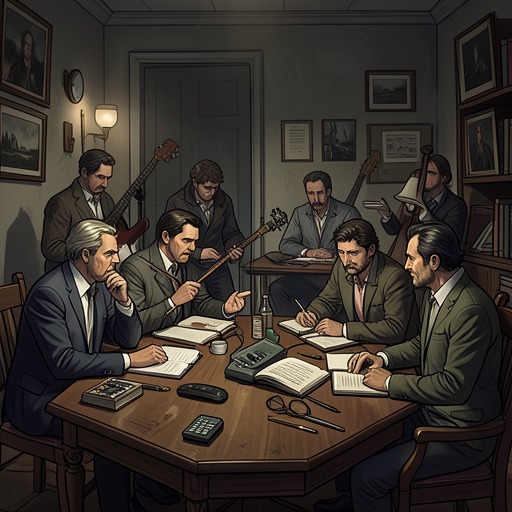
Around 1971, Rod Reyes encountered The Six outside a bar in the Bowery, where the band had just played. He was struck by Billy Dunne’s stage presence: Billy seemed confident, knew how to address a crowd, and brought emotion to his performance. Rod also thought the band had a strong sound. Billy later remembered Rod’s approach after a show at the Wreckage as a watershed moment, marking the arrival of a manager with ideas about what the group could become.
Those ideas could reach into the music itself. Rod told Graham Dunne to cut about half of his guitar solos. Graham understood the distinction Rod was making: the solos might interest listeners drawn to technical guitar playing, but could lose a broader audience. The advice reveals Rod’s attention to accessibility and audience response, as well as the influence a manager could exert beyond bookings and logistics. His management involved shaping how the band presented its music, even when that meant asking a musician to restrain a part of his own performance.
Keeping the Band on the Road
Rod’s responsibilities were not limited to the visible moments onstage. He described a touring operation involving the band, roadies, and crew, and noted that the musicians did not pay attention to how the tour remained supplied with gas. At the end of 1973, during the oil crisis and a gas shortage, Rod and the tour manager bribed gas-station attendants and changed license plates to keep the vehicles fueled. The band members, occupied with partying and other distractions, did not notice the arrangements that made continued travel possible.
The contrast between the tour’s public momentum and its behind-the-scenes demands defines this part of Rod’s work. The recurring pattern of reaching a town, sound-checking, performing, and getting back on the bus depended on mundane and sometimes illicit problem-solving. Rod’s account makes clear that the band’s apparent freedom on the road rested on labor and decisions that remained largely outside its members’ attention.
Advocacy for Daisy Jones
Rod also became a potential source of support for Daisy Jones. The band recognized that Daisy’s manager, Hank Allen, appeared to be taking advantage of her. Rod told Daisy that he was available if she needed help, and Graham encouraged her to leave Hank and work with Rod, describing Rod as someone who would look after her. The evidence presents an offer and an endorsement, not a confirmed change of management; what is established is that Rod had made himself available and that others saw his conduct toward The Six as evidence of dependable support.
His advocacy took a concrete form in media promotion. Rod arranged for Rolling Stone to send Jonah Berg to watch the group perform and spend time with them afterward, creating the possibility of a cover story. He made a point of including Daisy rather than seeking coverage focused only on the band. Jonah settled on the headline “The Six That Should Be Seven.” The resulting cover showed Billy and Daisy singing into the same microphone, Graham and Karen looking toward one another, and the rest of the band performing, with audience lighters visible in the foreground. Rod’s decision to include Daisy helped place her within the public image of the group before she formally joined it.
Promoting Aurora and Managing Success
For Aurora, Rod turned to visual marketing. He connected the band with his photographer friend Freddie Mendoza and played him early tracks to communicate the direction of the album. Mendoza responded with an image of desert mountains. The eventual photographic work drew on the band’s setting in the Santa Monica Mountains and included a moment in which Billy and Daisy, standing at opposite ends of the group, looked at one another. Mendoza also developed a close image of their torsos that became especially striking to him. Rod’s documented contribution was to set up the photographer and supply the musical context; the precise image-making choices belonged to Mendoza.
The cover’s later reception shows how consequential that promotional work became. Elaine Chang recalled that it mattered to teenage listeners, particularly girls, because Daisy appeared confident and in command of her own sexuality rather than posed to please Billy or the viewer. Freddie Mendoza, who had regarded the assignment as an ordinary gig at the time, later found that people continually asked him about the image. The photograph became a cultural emblem, extending the reach of the album beyond its songs and illustrating how a carefully developed public image could become part of a band’s commercial identity.
By the summer of 1978, “Turn It Off” had spent four weeks at the top of the charts, Aurora was selling more than 200,000 units a week, and the tour was selling out stadiums and adding holdover shows in major cities. Rod described the next task as getting the show on the road, and the touring arrangements reflected the scale of the act. The band used two buses, each bearing the group’s name but distinguished by imagery associated with Billy or Daisy; the separation also suited their reluctance to look at one another. On the tour, the accountant had to ensure that Billy and Daisy received equal provisions, from major items such as baby grand pianos to small supplies such as autographs’ Sharpies. Rod repeatedly authorized the requests, leaving Runner Records to pay, even as the accountant warned that the tour was spending heavily.
Function in the Band’s Story
Rod’s trajectory is defined less by a personal transformation than by the expanding demands of his work. He first recognizes a potential star and a promising band, then helps shape the group’s music, sustains its touring operation, opens media opportunities for Daisy, and arranges visual promotion for its major album. As The Six becomes a stadium act, his attention to presentation and practical execution links its artistic ambitions to the systems that carry them to audiences.
That role carries a tension. Rod’s willingness to approve costly tour demands helps preserve the band’s momentum, but it also enables waste at a moment when its commercial success makes almost any request seem affordable. At the same time, his intervention on Daisy’s behalf contrasts with the exploitation she appears to face from Hank Allen. Rod is therefore presented both as a manager who understands the commercial machinery of rock and as a person prepared to use his position to widen Daisy’s opportunities. His work makes fame look less like a spontaneous arrival than a coordinated achievement—one involving sound, logistics, coverage, images, and the constant negotiation of what a successful band can ask for.