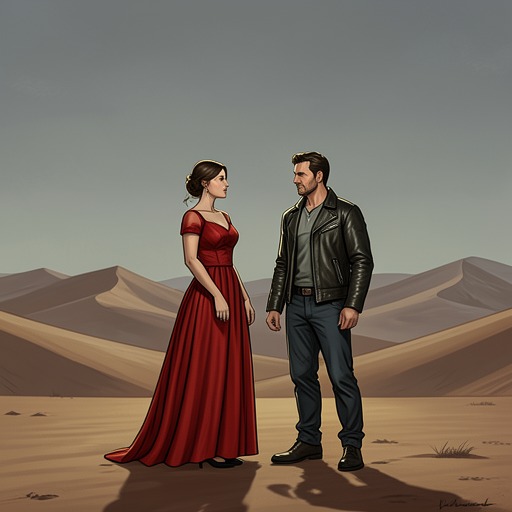
Santa Monica Mountains
Daisy Jones & the SixThe Santa Monica Mountains provide the dramatic setting for the dawn photo shoot that produced the cover image for Aurora. A road, a guardrail above a steep drop, and a rising sun framed the band; within that landscape, a fleeting exchange of looks between Daisy Jones and Billy Dunne gave the photographer an image that audiences would read as both a portrait of the group and a statement about Daisy’s independence.
Setting and Purpose
Rod Reyes arranged the photo shoot with photographer Freddie Mendoza to help market the album. Mendoza proposed a desert setting after hearing early tracks. Accounts of the original concept vary: Karen Karen remembered Billy Dunne favoring a boat, while Billy recalled suggesting a sunrise. By the time the group reached the chosen spot in the Santa Monica Mountains, the album was to be called Aurora, and Billy had accepted the desert setting.
The band had to arrive at daybreak. Pete Loving was about an hour late, and the group waited while Mendoza prepared the shot. He positioned all seven members along a road, against a guardrail separating the pavement from a steep drop-off, with a large mountain rising roughly a hundred feet behind them. The landscape combined open road and dust with the mountains’ desert and forest, the pale tan ground interrupted by patches of trees.
The Shoot
Mendoza was instructed to photograph the whole band with Billy and Daisy as the focus. He initially placed them toward opposite ends of the group and kept asking the members to vary their positions. Then Daisy leaned forward to look at Billy. Mendoza continued shooting without calling attention to the moment; for an instant, Billy turned toward her, and their eyes met while the others looked toward the camera. He recognized the resulting frame as a possible album cover.
The day also yielded a more intimate image of Billy and Daisy’s torsos. Billy wore denim, while Daisy’s shirt revealed her chest; their faces were not visible. Mendoza later described a clear blue sky between them and a small object in Daisy’s pocket that looked to him like a vial, though he did not know what it was. The landscape and the band’s poses made the shoot’s images feel at once carefully composed and caught in passing: the group arranged against the road and drop, and the central pair’s relationship suggested without a direct explanation.
The Images and Their Reception
Mendoza remembered the band’s guardrail portrait, with Billy and Daisy looking at one another, as strong; he recalled the torso image as immediately striking. The pictures distilled several contrasts into a single visual field: the road and mountain, the band’s contrasting appearances, Billy’s denim and Daisy’s exposed chest, and the suggestion of intimacy alongside the uncertainty of what was in her pocket. The setting gave the cover a distinctly Californian summer-rock character, while the photographs made the landscape a frame for the band’s public image rather than merely a backdrop.
The cover became especially meaningful to young listeners. Biographer Elaine Chang described Daisy’s posture and clothing as conveying control over her own sexuality: the image did not present her body as something offered to Billy or the viewer, but as an expression of her own terms. Chang recalled the cover as a reason she fell in love with Daisy as a young girl, and described its effect on teenagers as far-reaching. The mountains thus became inseparable from an image that helped shape how audiences understood Daisy—not only as a singer in a successful band, but as a woman who appeared to decide for herself how she would be seen.
Place in the Band’s Story
The photo shoot captured the band at a moment of anticipated success: the members were making an album they believed could become a major hit, even as later recollections emphasized that good fortune and trouble could follow close together. In the finished image, the mountain’s scale and the guardrail’s precarious edge lend the group portrait a tension that the day’s practical business of waiting, posing, and shooting could not fully explain. The site’s lasting significance comes from that transformation: a dawn marketing session in the Santa Monica Mountains became part of the visual story through which the public remembered Aurora, Daisy, and the band.