Sound City Studios
Daisy Jones & the SixSound City Studios is the Van Nuys recording studio where The Six worked on their debut album and where later sessions brought Daisy Jones into the band’s recorded sound. Its importance lies not simply in hosting the musicians, but in the way its schedules, equipment, and production decisions turned their performances into carefully shaped recordings. The accounts present the studio as a place of immersion: the band entered its dark rooms to work on music, while engineers and producers altered arrangements and textures until the recorded songs expressed a shared, if sometimes contested, vision.
Setting and Working Life
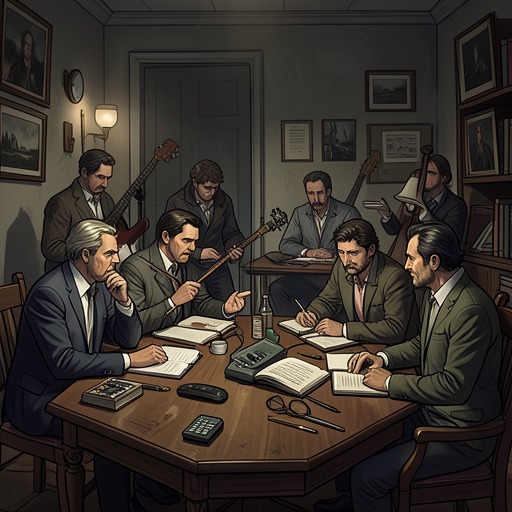
After settling in Los Angeles, The Six rented a house in Topanga Canyon and prepared to record their debut album. Teddy Price and a team of technicians, including lead engineer Artie Snyder, established their base at Sound City Studios in Van Nuys. The house and studio formed the two poles of the band’s working life: the musicians lived together in the hills, but their long creative hours were spent in the recording rooms.
Price was a night owl, so the group generally headed to the studio in the afternoon and stayed late into the night, sometimes working until morning. Billy described the effect of that routine as an intense separation from ordinary life: in the dark studio, the outside world seemed to disappear, leaving only the music. The sessions were not confined to scheduled daytime work. Graham recalled that Billy was always writing, that the band was continually working on some part of the record, and that members moved in and out of the studio, sometimes sleeping there.
The work’s duration is remembered differently by the musicians. Graham recalled that they finished recording everything in November, while Eddie placed the completion around March. The recollections do not resolve the discrepancy, and they may distinguish different understandings of when the recording process was finished. Both accounts, however, sit alongside the further months Billy and Price spent going over mixes, making clear that completing performances did not mean the album was ready to hear.
Recording, Engineering, and Performance
The studio’s technical work was closely bound to the musicians’ performance. During a session with Daisy, Artie placed her in an isolation booth, but the microphone failed. It took him about forty-five minutes to get it working. Daisy continued to sing test phrases while he worked and remained patient, telling him that the job would take as long as it took. Artie remembered this not only as an equipment delay but as an instance of Daisy treating him with consideration; he felt she cared about how his day was going. In a workplace often defined by pressure and musical ambition, the stalled microphone revealed a quieter dimension of collaboration.
When the band shaped a version of a song with Daisy’s voice, the recording and arrangement changed together. Artie recalled that the combination of Daisy’s and Billy’s vocals was so compelling that Price wanted to strip away much of the surrounding material. He softened the drums, brought the keys forward, and removed some of Graham’s more distracting flourishes. The resulting arrangement centered on acoustic guitar, percussive piano, and the two voices. The track retained an upbeat rhythm, but its attention shifted decisively toward the vocal interplay. Eddie saw the transformation as a move from rock toward pop; the change was audible in the reduced instrumental emphasis and the prominence given to the singers.
The recording setup for the song “Aurora” made the band’s physical arrangement part of the session’s method. Artie’s team placed Karen and Graham at the side of the room, Pete and Warren toward the back, and Eddie near the front, while Billy and Daisy sang in isolation booths from which they could still see the others. Artie and Price monitored from the control room. Once the microphones and positions were set, Artie called for the first take. The booths separated the lead singers acoustically without removing their visual connection to the ensemble. Daisy remembered the moment as evidence that she belonged in the band: the seven musicians were making music together, and she was one of them.
The sound did not arrive fully formed. Artie said the early takes sounded tinny, and he and his team repeatedly adjusted the setup, working to get the levels and microphones right. His attention remained fixed on the sound coming through the headphones; he did not recognize, while concentrating on those technical problems, that they were making a record that would become a major hit. Daisy, by contrast, recalled believing even then that it would be huge. Their differing memories distinguish the engineer’s immediate focus on a clean recording from the singer’s confidence in the music’s larger potential.
Mixing and Musical Decisions
After the band’s recording sessions, Billy and Price took extended control of the mixing process. Eddie recalled that no one else was allowed into the studio while the two worked on the album for months. When the rest of the group was finally invited to hear it, Eddie was struck by how good they sounded. Billy’s own account describes a painstaking process: he and Price revisited the album track by track, sometimes spending what felt like twenty hours a day in the control room for three weeks. When a riff did not feel right, Billy might rerecord an instrument or add a part, including tack piano, Dobro, or brushed drums.
Artie described the returned album as substantially transformed: more nuanced, layered, and innovative, with what he called the empty spaces filled in. The additions included cowbells, shakers, claves, and scrapers; at one point, the team even recorded the hollow sound of Billy’s fist striking the arm of a chair. Such details show the studio work extending beyond conventional instrumental parts. A found sound could become part of the arrangement if it contributed the right texture.
The revisions also altered the shape of particular songs. On “Regret Me,” the starting point had been a single vocal over a simple shuffle. Price pushed Billy to add a second vocal layer; Billy initially resisted, then rewrote and recorded the main riff, while he and Price held Warren’s drums back until the pre-chorus. Artie described the finished result as a new song. On “Aurora,” Billy slowed the tempo, reduced the prominence of Karen’s keys, and raised Graham’s part in the mix, producing a cleaner arrangement. The mix was therefore not merely a final polish: it redistributed attention among the musicians and could change a song’s structure and character.
Reach and Significance
The finished recordings moved beyond the studio into a commercial and public life. By the summer of 1978, “Turn It Off” had reached the top of the charts for four weeks, while sales of Aurora exceeded 200,000 units per week. The tour was selling out stadiums and adding holdover dates in major cities. Those figures mark the distance between the private labor of recording and the album’s scale as a popular success, without erasing the many decisions that shaped its sound along the way.
Sound City Studios is thus presented as a site of both concentration and negotiation. The band’s long sessions fostered immersion, but the recording’s final form depended on decisions about microphone placement, levels, arrangement, instrumentation, and whose part should be prominent. Daisy’s vocal presence could prompt an instrumental reduction; Billy and Price’s mixing could remake a song after the rest of the band had left; and an engineer’s technical focus could coexist with the larger artistic result taking shape around him. The studio’s significance comes from that process: music made collectively was repeatedly listened to, altered, and reorganized until the recorded version became something more deliberate than a capture of the original performance.