The band votes to record Regret Me
Daisy Jones & the SixThe band’s vote to record Regret Me is a decisive confrontation over authorship and authority during the making of Aurora: Daisy Jones puts a song before her colleagues, Billy Dunne opposes it, and the band chooses to proceed without his consent. The vote gives the group’s collective judgment practical force, but it does not settle control of the music. Billy later returns to the recording and helps reshape the track, making the song both a challenge to his authority and a product of his subsequent creative work.
Background and Stakes
Daisy’s demand for a vote followed a career in which she had insisted on writing and singing her own material. Early on, when a manager wanted her to sing a demo more sweetly and in a higher key, she refused and walked out of the session; she later explained that she did not want to be a puppet singing other people’s words. That history makes her insistence on bringing a song to the band more than a bid for one album slot. She is claiming the right to define what she sings and asking her fellow musicians to judge the work itself.
The immediate stakes are musical and institutional. The question is whether the song will be recorded and included on the album, but Daisy frames the decision as one the band can make collectively. Billy’s opposition carries particular weight because he is accustomed to refining the album with producer Teddy Price. The vote therefore tests whether his judgment remains decisive when the others disagree, and whether Daisy’s place in the group includes real influence over its recorded music.
The Song Is Put to the Band
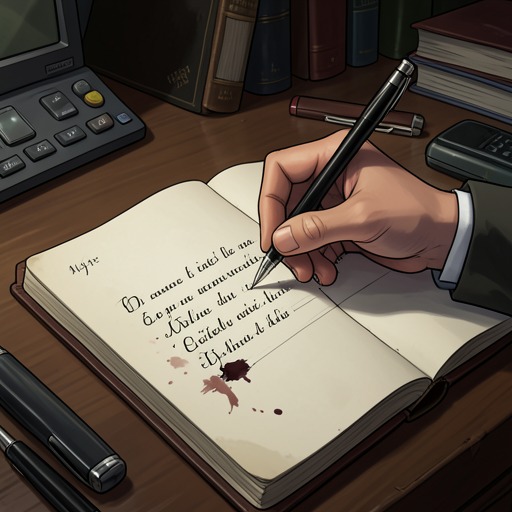
The song first appears as writing on a napkin and the back of a bill, covered in black smudges. Daisy explains that the marks came from an eyeliner pencil and identifies the scrawl as their new song. Billy says he cannot make out what he is looking at. The improvised paper object makes the moment feel unfinished: the work arrives not as a polished studio product but as a piece of writing Daisy is determined to have heard.
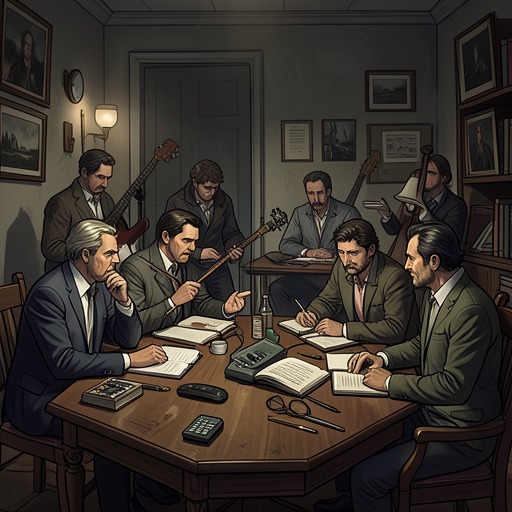
Daisy asks Billy for a reason not to record it, then says she can give five reasons to record it. She gathers the band in the lounge, announces that she is going to sing them a song, and tells them they will vote on whether it should be recorded for the album. Billy recalls finding everyone assembled and feeling confused; by the time Daisy states the terms, he is furious. His anger is described as becoming so intense that it gives way to a frozen, stunned feeling. The procedure is simple, but it makes the conflict public: rather than letting Billy decide privately, Daisy asks the band to show where it stands.
Daisy sings without accompaniment, presenting the song as she hears it in her head. Its words address someone who has ruined the singer, and the performance makes the grievance difficult to overlook. Karen remembers Daisy’s voice as guttural and scratchy, with the sound shaped by her being drunk or buzzed; she also emphasizes the anger in the delivery. Eddie hears rock-and-roll rage, while Warren identifies the song’s threat to leave its subject with a lasting association between the singer and ruined rock music. The accounts differ in emphasis, but each describes a performance whose force depends on Daisy’s exposed voice rather than an arrangement cushioning it.
The Vote and Billy’s Defeat
After Daisy finishes, the room falls silent. Billy takes that quiet as a hopeful sign that the others do not like the song. Daisy then asks those who want it on the album to raise their hands. Karen’s hand goes up immediately; she wants to play on a song that would let her rock out onstage. Eddie and Pete also vote for it. Eddie values its scorned-woman perspective and its energy, while Pete likes that it feels dangerous beside material he considers softer.
Graham’s response makes the vote more than a straightforward alignment of personalities. His instinct is to support his brother, Billy, but he also thinks the song is good. Daisy reports that every hand is raised except Graham’s and Billy’s; Graham then raises his as well. She tells Billy the result is six against one. He nods to her and to the others, then walks away. His departure is the immediate consequence of losing the vote: the band has acted collectively, but the defeat is personal, and the scene does not present agreement as emotional reconciliation.
The result gives Daisy’s proposal concrete force. She has not merely persuaded the room that the song is compelling; she has made the decision to record it depend on a count that can overrule Billy. At the same time, the accounts preserve the strain within that act of self-government. Graham’s hesitation shows how family loyalty and musical judgment pull in different directions, while Billy’s silence after the count leaves his acceptance distinct from enthusiasm.
Recording and Aftermath
The band records Regret Me without Billy. That detail makes the vote’s outcome unmistakable: the others do not defer the session until their leader changes his mind, and the decision moves directly from discussion into production. The song’s route onto the album is therefore marked by a division between the band’s collective choice and Billy’s participation at that initial recording stage.
The track’s later development complicates any simple picture of Billy being permanently excluded. During the album’s subsequent work with Teddy and engineer Artie Snyder, Billy contributes substantially to the version of Regret Me that takes shape. Artie recalls that the song began with a single vocal and a relatively simple shuffle. Teddy pressed Billy to add a second vocal layer; Billy initially resisted, but eventually made a strong imprint on the track. He rewrote and recorded its main riff, and he and Teddy held back Warren’s drums until the pre-chorus. In Artie’s account, their interventions made it a new song.
This later work does not undo the vote. It distinguishes two kinds of power in the album’s making: the band can decide that Daisy’s song belongs on the record, while Billy and Teddy can still exercise considerable influence over how that song is produced. The episode thus moves from a visible contest over whether the song will exist on the album to a more collaborative, though not necessarily equal, process of shaping its recorded form.
Significance and Reconstructed Memory
The vote is especially revealing in the book’s oral-history form. The history is assembled from separate interviews, and its author acknowledges that accounts of the same events sometimes differ, with truth potentially lying between them. Here the participants remember different aspects of the performance: Daisy’s initiative, Billy’s shock, Karen’s musical appetite, Graham’s divided allegiance, and the production decisions that later changed the song. Their testimony does not reduce the scene to a single uncontested verdict; it shows how the same decision could register as artistic conviction, group solidarity, anger, or an opportunity to make a more forceful record.
The lasting significance of the event lies in that combination of resistance and participation. Daisy wins the immediate decision through a vote, and the band records the song without Billy. Yet the finished track bears the imprint of Billy’s later work as well as Daisy’s writing and performance. Regret Me consequently records two linked conflicts: who has the right to determine what the band makes, and how a song can change when the person who first opposed it later becomes one of its principal shapers.