The unresolved attraction between Billy Dunne and Daisy Jones
Daisy Jones & the SixThe unresolved attraction between Billy Dunne and Daisy Jones becomes most legible in the spaces where direct explanation fails: songs that seem to carry feelings their writers will not name, a near-kiss that ends with Billy pulling away, and performances whose intimacy can be read as either genuine or staged. Their connection is not resolved into a simple romance or dismissed as marketing. Instead, the band’s music and public images preserve the uncertainty, making the unsaid part of what listeners see and hear.
Songwriting as Indirect Disclosure
Billy describes songwriting as a process whose meanings may elude even the writer: a line can arrive without a clear reason, and its significance may not be understood at the moment of writing. He also acknowledges that songs can be drawn from different sources and that their meanings can shift to suit later circumstances. That uncertainty gives the collaboration between him and Daisy a particular charge. The songs are not transparent confessions, but neither are they sealed off from the feelings that may have produced them.
Daisy recalls beginning to feel that much of what Billy wrote with her reflected how he actually felt. In her account, their work together gave voice to things left unsaid between them. Billy’s uncertainty about what a song means and Daisy’s sense that it conveys something real do not cancel each other out: they establish the central ambiguity of their relationship. The music can disclose an emotion without either writer having to state it plainly, while its openness lets Billy resist treating each lyric as a direct declaration.
That tension is especially apparent as they work on For You. Billy’s private premise is that the song concerns getting sober for Camila Dunne, but he avoids saying so because he expects Daisy to object to his writing about Camila. Instead, he presents the idea more generally, as being willing to give something up for another person. Daisy remembers sitting beside him at the keyboard at around eleven in the morning, already buzzed, as they worked out notes and the song’s key. She remembers a line he had written about going back to the past and waiting for someone. Their closeness in the act of making the song sits beside the undisclosed subject Billy is trying to keep from the collaboration. The episode does not establish that the lyric is about Daisy; it shows how the work can hold a private meaning and an intimate shared moment at once.
The Near-Kiss and Its Refusal
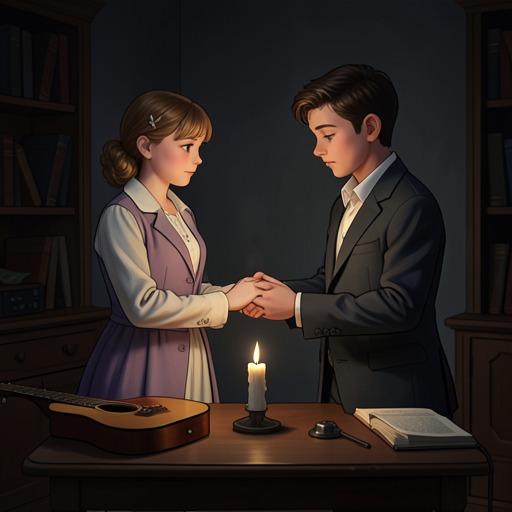
The attraction becomes physical when Daisy leans in to kiss Billy. Her memory emphasizes how close they are: she can feel his breath, and, when she opens her eyes, his are closed. For a moment, the action seems to her to make sense. Billy later recalls losing himself, at least briefly, before pulling back. Daisy’s lips barely graze his; the contact is defined by how nearly it happens rather than by a completed kiss.
Billy’s response is a boundary, not a reciprocal declaration. He looks at Daisy kindly and tells her he cannot go further. Daisy says she should leave, and Billy reassures her that it is all right. The scene therefore changes the attraction from implication into acknowledged possibility, but not into an affair. Its restraint matters: the closeness is real enough to be remembered by both, while Billy’s refusal keeps it from becoming a settled account of what their relationship is.
Daisy’s sense of danger around Billy also extends beyond the kiss. She recalls standing beside him and being frightened by the thought that she could push him into a pool, while insisting she would never do it. What unsettles her is the precariousness of the moment—the recognition that a terrible act could depend on a person’s choice rather than some outside mechanism preventing it. She identifies that feeling as what being around Billy was like. The memory makes proximity itself feel consequential, without turning the frightening thought into an action or claiming that attraction alone explains it.
Performance, Audience, and Uncertainty
Onstage, the connection remains conspicuous but interpretable in competing ways. Karen Karen remembers dirty looks between Billy and Daisy, especially during Regret Me. Rod Reyes observes that an audience expecting hatred could find evidence for it, while an audience suspecting that hatred concealed another feeling could find evidence for that too. The same gestures can sustain opposite stories, so the public performance does not supply a definitive answer.
Billy admits that writing songs with someone, writing songs about someone, and singing material that the other person wrote about him would inevitably draw them toward each other. He remembers looking across the stage at Daisy and being unable to look away, and notes that photographs from the tour repeatedly caught them looking into one another’s eyes. Yet he cannot finally separate performance from feeling: he had told himself they were putting it on, but no longer knows what was staged or what they meant. The unresolved attraction is thus not merely hidden behind the act. The act becomes one of the conditions that makes its meaning hard to distinguish.
Daisy remembers that Nicky was often jealous of what happened onstage. She identifies Young Stars as a song about two people drawn to each other but forced to deny it, Turn It Off as an effort to fall out of love with someone one cannot help loving, and This Could Get Ugly as a song about knowing someone more deeply than that person’s partner does. She also describes the work of making sure Nicky felt comfortable and had a good time. These accounts place the songs’ emotional force inside a wider relationship context: their performance affected someone beyond the two singers, while Daisy’s efforts to manage that effect did not make the songs less charged.
Images and the Public Meaning of Desire
The attraction also enters the band’s public image through the making of the Aurora album cover. For the shoot, Rod Reyes arranged for photographer Freddie Mendoza to work with the band after playing him early tracks; Mendoza imagined the images in the desert mountains. During the session, he kept photographing as Daisy looked toward Billy and, for a brief moment, Billy turned to meet her gaze while the others faced the camera. Mendoza thought the caught look could make an album cover. The image turns a fleeting exchange into something repeatable: a viewer can return to it, but the photograph cannot say whether the look belonged to private feeling, performance, or both.
Mendoza also singled out a striking image of Billy and Daisy’s torsos. Billy’s denim and Daisy’s exposed chest, set against the clear sky, allowed viewers to recognize the pair without seeing their faces; a small object in Daisy’s pocket looked to him like a vial, though he did not know what it was. The photograph gathered sex, drugs, summer, and rock and roll into a single image, but its meaning was not limited to Billy’s relation to Daisy. Biographer Elaine Chang stresses that Daisy’s body is not aimed at him or at the viewer, and interprets her stance as confident and self-possessed rather than designed to please. A young girl’s response to the cover was to see Daisy as fearless. The image therefore makes desire part of the band’s spectacle while also presenting Daisy as an agent whose sexuality is on her own terms.
The attraction’s public visibility persists beyond the early ambiguity of the photographs and performances. After Daisy leaves Niccolo Argento, Chang describes her as in command of herself and her talent. At the Grammy ceremony, Daisy accepts the Record of the Year award in a cream silk dress, with disheveled hair and bangles up to her elbows, appearing confident and in control of the band. In the account of the ceremony, Billy catches her eye as they leave the stage with the award and reads her smile as a sign that she is turning things around. The moment preserves their capacity to register one another, but it does not resolve the earlier uncertainty into a conventional romantic ending. What endures is a connection made visible through songs, glances, images, and remembered gestures—powerful enough to invite interpretation, never fully settled by it.