Warren Rhodes
Daisy Jones & the SixWarren Rhodes is the drummer whose work and recollections illuminate both the collective force and the unruly private life of The Six. Recruited while the Dunne brothers were still teenagers, he joined a band because, as he understood it, a drummer needed other musicians in a way a singer or guitarist did not. Onstage he became a musical anchor; offstage he embraced the touring party, the houseboat, and the rituals of fame, before building a quieter life with Lisa Crowne and their children.
Identity and Entry into The Six
In 1967, Billy Dunne and Graham Dunne brought Rhodes into the group alongside bassist Pete Loving and rhythm guitarist Chuck Williams. His route into music was shaped by the instrument itself: a drummer could not simply perform alone, and Rhodes wanted the belonging and opportunity that a band could provide. He was listening to the Who, the Kinks, and the Yardbirds, and looked up to Keith Moon, Ringo, and Mitch Mitchell. Joining The Six gave that ambition a collective setting.
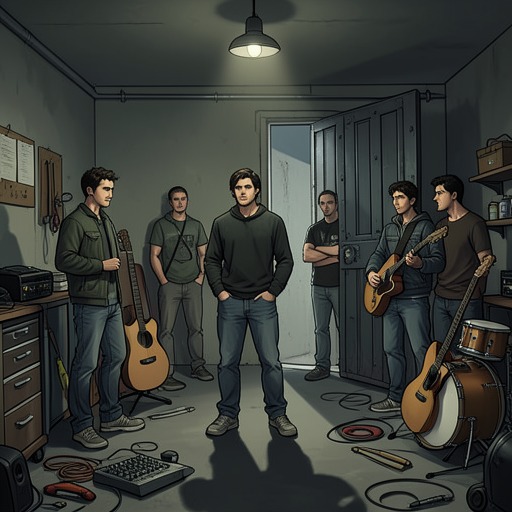
Rhodes’s account of the band’s first home in Los Angeles captures the crowded, makeshift texture of their early domestic life. Graham Dunne and Karen Sirko each had a bedroom off the kitchen; Pete Loving and Eddie Loving took the garage; Billy Dunne and Camila Dunne wanted the loft. Rhodes got the only bedroom with a bathroom, although Graham Dunne later clarified that it contained a toilet in the corner rather than a proper bathroom. It was an arrangement that made the band’s closeness literal, and its comfort decidedly uneven.
Touring Life and the Party Rules
As The Six toured, the repeated cycle of sound check, performance, partying, and travel became a way of life. Rhodes described one of its practical rituals: every band member received five matchsticks, which could be handed to people in the crowd as invitations to the after-party. A matchstick meant entry, while the band tried to avoid inviting anyone they considered a stranger or a risk. The rule turned access to the party into a small, transferable token—and made the group’s social life an organized extension of its performances.
Rhodes’s stories also register how readily work and indulgence ran together. By the time money was coming in, he had bought a boat: a one-bedroom Gibson docked in Marina del Rey. He kept his drums at the house in Topanga Canyon, while spending nights and weekends drinking beer on the water and enjoying the company there. His image of success was not only the public one of a touring musician; it was also the private freedom to leave the house and live aboard.
One of his most revealing recollections concerns a Glasgow show. After sound check, Rhodes had a beer and fallen asleep, a habit he called a beer nap, when noise from the next room woke him: Karen Sirko was having sex with someone. Rhodes never learned who the person was. He recalled seeing her flirt with the lighting technician, whom he knew as Bones, and speculated that the two might have been involved, but offered no confirmation. The anecdote is notable as much for its limits as for its gossip: it preserves the backstage atmosphere while leaving the identity of the other person unresolved.
Musical Work and Band Relationships
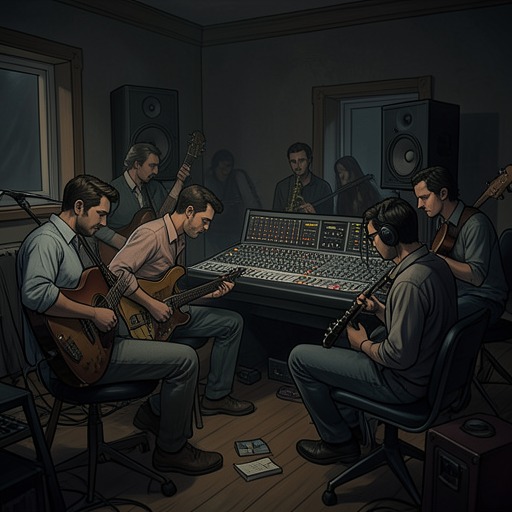
Rhodes’s role was not confined to keeping time. While The Six worked on Midnights, Daisy Jones suggested that he hold back the drums during the bridge. He considered the idea and agreed that it was a good one. He remembered their musical exchanges as unusually free of ego: Daisy Jones could offer a change, and he could take it seriously without feeling threatened. When he told her that her singing on Turn It Off sounded too sexually charged, she responded by deciding to pull back on the chorus. Their rapport depended on direct criticism being usable rather than becoming a contest for control.
That openness contrasts with the threats Rhodes saw in other relationships. He described some people as naturally unthreatening to one another and others as unsettling each other simply by existing in the same space. His observation gives a compact account of the band’s wider tensions: musical collaboration could be generous, but not every pairing made room for the same ease.
Onstage, Rhodes supplied the physical force that made the ensemble cohere. During a performance in which Billy Dunne and Daisy Jones drew the audience’s attention, his drumming remained a spectacle in its own right. He drove the floor toms with such energy that an observer’s eye could move from the singers to him. The effect was both individual and collective: Rhodes could command attention, yet the power of his playing lay in holding the band together beneath the song.
Fame, Image, and the Road
The Aurora cover session placed the seven band members together against the landscape of the Santa Monica Mountains. Photographer Freddie Mendoza described the resulting image less as a simple portrait than as an emotionally charged capture of Billy Dunne and Daisy Jones meeting each other’s gaze. The cover’s later reception centered particularly on Daisy Jones’s self-possession and its impact on young listeners. Rhodes was part of the ensemble whose image became a defining piece of the band’s public identity, even though the remembered meaning of the photograph focused on the charged space between its two singers.
By the tour, the group’s success had altered its logistics as well as its reputation. The Six traveled in two buses bearing the same name: one had Billy Dunne’s denim shirt in the background, the other Daisy Jones’s tank top. Rhodes rode on the white bus with Daisy Jones, Niccolo Argento, Eddie Loving, and Pete Loving; Jenny Manes sometimes joined Pete Loving. He called it the better bus and joked about being happy to ride in the one with breasts painted on its window. The split made the strain between the band’s two central figures visible in an everyday arrangement, while Rhodes’s choice shows that he could treat the division with irreverence.
The band’s appearance on Saturday Night Live marked another threshold. Afterward, Rhodes went to the party hosted by Lisa Crowne, tried to play it cool in the hope that she might be interested, and found that she was. Graham Dunne later saw Rhodes with his arm around her and took the encounter as a sign of how famous the group had become: in his view, the band would have to be exceptionally well known for Rhodes to have a chance with Lisa Crowne. The story links public stature to private possibility, but also shows Rhodes approaching fame through the same casual sociability that had characterized the touring parties.
Later Life and Retrospective Voice
Rhodes married Lisa Crowne, and they had two children, Brandon and Rachel. Lisa made him sell the houseboat; he later lived in a large house in Tarzana, California, surrounded by strip malls. By the time he recounted this, his children were in college and strangers no longer asked him to sign their breasts. Lisa occasionally did so as a joke, and Rhodes said he indulged her partly because he remembered how many people would once have wanted that attention. The humor preserves his old appetite for irreverence, while the marriage and family mark a life no longer organized around touring.
His recollections of The Six move easily between the absurd, the intimate, and the musical: a toilet in the corner of his bedroom, matchsticks used as party invitations, an interrupted nap in Glasgow, a suggestion that changed a drum part, and the force of the floor toms beneath a performance. Together, these details make Rhodes more than a background witness. He is a participant whose practical musicianship binds the band’s sound and whose stories show how its communal life could be exuberant, cramped, divided, and ultimately left behind.