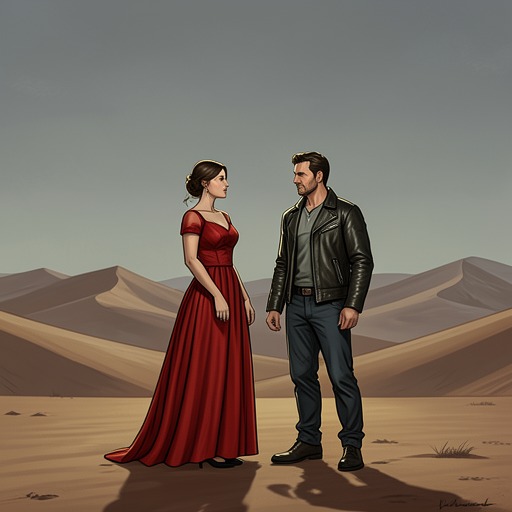
Aurora album-cover photo shoot
Daisy Jones & the SixThe Aurora album-cover photo shoot transformed a routine marketing assignment into one of the band’s defining images. Arranged as the group prepared to promote its forthcoming album, the session yielded two linked photographs: the whole band at a mountain roadside, with Daisy Jones and Billy Dunne exchanging a look, and a closer image of the pair’s torsos separated by open sky. The images made the group legible as a public spectacle while preserving, in the space between its two singers, an intimacy that neither quite acted upon.
Planning and Setting
As the band considered how to market the album, Rod Reyes arranged a meeting with his photographer friend Freddie Mendoza and played him early tracks to suggest the direction of the music. Mendoza imagined the photographs in the desert mountains. The setting was not the band’s only proposed image: Karen Karen remembered Billy favoring a boat, while Billy recalled suggesting a sunrise. The album had already been named Aurora, and the sunrise idea suited that title; the eventual desert setting gave the cover a different kind of dawn, grounded in California terrain and the band’s physical presence.
The Shoot
The band assembled at a spot in the Santa Monica Mountains at daybreak. Pete Loving arrived about an hour late, and the shoot began with the group arranged along a road, beside a guardrail separating the pavement from a steep drop. A large mountain rose behind them. The composition placed the seven band members in a rugged landscape of road, dust, dirt, and sparse trees, with the rising sun completing the scene. Mendoza was looking for an image of the full band that would keep Billy and Daisy in focus without making the arrangement look forced.
The first decisive moment came when the band members had drifted toward opposite ends of the group. As Mendoza tried to rearrange them, Daisy leaned forward to look at Billy. The others faced the camera; Billy then turned toward Daisy, and the two met each other’s eyes for an instant. Mendoza kept shooting rather than interrupting the moment. That glance gave the wider group portrait an internal focal point: the band faced outward, but its two central singers appeared to be attending to one another. Mendoza recognized the photograph’s potential and, feeling free to experiment after getting the shot, moved the group to the top of the mountain.
After the band had spent an hour or two in the sun, Graham Dunne insisted that the group drive rather than walk up. At the new location, Mendoza placed Billy and Daisy beside each other, with the others lined up between them. Their bodies seemed deliberately not to touch. When Mendoza asked how Daisy had joined the band, they began answering at the same time, then looked at each other again. He photographed their torsos as they spoke: their bodies angled inward, while a strip of clear blue sky remained between them. The distance did not read as empty space. In Mendoza’s view, the refusal of contact gave it a palpable charge, and he knew he had another strong image.
The Images and Their Meaning
Mendoza initially regarded the session as a job, but he came to see the torso photograph as exceptional. The image made Billy recognizable through his denim and Daisy through her exposed chest, even without their faces. The sky between them formed a comparatively straight boundary on Billy’s side and a curved one alongside Daisy. Mendoza saw the composition as combining masculine and feminine forms, while the empty space between the singers made their separation feel intentional rather than incidental.
Daisy’s pocket contained a small vial. Mendoza could not identify it at the time, but its presence became part of the image’s meaning; Daisy later confirmed that it held cocaine. The photograph consequently joined glamour and unease in one frame: exposed skin, sexual suggestion, summer, rock music, and a trace of the drug culture surrounding the band. The final cover design used the close image of Billy and Daisy’s torsos on the front and the wider band photograph, with the pair looking at one another, on the back. Together, the pictures offered both an eroticized close-up and a view of the larger group, without resolving the tension between them.
Public Afterlife
The cover became more than an album-marketing image. Biographer Elaine Chang described it as an emblematic image for teenagers in the late 1970s, particularly girls. Her reading centered not simply on Daisy’s exposed chest but on how the photograph framed it: Daisy’s body was not aimed at Billy or at the viewer, and her posture did not appear to ask for their approval. The image could therefore signify sexual visibility on Daisy’s own terms, rather than availability for someone else’s desire. Chang recalled that this sense of fearlessness was part of why she fell in love with Daisy as a young girl.
The photographs also helped establish the public image of the band and its two most scrutinized singers. Their staging gave viewers a story to read into the distance between Billy and Daisy, even though the shoot itself captured gestures and glances rather than explaining their relationship. Billy later recalled trying not to look at Daisy and feeling that Mendoza had caught the only two moments when he did: once for the back-cover group image and once for the front-cover portrait. The photographer’s choices thus turned unguarded-looking instants into a durable public image, one that seemed to disclose a private attraction while leaving its meaning unsettled. The cover’s later association with Daisy’s confidence, including the commanding image described around her Grammy appearance, extended the sense that she could control how the public saw her; it did not reduce her to the band’s visual counterpart to Billy.