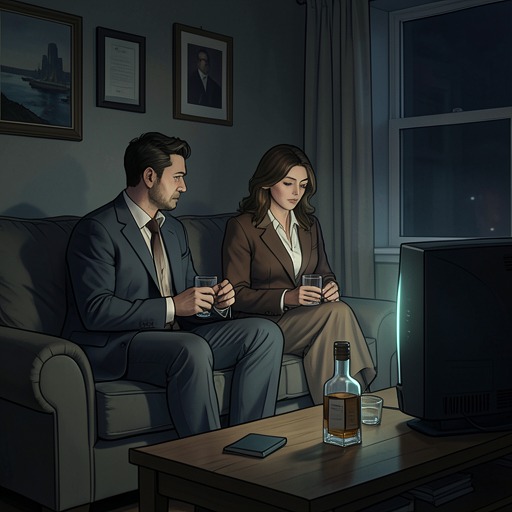
Billy Dunne's sobriety and recovery
Daisy Jones & the SixBilly Dunne’s sobriety and recovery are not presented as a clean break from addiction but as a continuing practice shaped by fatherhood, family responsibility, and the recurring pull of the life he once pursued. Rehab gives him a reason to begin again, and meeting Julia Dunne makes that reason tangible; later, the road and Daisy Jones’s drug use test whether the commitment can survive without the daily presence of his family.
Rehab and the reason to stay
Billy entered rehab in the winter of 1974, and The Six canceled the remaining dates of its tour. The interruption scattered the band: Warren Rhodes bought a boat and docked it off Marina del Rey, while Eddie Loving, Graham Dunne, and Karen Karen stayed in the Topanga Canyon house. Pete Loving went temporarily to the East Coast to be with Jenny Manes, and Camila Dunne settled into motherhood in a rented house in Eagle Rock. Billy’s treatment therefore began not in the ordinary rhythm of touring but in a pause that rearranged both the band’s work and his family’s life.
Billy later questioned whether he had entered rehab for the right reasons. Shame, embarrassment, and avoidance had helped bring him there, but a group therapist gave him a reason to remain: instead of imagining his daughter ashamed of him, he should imagine what he would need to do to believe she was proud. That thought became a guiding image. He worked each day toward becoming a man his daughter might feel lucky to have, rather than treating treatment as a brief escape from consequences.
After sixty days in the rehabilitation center, Billy met Julia for the first time. She was sixty-three days old. The two days between his discharge and their meeting sharpen the cost of his addiction: he had missed the first months of her life and her birth. Billy recalled that meeting her at a picnic table with Camila seemed to break through the protective crust he had built around himself. Julia had his eyes, knew nothing of who he had been, and responded only to who he was then. Her presence made both his failure and the possibility of change immediate.
Family as commitment, not proof
At the meeting, Billy fell to his knees, grateful that Camila was still there after what he had put her through. He promised to spend their life trying to be twice as good to her as she deserved. Although he had technically married her almost a year earlier, he described this moment as the point when he submitted himself to their shared future: he dedicated himself to Camila and Julia and to raising his daughter wholeheartedly. As the family left, Camila reminded him that they were in it together and that he must not forget again. The promise that followed rehab was therefore not only abstinence; it was a commitment to show up for a family he feared he had already failed.
That commitment was tested when Billy returned to the road for the first time since rehab. While Daisy Jones was added to The Six’s tour and Honeycomb had entered the Top 20, Billy was focused on how to remain sober, not on the billing. Camila initially described plans to call him three times a day and keep a journal of everything she did, but he told her he did not want her to prove herself to him. He needed to believe that she trusted him, and asked what he could do to make the situation easier rather than harder. He brought Camila and Julia on tour at first; Camila was about two months pregnant with the twins, and they knew she would not be able to stay as the pregnancy advanced.
The work of staying sober on tour
When Camila and Julia could no longer remain with him, Billy understood that he had to take responsibility for his sobriety himself. The first night alone, after a show, he sat on his suite balcony hearing the commotion outside and wanting to join it. An inner voice told him he would not be able to stay sober much longer. Rather than treating the thought as harmless, he called Teddy Price in the early hours of the morning. He invented a reason to talk, and the conversation turned to whether Teddy should marry Yasmine. By the end of the call, Billy felt tired enough to sleep; Teddy checked whether he was all right, and Billy said that he was.
Getting through that first night did not make the temptation disappear, but it made the next night more possible. Billy kept to a routine, avoided the parties, and returned to his hotel room after shows. Sometimes he listened to records; sometimes he went to a diner for decaffeinated coffee and read the paper. Pete Loving or Graham sometimes joined him, though Graham often went off after Karen. Billy continued behaving as he had when Camila and Julia were there. Graham observed that Billy stayed with the band when work was to be done, while Daisy was with them when partying was to be done. The separation captures the pressure around Billy’s recovery without suggesting that the surrounding rock life had changed to accommodate it.
Billy also understood his addiction through the family history he had hoped not to repeat. His father had been a drunk who was absent from Billy and Graham’s lives. Billy feared becoming that same kind of father, and saw his drug use—including heroin—as the first act of fatherhood he had never wanted: he had let Julia down and missed her birth. He believed Camila had helped prevent him from becoming the man he feared he already was. Graham later described Billy as sober, putting his children first, and working every day to make things right. In a family where no man had done as much, redemption was not the erasure of shame but the labor of living differently.
Temptation, Daisy, and recovery’s limits
Billy did not regard addiction as something safely left behind. In conversation with Daisy, he admitted that he kept hoping it would eventually feel as though he no longer had to look over his shoulder. For him, recovery remained a fight, easier at some times than others, and Daisy made it harder. Their exchange connected his fear of his own past to her drug use: when Billy asked when she would quit the pills, Daisy challenged his fixation on them. She recognized that he was reacting to the parts of himself he disliked. Her comparison of people chasing nightmares to others chasing dreams became a possible song idea, but the exchange did not resolve the underlying conflict.
The danger became especially vivid at a party where Billy saw Daisy wet, bleeding, and out of it. His first response was not gratitude that he had stopped using, but the thought that she knew how to have fun. Rod Reyes saw Billy turn to leave and understood that he was taking care of himself. Billy made sure Rod could get a cab home, then went back to Camila. Lying beside his wife, he imagined the paths he might have taken if he had accepted whiskey from a man there: laughing and playing music, swimming with strangers, or watching someone inject heroin. The quiet of home was the consequence of a choice, not evidence that the other possibilities had ceased to attract him. He later described himself as someone who survives despite his instincts: the instinct pulled him toward chaos, while his better judgment sent him home. Unable to sleep, he got up and wrote a song.
Recovery beside the band’s public image
As The Six prepared to market Aurora, Rod Reyes arranged a photo shoot with Freddie Mendoza. The band’s image was built from more than its music: Mendoza photographed the group against a mountain guardrail, and caught a brief moment when Daisy and Billy, positioned at opposite ends, looked at each other while the others faced the camera. In another image, only their torsos were visible; Mendoza noticed what looked like a vial in Daisy’s pocket but did not know for certain what it was. The photograph brought sexuality, drugs, summer, and rock music into a single charged image, while the band’s commercial rise continued around Billy’s attempt to live soberly.
Years later, biographer Elaine Chang described the cover’s significance to young listeners, especially girls: Daisy appeared in control of her sexuality, with a confident stance that did not seem designed to please either Billy or the viewer. Chang said the image helped her fall in love with Daisy’s apparent fearlessness. The contrast matters to Billy’s recovery because the band’s public mythology could turn danger and excess into compelling images, while Billy’s private progress depended on avoiding the party and returning to an ordinary routine. After Daisy left Niccolo Argento, she was widely celebrated; at the Grammy ceremony she appeared disheveled yet in control, and later sang Impossible Woman at Madison Square Garden with fearless intensity. Those images mark Daisy’s public command of herself, but Billy’s recovery follows a less spectacular measure: whether, night after night, he can choose his family and wake sober the next day.