Recording the Aurora album
Daisy Jones & the SixThe recording of Aurora began in August 1977, when the seven members of The Six entered Wally Heider’s Studio 3 to make their third album. The sessions joined two kinds of work: Daisy Jones and Billy Dunne’s increasingly abundant songwriting, and the band’s collective effort to arrange and record it. What emerged was not simply a document of seven musicians playing together. Microphone placement, vocal balance, instrumental revisions, and later mixing determined how the band’s different voices—and its internal strains—would be heard.
Songs and preparation
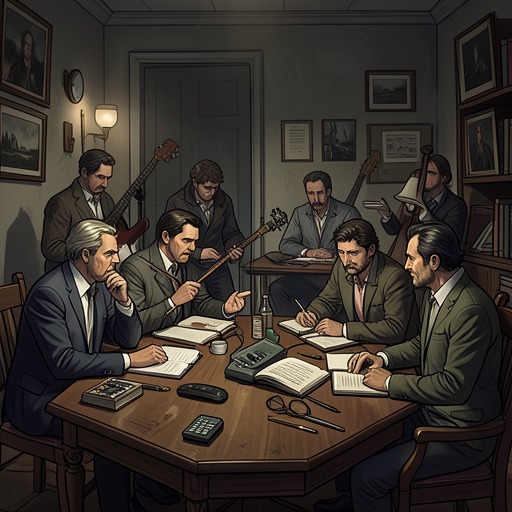
By the time the album took shape, Daisy and Billy were bringing in new material at a striking pace. They worked in the studio lounge or, when they needed quiet, at Teddy Price’s pool house. Sometimes Billy arrived with a song Daisy helped refine; sometimes they began with one of her ideas. Rod Reyes remembered a period when they seemed to bring in something new every day. The results accumulated into a substantial backlog: the band had almost an entire album’s worth of their songs, and was already deciding what could fit. The physical limits of a record mattered; as Rod noted, a side usually held only about twenty-two minutes.
Their partnership also altered the working conditions for the rest of the group. Graham Dunne recalled that while Billy was writing with Daisy, the other musicians had their first opportunity to compose on their own. Karen Karen, for example, developed the arrangement of the song Aurora around sustained roots and fifths, broken-up melodic chords, and bass notes she let ring. Her movement between staccato and legato gave the part a different kind of motion from Billy’s more restrained keyboard preferences. The album’s material thus grew both through Daisy and Billy’s close collaboration and through the room the collaboration made for other musicians to contribute independently.
Daisy arrived at the first session prepared to work, carrying a basket of cakes sent to her at the Marmont and a notebook full of songs. The gathering was not yet a smoothly functioning unit. During an earlier recording setup, the microphone in an isolation booth failed, and Artie Snyder spent about forty-five minutes getting it to work. Daisy kept helping with the tests, singing into it on and off, while Billy grew increasingly tense. Artie remembered Daisy staying patient and considerate throughout the delay. The episode offered a small but telling contrast: the sessions could be technically frustrating and emotionally charged, yet Daisy’s attention to the people around her was part of how she worked.
Recording the band
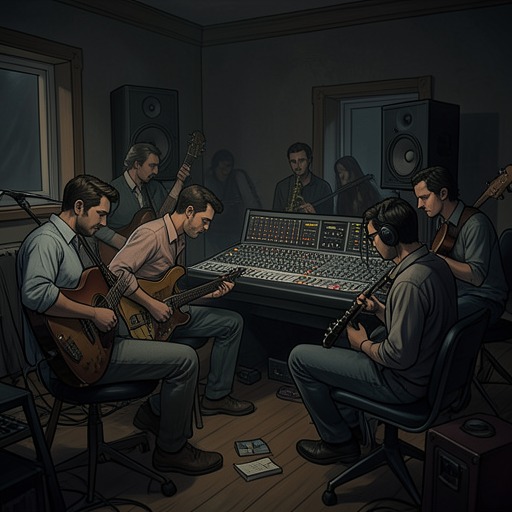
For the song Aurora, Artie miked the musicians across the studio: Karen and Graham on one side, Pete and Warren Rhodes toward the back, Eddie Loving nearer the front, and Billy and Daisy in separate isolation booths where they could still see everyone. Teddy Price sat beside Artie in the control room. The arrangement made separation and connection simultaneous: the two lead singers were acoustically isolated, but remained visually linked to the band they were recording with.
The opening takes did not immediately sound finished. Artie was preoccupied with levels and microphone placement; the early recordings seemed tinny, and he was still adjusting to the new people, sounds, and studio. Daisy, by contrast, seemed to recognize the song’s potential early. Billy needed several takes to warm up, while she delivered her vocal effectively right away. He later described the difference as both irritating and exhilarating: Daisy’s natural ability could be difficult to face as a rival, but extraordinary to have on the same team. Artie recalled that he did not realize during those early technical adjustments that they were making a massive hit record. Daisy believed she already knew it would be huge.
The arrangement itself changed substantially as the musicians and producers listened to the recordings. On an earlier version made with Daisy, the force of her and Billy’s voices led Teddy to strip back other elements: the drums were softened, the keyboards raised, and some of Graham’s flourishes reduced. What remained was a broad acoustic guitar and percussive piano, with the vocal relationship taking precedence over the rock arrangement. The song kept its rhythm and pace, but the two voices became its center of gravity. The response was not unanimous; Eddie objected to the transformation of a rock song into a pop song. That disagreement made the production choices audible as a dispute about what kind of band—and what kind of record—The Six was becoming.
Revising the sound
After the initial recording, Billy took some time away, then returned to the control room with Teddy and Artie for an intensive round of mixing. For about three weeks, they worked for what Billy remembered as nearly twenty hours a day, moving through the album track by track and revisiting it repeatedly. They rerecorded parts when a riff needed adjustment or when they wanted to add an instrument, including tack piano, Dobro, or brushed drums. Artie described the finished version as transformed: Teddy and Billy filled out what had seemed like empty space with cowbells, shakers, claves, scrapers, and even the hollow sound of Billy’s fist striking the arm of a chair.
The revisions did not simply add layers; they reshaped the songs. On Regret Me, what had begun as a vocal over a simple shuffle gained a second vocal layer after Teddy pressed Billy to record one. Billy eventually rewrote and recorded the main riff, while he and Teddy held back Warren’s drums until the pre-chorus. On Aurora, Billy slowed the song, pared back Karen’s keyboards, and brought Graham’s part forward, producing a cleaner mix. These decisions show the record being made through selective emphasis as much as accumulation: instruments were added, restrained, moved, or rewritten to control how each song built.
Billy and Teddy also worked out the running order with care. They wanted the album to move through contrasting emotional and musical passages rather than leave listeners in unrelieved sadness; Billy believed a strong record should end with some hope. The sequencing therefore became another part of the production, organizing the songs into an experience rather than treating them as a stack of separate recordings. The meticulous revisions and deliberate order helped give the album the sense of momentum its makers sought.
Image and reception
The album’s public presentation developed alongside its sound. Rod arranged a photo session with Freddie Mendoza after playing him early tracks; Mendoza imagined the band in the desert mountains. The seven musicians gathered in the landscape of the Santa Monica Mountains, with the road, dust, and sun forming the setting. During the shoot, Daisy and Billy stood at opposite ends of the group. As Daisy looked toward Billy, he turned and met her gaze; Mendoza kept shooting and caught the brief exchange. The moment gave the image a human tension that the surrounding group portrait did not need to explain.
Mendoza also recalled a striking photograph of Daisy and Billy’s torsos, with their faces outside the frame and a clear blue sky between them. A vial-like object in Daisy’s pocket suggested pills or powder to him, bringing the image’s associations with sex, drugs, summer, and rock ’n’ roll into a single composition. The picture’s meaning did not rest only on the musicians’ private relationship. Elaine Chang later emphasized Daisy’s self-possession: the image showed her body on her own terms, rather than presenting it as something meant to please Billy or the viewer. For many young listeners, especially girls, that confidence became part of what the cover represented. The recording sessions had produced an album, but its image would also help define Daisy’s public presence.
In retrospect, the album’s significance rests in the convergence of those forms of authorship. Daisy and Billy supplied a prolific songwriting partnership; the other musicians found room to shape arrangements; Teddy, Billy, and Artie reworked performances into a carefully layered mix; and the cover made the band’s intimacy and Daisy’s independence visible to a mass audience. At the outset, even the engineer focused on whether the sound was coming through cleanly. The eventual hit was built through that close attention to technical particulars, but it exceeded the studio: Aurora became a defining artistic and public statement for The Six.