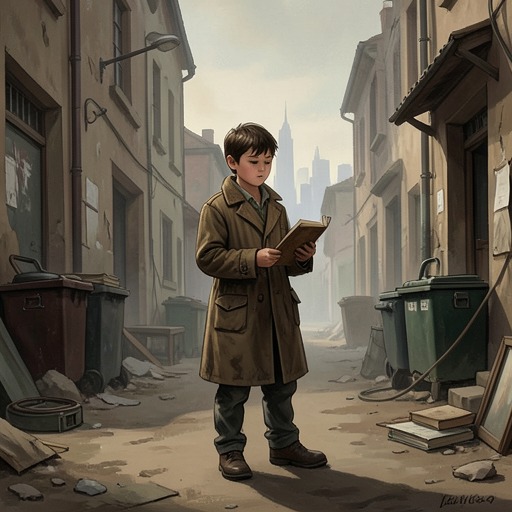
“Beware of Him—He Bites” placard
David CopperfieldThe “Beware of Him—He Bites” placard is a hand-lettered warning fastened to David Copperfield’s back when he arrives at Salem House. More than a practical sign, it makes him carry an imposed identity through the school: other people are invited to treat him as dangerous before they know him, and he comes to fear that the label may be true. Its force lies not only in the words but in their public display, which turns an adult instruction into a child’s persistent humiliation.
Appearance and First Misreading
The placard first appears on a desk in the schoolroom, a long, dirty, ink-splashed space furnished with rows of desks and forms. The room’s neglected animals and scraps of schoolwork give the warning an ominous setting: David sees two white mice searching for food in a makeshift castle and a caged bird that neither sings nor chirps. When he notices the sign, he climbs onto the desk to look for the dog he assumes must be nearby. His mistake is literal, but it also exposes the sign’s basic trick: it presents a person as a threat to be managed, as though the warning described an animal.
Mr. Mell corrects the misunderstanding and explains that the placard is to be put on David. He apologizes for having to make this beginning with him, then ties it across the boy’s shoulders like a knapsack. The comparison makes the sign’s burden concrete. David is not merely shown the message; he is made to carry it wherever he goes. The neat construction of the placard contrasts with the cruelty of its purpose: it is deliberately made to stay in place and remain visible.
Public Exposure and Anticipated Judgment
David describes the placard’s effects as constant, even when he cannot see anyone reading it. Turning around to check brings no relief, because he imagines that someone is always behind him, looking at the words. The wooden-legged man in authority intensifies that exposure. Whenever David leans against a tree, wall, or house, the man orders him to show the badge conspicuously and threatens to report him. In the bare gravel playground, the sign becomes a public spectacle rather than a private reprimand.
David imagines servants, the butcher, and the baker reading the warning as they pass through the school in the morning. Its audience therefore extends beyond the boys and masters to the people who come and go. The sign’s reach is partly imagined, but its power over David is real: he begins to dread himself as a wild boy who bites. A label imposed from outside becomes a source of self-suspicion, as he starts to interpret his own identity through the accusation.
The Schoolboys as an Imagined Audience
Before the other boys return from vacation, David studies their names carved into an old playground door. There are forty-five boys at the school, Mr. Mell tells him, and each name becomes the imagined owner of a future response to the placard. J. Steerforth, whose name is carved deeply and repeatedly, seems likely to read it in a strong voice and pull David’s hair. David expects Thomas Traddles to make a joke of the warning by pretending to be terrified, while he imagines George Demple singing it.
These anticipated reactions differ, but they all make the placard a script for how David expects to be treated. He imagines each boy repeating its message in his own manner, until the carved names seem to join in a collective rejection. The other boys have not yet returned, so this scene shows the stigma at work in advance: the sign has already narrowed David’s expectations of friendship into forecasts of ridicule, roughness, and exclusion.
Recurrence and Narrative Significance
The placard follows David in memory beyond the playground. He associates it with the school desks and forms and with the deserted rows of bedsteads he passes on the way to his own bed. In repeated dreams, scenes of home, Mr. Peggotty’s party, travel by stage-coach, and a meal with a waiter are transformed by the same humiliation: David imagines people staring because he is wearing only his nightshirt and the warning. The sign thus invades both ordinary school spaces and the private world of sleep, recurring as an emblem of exposure that he cannot put aside.
When Mr. Creakle summons David after returning home, the placard is displayed again. He calls David the young gentleman whose teeth are to be filed, and the wooden-legged man turns him around so that the warning can be inspected before David faces the master. Mr. Creakle’s mockery makes the label part of the school’s disciplinary encounter: David is presented first through the accusation attached to his back. The placard’s significance therefore extends beyond a cruel joke. It shows how authority can define a child publicly, how that definition can be carried from one setting into another, and how anticipated judgment can alter the child’s sense of himself before his schoolmates have even arrived.