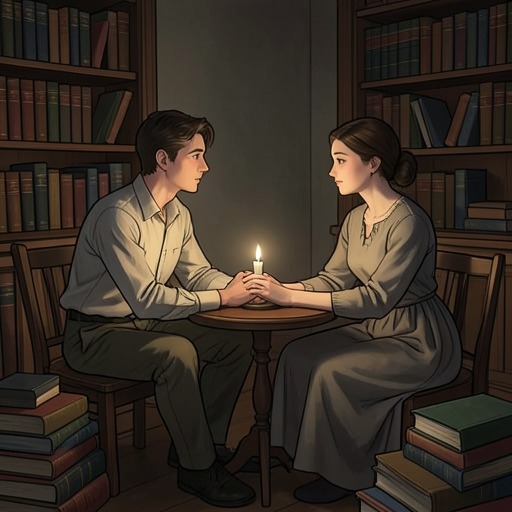
“What might have been”
David Copperfield“What might have been” is the counterfactual life David Copperfield imagines with Agnes Wickfield: a future that never came to pass, yet shapes his conduct as powerfully as an actual experience. It is not simply a wish to undo the past. David treats the lost possibility as a claim on his conscience, turning regret into a reason not to disturb Agnes’s life or presume upon her affection. The idea gives retrospective memory practical force: what did not happen becomes part of what he must now live with.
A possibility made real by memory
After returning to England from three years abroad, David understands his feelings for Agnes through the choices that preceded them. He recalls that he had once regarded her as far removed from his youthful romantic fancies and had given his passionate tenderness to someone else. If Agnes had loved him differently in the past, he believes, he had cast that love away; if she had not, he cannot assume that she would love him now. Either way, the imagined alternative cannot be separated from his own decisions.
David’s reasoning moves between two possible histories without settling the uncertainty of Agnes’s earlier feelings. He allows that she may once have loved him, but does not turn that possibility into a claim. Instead, the thought makes him more conscious of what she has given up in order to remain his friend and sister, and of the victory represented by her constancy. The counterfactual is emotionally vivid but ethically limited: it can deepen his understanding of their bond, not authorize him to rewrite it in his favor.
The narrator gives this unrealized life the weight of duration. The years that might have tested David and Agnes’s relationship are not actual shared years, but they acquire consequences in his reflection. He considers Dora’s own imagining of what their married life might have been, and recognizes that an unfulfilled possibility can be real in its effects. The novel thus distinguishes between an event and its afterlife in memory: the former may never have occurred, while the latter can still correct and change the person who remembers it.
Choice, loss, and restraint
David’s first hope is that he might, after a period of personal change, cancel the mistaken past and eventually marry Agnes. But he describes that prospect as shadowy, and it fades as time passes. His judgment is not that a different future was impossible in every sense; rather, the moment when he might have chosen differently has gone. He feels that he has worked out his own destiny and won what he had impetuously set his heart on, so he has no right to complain of the consequences.
That conclusion makes his love for Agnes inseparable from self-restraint. David admits to himself that he loves her and is devoted to her, yet regards it as wrong to turn to her in the withering of his hopes after having frivolously turned away when those hopes were fresh. He experiences this refusal as painful and remorseful, but also as required by right and honor. The old alternative therefore governs a present decision: he will not convert Agnes’s loyalty into consolation for his own bereavement or disappointment.
His account remains uneasy rather than triumphant. David measures his earlier weakness against Agnes’s constancy and fortitude, and believes that he has deserved to lose the future he imagines. The counterfactual offers no clean escape into a better version of events. It intensifies his awareness that choices have lasting consequences, including consequences that cannot be repaired by later recognition. His responsibility is to acknowledge the lost possibility without treating belated love as a right to possess it.
Dora as a measure of the unrealized life
Dora Spenlow enters the idea not merely as the woman David married, but as the person whose imagined version of their unrealized years helps him understand his own. David recalls her imagining what might have happened during the years that were not destined to test their marriage. After Dora’s death, those absent years become part of his effort to make sense of what he experienced and what he lacked. He thinks he had wished for his wife to be what Agnes was, an insight that connects his marriage to the alternative he had not chosen.
The contrast does not erase David’s love for Dora or turn their marriage into a simple mistake. Instead, Dora’s imagined future makes visible the gap between a lived relationship and an ideal one formed through comparison. David’s reflection is corrective because it forces him to see that an alternative can influence judgment without becoming an actual life. The years he imagines with Agnes are not evidence that such a marriage would have succeeded; they are a measure through which he examines his own desires, errors, and expectations.
The contrast also clarifies the difference between passionate choice and sustained compatibility as David understands it in retrospect. He had once allowed his romantic attention to settle elsewhere, while Agnes remained a trusted presence who knew his errant heart. Later, the very knowledge and intimacy that make her precious to him also make a sudden declaration ethically fraught. His memory of the unchosen life deepens affection, but it also places limits on what he can ask of Agnes.
Return and the life that remains
When David comes home, his inner argument continues through ordinary encounters. Agnes’s work at her school is laborious, though she describes the labor as so pleasant that it is scarcely grateful to call it by that name. David praises her goodness, while privately trying to discipline his heart and do his duty toward her. Her composure and established work belong to her present life; his imagined future cannot be allowed to eclipse them.
At Christmas, more than two months after his return, David sees Agnes frequently, often riding to spend an evening with her and returning at night. Her praise matters to him above the general encouragement he receives, but leaving her revives the old unhappiness. During those rides he revisits the thoughts formed in his long absence. He understands them as echoes from a distance: he has accepted his place, even while continuing to feel what another course of life might have meant.
David and Betsey Trotwood share an unspoken understanding about the subject. They often fall into the same train of thought by the fire, but preserve their silence; David believes that Betsey partly understands why he does not express his feelings more distinctly. Her earlier warning draws on her own regret about people now dead with whom she might have been on kinder terms, and on her bitter experience of marriage. She also fears that interference could divide her from David or make their cherished Little Blossom unhappy. Her history reinforces the novel’s concern with possibilities that cannot be recovered, while her restraint parallels David’s decision not to force an outcome.
The concept finally settles not in a recovered romance but in a changed way of remembering. David does not deny that he loves Agnes; he hopes only that, in some distant time, he might avow that love without blame. Until then, their long-standing relationship must remain undisturbed. “What might have been” is therefore both an elegy for a life not lived and an ethic for the life that remains: memory makes the lost possibility consequential, while honor requires David to accept that it is past.