Clara Copperfield
David CopperfieldClara Copperfield is David Copperfield’s mother, a tender and affectionate woman whose life narrows under the domestic authority of Mr. Murdstone and Miss Murdstone. Her story joins private grief to the novel’s account of childhood: David first remembers her as a loving, youthful presence, but later learns how her confidence and health deteriorated before she died soon after giving birth. The distance between those images is central to the way her life survives in his memory.
Identity and Background
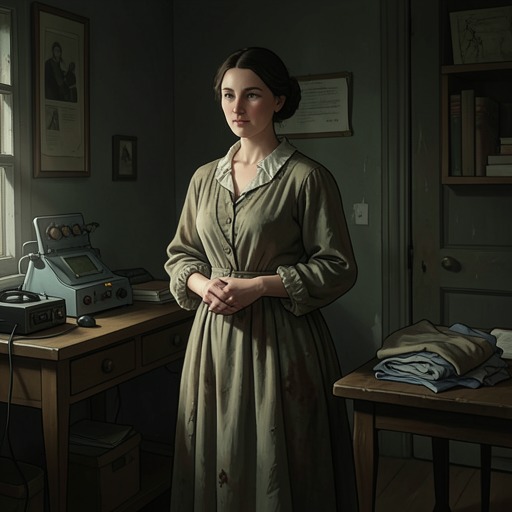
Clara Copperfield is a young widow when the narrative introduces her, and David’s father has been dead since six months before David’s birth. Her late husband was twice her age, had a delicate constitution, and died a year after marrying her. Betsey Trotwood had once been his favorite, but took offense at the marriage because she considered Clara too young and dismissed her as a wax doll, though she had never met her. When Betsey visits the house on the Friday afternoon before David’s birth, she addresses Clara as Mrs. David Copperfield, a formal recognition of her married identity at a moment when Clara is frightened about the approaching birth and doubtful she will survive it.
Clara’s youth and gentleness are not merely Betsey’s distant impression. David’s later recollections show a woman who loves readily, hopes for kindness, and is susceptible to the judgments of those who claim authority over her. After marrying Mr. Murdstone, she is increasingly described as delicate, anxious, and uncertain of her own feelings. That vulnerability exists alongside attachment and maternal warmth; it should not be mistaken for an absence of feeling or will.
Marriage and Household Authority
Mr. Murdstone’s authority enters Clara’s household through both intimate gestures and practical control. When David returns home from school, Clara rises hurriedly but timidly. She kisses him, yet soon resumes her work while Mr. Murdstone observes mother and son. The scene makes the strain of the household visible in David’s inability to look at either of them and his turn toward the cold view outside. Later, Mr. Murdstone sends Clara downstairs and tells Clara Peggotty that Clara has taken his name, insisting that the old servant remember it. The declaration recasts a long-standing household bond as subordinate to the new husband’s claim.
Miss Murdstone makes that claim material. On the morning after arriving, she offers to relieve Clara of household duties on the grounds that Clara is too pretty and thoughtless for them, then takes her keys. She keeps them in her own custody by day and under her pillow at night, leaving Clara with no authority over the domestic arrangements. Clara does not surrender this authority without protest: after Miss Murdstone presents household plans to her brother and receives his approval, Clara cries that she should have been consulted. Mr. Murdstone answers sternly, and Clara points out that his insistence on firmness would not be welcome if imposed on him. Her challenge is brief, but it identifies the unequal rule of the house.
David’s retrospective account describes firmness as the governing doctrine of the Murdstones: Mr. Murdstone reserves the right to impose his will, while Clara is expected to endure it and believe that no other authority exists. In private, Clara repeats the logic that weakens her resistance. She tells Clara Peggotty that Mr. Murdstone’s sternness serves another person’s good, calls herself weak and girlish, and says she should be thankful and submissive even in thought. When she worries that she has judged him unfairly, she doubts her own heart. Her affectionate nature is thus turned into a means of self-reproach: she treats submission as proof of goodness and her misgivings as evidence against herself.
Motherhood and Declining Health
Clara’s relationship with David is marked by genuine tenderness, though the household’s surveillance makes affection difficult to express freely. During one return home, David finds her singing softly beside the fire while nursing an infant. He believes she is alone; when he speaks, she starts, then calls him her dear boy, kneels to kiss him, and lays his head against her bosom beside the baby. The welcome briefly joins his childhood memory of her warmth to the younger child’s immediate care. David later gives this encounter an anguished importance, wishing he could have died while the feeling of that reunion was still intact.
By then, however, Clara has changed. David notices that her once-pretty face looks careworn and too delicate, and that her thin, white hand seems almost transparent. Her manner has become anxious and fluttered. When she asks Clara Peggotty whether she intends to marry, the question reveals Clara’s own preoccupation with marriage and its consequences, as well as her dependence on her longtime servant for emotional reassurance. The later narration makes clear that Clara had not been well for a long time: she was troubled and unhappy, and after the baby’s birth she became more delicate and declined day by day. She had once sat alone and cried; after the birth, she sang to the baby so softly that Clara Peggotty remembered the sound as a voice rising away.
Clara also grows more timid. According to Clara Peggotty, a harsh word came to affect her like a blow, although Clara remained loving toward her old servant. When Mrs. Creakle tells David at school that his mother is very ill, the news reaches him first as a mist between him and the speaker; the tears that follow register the force of his fear before he can answer. The illness is dangerous, and the child is away from home as his mother’s life approaches its end.
Death and David’s Memory
Clara Peggotty recounts Clara’s last hours to David beside his bed. Late at night Clara asks for a drink and gives her attendant a patient, beautiful smile. At daybreak, as the sun rises, she speaks fondly of her first husband, remembering him as kind and considerate, and recalls his reassurance when she doubted herself: that a loving heart was better and stronger than wisdom. Weak and frightened by how far away Clara Peggotty’s face seems, Clara asks to be turned toward her and to have her arm beneath her neck. She dies with her head resting on that arm, in Clara Peggotty’s account like a child falling asleep.
David’s response to the story is not to remember his mother more fully in all her changing circumstances. Instead, the image of the anxious, declining woman disappears from his mind, and he remembers her as the young mother of his earliest impressions: bright curls wound around her finger, dancing with him at twilight in the parlor. Clara Peggotty’s account of the death strengthens this earlier image rather than replacing it. David’s narration makes memory an act of preservation, but also of selection: the mother in the grave becomes the mother of his infancy, and the baby in her arms becomes the infant David, held there forever in recollection.
Aftermath and Narrative Significance
Clara’s death shapes the way other characters explain David’s childhood. When Betsey Trotwood hears what happened after Clara’s remarriage, she cannot understand why Clara married again and condemns the decision as disastrous. She sees Clara as an unhappy, unworldly child who trusted her second husband, and later tells Mr. Murdstone that he was a tyrant who broke Clara’s heart. Her judgment expresses a protective attachment to David and anger at the Murdstones, but it is also a retrospective interpretation, not a neutral account of Clara’s inner life. Mr. Murdstone, by contrast, insists that his late wife loved and trusted him implicitly. The clash over Clara’s history exposes how little power she has, after death, to define the meaning of her own marriage.
David himself defends the people who cared for his mother. When Betsey disparages Clara Peggotty’s marriage, he breaks down while recalling her fidelity to Clara and the support she gave at Clara’s death. He explains that Clara Peggotty’s home could have been his refuge, but that her humble station made him fear bringing trouble upon her. His testimony links his mother’s loss to the precariousness of the care network around him: affection is present, but a child’s access to safety is constrained by household power and social position.
The abandoned family home extends that loss beyond the funeral. In a letter, Clara Peggotty tells David that the furniture has been sold, the Murdstones have gone, and the house is closed, to be let or sold. David imagines weeds overtaking the garden, leaves lying on the paths, weather beating against the windows, and the empty rooms becoming a place of solitude. The house seems dead to him, as if everything connected with his parents has faded away. Clara’s significance in the narrative therefore rests not only on her tenderness or her suffering, but on the way her absence reorganizes David’s sense of childhood, home, and the people who once made him feel loved.