Clara Peggotty
David CopperfieldClara Peggotty, known in the household as Peggotty, is David Copperfield’s nurse, confidante, and one of the steadiest attachments of his childhood and adult life. Her importance is shown not through status or authority but through sustained acts of care: comforting David and Clara Copperfield, remaining with Clara Copperfield through her final hours, helping David when he is on his own, and preserving a home to which he can always return. After Clara Copperfield’s death, the narrative repeatedly measures loss against the safety and constancy Peggotty provides.
Identity and Caregiving Bond
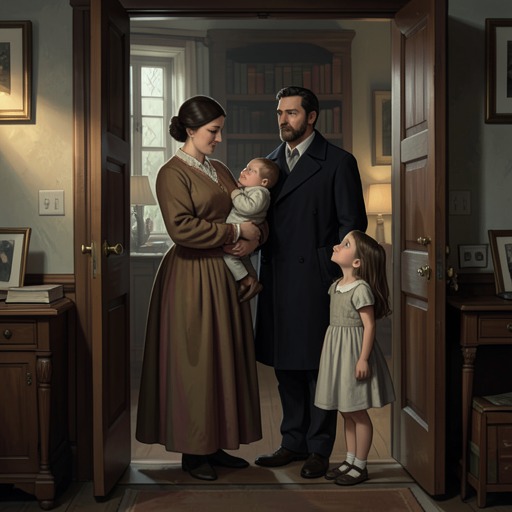
Peggotty is a servant in the Copperfield household and the person David turns to for comfort and affection. Her closeness to him is evident in a family scene in which Clara Copperfield holds David, calls him her child, and kisses him while Peggotty rushes in and joins them. Peggotty’s relationship with the boy is not merely a matter of household duty: he later describes her as his faithful friend, and he regards her home as a possible refuge when he has nowhere else to turn.
Her care extends to Clara Copperfield as well. Clara Copperfield asks Peggotty not to leave her, fearing what she would do without her. Peggotty says she remains by her afterward. Although Clara Copperfield continues to love the people around her, when they leave her bedside she turns to Peggotty for comfort and falls asleep only in her presence. In this account, Peggotty is the reliable companion at the bedside, offering a closeness that the failing household cannot replace.
Clara Copperfield’s Death and Its Memory
Peggotty recounts Clara Copperfield’s last morning as day breaks. Clara Copperfield recalls the kindness of her late husband and the reassurance he had given her, then asks Peggotty to move her nearer and support her head with her arm. Peggotty does as asked; Clara Copperfield dies resting against her. The scene makes the bond between the two women central to Clara Copperfield’s final moments, and Peggotty’s narrative becomes the means by which David learns how his mother spent them.
After hearing Peggotty’s account, David describes a striking change in his own memory. The image of his mother in her later years recedes, and the younger mother of his earliest recollections becomes fixed in his mind: the woman whose bright curls he remembers and who danced with him at twilight. Peggotty’s testimony does not restore the later period to him; instead, it strengthens his earlier, happier image. Her role therefore reaches beyond nursing and comfort. By telling David what happened, she helps shape the memory through which he continues to hold his mother.
The household’s response to Clara Copperfield’s death soon makes Peggotty’s own position precarious. Once the funeral solemnity has passed, Miss Murdstone gives her a month’s notice. Peggotty tells David that they must part and explains why; the two grieve together. David later insists that she had loved both him and his mother, had held his mother’s head as she died, and had received her last grateful kiss. His distress at hearing Betsey Trotwood speak harshly of Peggotty shows that he understands the dismissal not as a measure of her loyalty but as a rupture imposed on a bond he still depends on.
Marriage and a Home Kept Open
After leaving the Copperfield household, Peggotty considers working in her own home rather than serving a stranger. She values the independence of that arrangement and the chance to remain near Clara Copperfield’s resting place. She eventually marries Mr. Barkis in a deliberately quiet ceremony: the clerk gives her away, and there are no witnesses. When Mr. Barkis announces the marriage, Peggotty is briefly confused, but she soon recovers and says she is glad the ceremony is over.
Marriage does not close her household to David. Peggotty promises that while she is alive and has a roof over her head, he will find the home ready for him, as though his arrival were expected at any moment. She says she will keep his old little room for him even if he goes as far away as China. The promise turns a remembered childhood bedroom into a lasting sign of welcome: distance and absence may interrupt their daily life, but they will not cancel his place in her home.
Peggotty’s affection also persists in her relations with Betsey Trotwood. When Betsey disparages Peggotty for marrying, David defends her as faithful, devoted, and self-denying, recalling both her care for Clara Copperfield and her willingness to shelter him. Betsey later objects to the name Peggotty after the marriage and asks to use a form that recognizes the change. These moments show how Peggotty’s marriage alters her household identity without diminishing her importance in David’s emotional life.
Help Through David’s Separation and Hardship
When David is sent to work at the warehouse, he is living in straitened circumstances and later recalls having no advice, encouragement, or support during the week. His connection with Peggotty nevertheless remains active through letters. When he decides to seek Betsey Trotwood, he writes to Peggotty indirectly, pretending he is asking about a woman at a place he names at random. He also asks to borrow half a guinea, without revealing why he needs it. Peggotty sends the money and tells him that Betsey Trotwood lives near Dover, though she cannot say exactly where. Her response supplies both practical assistance and the information David needs to begin his journey.
After David reaches safety and Betsey Trotwood formally takes him under her protection, he writes to Peggotty again with the full account. Once he is settled at Doctor Strong’s school, he sends her another letter describing his improved circumstances and prospects. He repays the half-guinea by enclosing a gold half-guinea, and only then explains that he had used the loan during his flight. Repayment matters to him as more than a financial formality: he says that sending the money gives him a pleasure he could not have found in spending it on himself.
Peggotty’s answer is prompt, though her written expression is halting. David describes pages of unfinished sentences and blots, which tell him that she has been crying over his account. Her letters also carry news of the household. She reports that Mr. Barkis is an excellent, if somewhat close-fisted, husband; that he sends his respects; and that David’s little bedroom remains ready. She also reports on Daniel Peggotty, Ham Peggotty, Mrs. Gummidge, and Emily Peggotty, keeping David connected to the people and home he left behind.
Mr. Barkis’s Illness, Will, and Peggotty’s Lasting Place
Peggotty cares for Mr. Barkis during his final illness. When David visits, Mr. Barkis says he has money somewhere about him but is tired and will look for it after a nap. Later, Peggotty thanks David for being a comfort to her in her distress and explains that Mr. Barkis had liked and admired him, often speaking of him before falling into a stupor. David stays at her request until the carrier’s remains are taken to Blunderstone village for burial.
Peggotty has prepared for that burial from her own savings. She bought a small piece of ground in the old churchyard near the grave of Clara Copperfield, whom she calls her sweet girl, so that the resting place would be close to the woman she had served and loved. Mr. Barkis’s will also recognizes Peggotty’s place in the wider family circle. His property amounts to nearly three thousand pounds. He leaves the interest on one thousand pounds to Daniel Peggotty for life, with the principal afterward divided equally among Peggotty, Emily Peggotty, and David, or whichever of them survive; the rest goes to Peggotty, who is named residuary legatee and sole executrix.
Across these episodes, Peggotty’s constancy takes practical as well as emotional forms: she nurses, shelters, writes, lends, receives repayment, mourns, and manages the consequences of her husband’s death. The narrative’s later recollections preserve her as a point of continuity between David’s childhood home and the uncertain places he enters afterward. Even when separation and bereavement change the household, her welcome remains one of the clearest assurances that he still belongs somewhere.