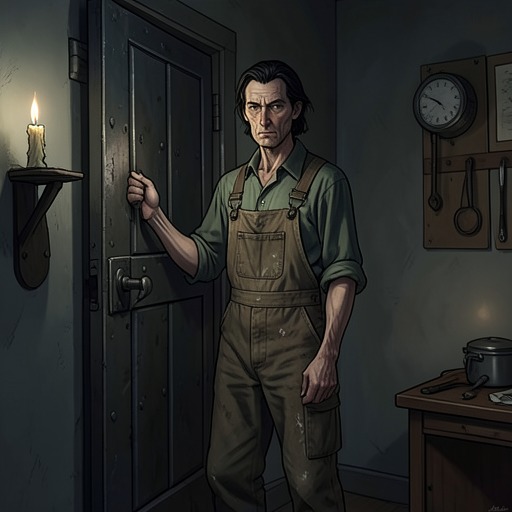
Doctor Strong
David CopperfieldDoctor Strong is the headmaster of the Canterbury school that gives David Copperfield an education founded on trust rather than fear. Learned, absent-minded, and notably generous, he stands in sharp contrast to the harsh authority David has encountered at home and at Salem House. The school’s humane ethos is not incidental to his character: it reflects his confidence that boys can be treated as honorable participants in their own community.
Identity and Arrival
David first meets Doctor Strong after entering school again under the care of Mr. Wickfield. The school occupies a grave-looking building in a courtyard, an appropriately scholarly setting in David’s eyes, with rooks and jackdaws straying down from the Cathedral towers. Doctor Strong himself seems as rusty as the iron railings and gates, and as stiff as the stone urns set along the wall. His clothes are poorly brushed, his hair uncombed, his knee-breeches unfastened, and his long gaiters undone; his shoes gape on the hearth rug. When he turns to greet David, his dull eye and heavy manner make him seem slow to register the moment. His offered hand does nothing to guide the boy, who is left unsure what to do with it.
The scene immediately complicates that ungainly first impression. While Doctor Strong remains in his library, Annie Strong cheerfully kneels to put on his shoes and fasten his gaiters. David initially takes her for the Doctor’s daughter; Mr. Wickfield’s greeting reveals that she is Mrs. Strong. Doctor Strong’s own passing question about finding suitable provision for his wife’s cousin indicates that he is attentive to the practical needs of his household, even as his distracted manner makes him appear remote from ordinary details.
A School Built on Trust
The schoolroom is a quiet hall facing an old secluded garden, where peaches ripen against a sunny wall. Two aloes stand outside the windows, their broad, hard leaves becoming for the older David an image of silence and retirement. About twenty-five boys are at their books when Doctor Strong brings David in and presents him to the school as a new pupil. The setting and the orderly welcome mark a decisive change from the loneliness and neglect associated with David’s earlier schooling.
David judges Doctor Strong’s school to be the opposite of Mr. Creakle’s Salem House. It is gravely and decorously run, but its order is not imposed through intimidation. The school appeals to the boys’ honor and good faith, trusting those qualities unless a pupil gives reason to withdraw that trust. The boys consequently feel that they share responsibility for the school’s management and reputation. They become attached to it and study with a desire to do it credit; outside lessons they have substantial freedom and play vigorous games. Their conduct also sustains the school’s standing in town: they are generally spoken of well and rarely bring discredit upon it.
Doctor Strong’s educational authority therefore works through confidence and belonging. David’s earlier home lessons under Mr. Murdstone and Miss Murdstone had turned learning into long, bewildering daily misery, while Salem House is associated with punishment. Against both experiences, the Canterbury school offers a system in which a pupil is treated as capable of moral responsibility. David’s account stresses not just that the institution is more pleasant, but that its reliance on the boys’ own integrity helps produce their willing attachment and effort.
Scholarship and Generosity
Doctor Strong’s defining scholarly project is a dictionary. He is often occupied with Greek roots, though David, misunderstanding the phrase in his innocence, supposes that the Doctor has a botanical fascination with roots. The boys explain that he is tracing the roots of words for a dictionary he intends to compile. The work is so vast, and Doctor Strong’s pace so measured, that Adams, the head boy, calculates it would take 1,649 years from the Doctor’s sixty-second birthday to finish according to his plan. The calculation gently renders the scale of the project comic without making the Doctor’s learning or purpose contemptible: his scholarship belongs to a patient, inward world largely untouched by practical calculation.
The boys’ affection for Doctor Strong rests even more on his kindness. In the courtyard, he is vulnerable to anyone able to catch his attention with a tale of distress. A beggar who succeeds may receive enough help to live for the next two days, and the masters and senior boys sometimes try to keep such petitioners from reaching him. A story circulating among the pupils claims that, on a frosty day, he gave his gaiters to a beggar woman, who later used them to wrap an infant. The narrator admits that he never knew the story’s authority, but says he has believed it for so many years that it feels certain. In the anecdote, Doctor Strong’s generosity is so habitual that he apparently fails to recognize his own distinctive garments when they reappear for sale.
Marriage and Narrative Significance
The pupils also learn, secondhand, that Doctor Strong has been married for less than a year to the young woman David sees in the library. They say that he married Annie Strong for love despite her having no money and a large number of poor relations who might burden the household. This information is explicitly presented as school talk, rather than as David’s firsthand knowledge of their private life. It nevertheless accords with the kindness and unguarded generosity already associated with Doctor Strong: he is represented as a man whose commitments are not governed by worldly advantage.
As David remembers him, Doctor Strong’s character is defined by a productive contrast between scholarly absorption and moral responsiveness. He can move slowly through a dictionary project on a scale that invites the boys’ jokes, and appear so absent-minded that others must attend to the fastening of his clothes. Yet the same apparent unworldliness leaves him open to appeals from the needy, while his school entrusts its order to the honor and good faith of its pupils. His importance in David’s story lies in this alternative model of authority: unlike discipline imposed through fear, Doctor Strong’s leadership creates a community whose members are expected to sustain its dignity themselves.