Doctors’ Commons appellate procedure
David CopperfieldDoctors’ Commons appellate procedure is presented as a sequence of ecclesiastical hearings and appeals whose formal stages offer the appearance of review while remaining inside a tightly connected legal establishment. Through David Copperfield’s introduction to the institution and Mr. Spenlow’s explanation of its workings, the procedure becomes both a practical framework for disputes over marriage and wills and a target of satire about professional privilege and institutional self-interest.
Jurisdiction and Setting
Mr. Spenlow describes Doctors’ Commons as a specialist forum administering ecclesiastical law, with business concerning wills and marriages alongside disputes involving ships and boats. Its work takes place in a secluded complex reached through a low archway, where the noise of the city recedes before the visitor arrives at the offices of Spenlow and Jorkins. Inside, clerks copy documents and the chambers contain bundles marked for different courts, including the Consistory Court, the Court of Arches, and the Admiralty Court. The accumulation of case papers and affidavits makes the institution’s legal business tangible: procedure depends on records, arguments, and documentary evidence as well as the formal authority of judges.
David first encounters this world while considering a career as a proctor. Mr. Spenlow presents the profession as genteel, exclusive, and distinct from that of a solicitor, although proctors chiefly serve solicitors. The setting thus introduces appellate procedure not as an abstract diagram but as part of a professional culture that controls access to ecclesiastical litigation and profits from it.
The Route Through the Courts
In Mr. Spenlow’s account, a divorce or restitution case begins in the Consistory Court. A dissatisfied party may then take the matter to the Court of Arches, followed by the Ecclesiastical Delegates. The description makes each stage sound like another turn of a compact institutional game: the case is heard again within the same professional circle rather than passed into an entirely separate system.
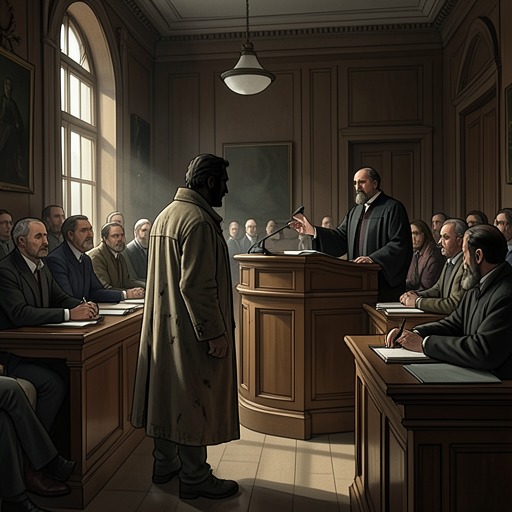
The Court of Arches is, as Mr. Spenlow describes it, the same courtroom, with the same bar and practitioners, but a different judge. A further reversal follows at the level of the Delegates. Those who watched proceedings in the earlier courts and had discussed them with the participants become judges at the final ecclesiastical stage. The structure therefore permits a change of judicial personnel without a corresponding change in the close-knit community conducting the business. Mr. Spenlow emphasizes the system’s compactness, but that very compactness makes the separation between advocate, observer, and adjudicator appear unstable.
A disputed will supplies a related example of appeal. Mr. Spenlow presents a case involving an estate of thirty or forty thousand pounds as especially lucrative: argument and evidence could accumulate through the proceedings, with an appeal first to the Delegates and then to the Lords. That example highlights the financial stakes and the possibility of extended litigation. It should be distinguished from his account of the divorce route, which names the Consistory Court, the Court of Arches, and the Ecclesiastical Delegates.
Practice, Paperwork, and Institutional Critique
The procedure is embedded in a business whose costs and incentives are visible. Mr. Spenlow tells David that disputed cases generate repeated arguments and extensive evidence, while costs may ultimately be paid out of an estate. In another professional exchange, he regrets a client’s bill but attributes his inability to reduce it to his partner, Mr. Jorkins. The episode reinforces the gap between the genial practitioner’s presentation of himself and the fee-collecting machinery of the office.
David’s account also places legal formalities beside questions of fairness. He objects to the unsafe, overcrowded Prerogative Office, where original wills were stored in a building not designed for the purpose and public records were handled within a system he considers badly managed. A separate marriage case turns on a man having taken out a licence under the name Thomas alone, then later claiming that the omission of Benjamin meant he had never been married; the Court accepts the claim. These matters do not add another stage to the appellate route, but they show how consequential institutional decisions can rest on paperwork, jurisdiction, and procedural interpretation.
Narrative Significance
The account is filtered through David’s apprenticeship and Mr. Spenlow’s confident advocacy for his profession. Mr. Spenlow presents the system’s organization as a virtue and invokes its apparent importance to the country, while David registers doubts about whether its arrangements deserve such deference. The contrast makes the procedure’s central irony legible: repeated hearings promise reconsideration, yet the same room, practitioners, and professional relationships recur. The appellate route is therefore both a description of how cases are said to proceed and a means of exposing how formal review can remain enclosed within the institution whose practices are under question.