Dora Spenlow
David CopperfieldDora Spenlow is Mr. Spenlow’s daughter and David Copperfield’s beloved, whose marriage is remembered through a tension between genuine tenderness and the childlike ideal David makes of her. First encountered as an enchanting young woman, she later acknowledges that she was too young for marriage and that, with more years, the pair might have disappointed one another. Her story therefore gives David’s romantic devotion an intimate, bittersweet limit: affection endures, but it cannot by itself supply the maturity their marriage lacked.
Identity and Introduction
Dora enters David’s account through Mr. Spenlow’s introduction of her as his daughter, alongside her confidential friend. David does not pause to weigh the social setting or consider what he might say; he describes himself as instantly captivated. The speed of that response establishes an important distinction between Dora as a person and Dora as she first exists in his imagination: his account gives far more space to the force of his enchantment than to any independent portrait of her thoughts.
His first recollection of her is arranged around appearance and charm. Sitting by his fire afterward, David cannot bring himself to dress or take action; instead, he bites the key of his carpetbag and dwells on Dora’s bright eyes, face, figure, and changing manner. The small, inert scene records the scale of his infatuation, but also its inwardness: at this stage, love means looking, remembering, and elaborating an image.
David’s hopes are correspondingly modest in practical terms, though absolute in feeling. In the garden, he imagines that being allowed to call her by her first name, write to her, and believe that she thinks of him would amount to the summit of his ambition. He recalls that he gave little thought to marriage or fortune, and describes his younger self as foolishly sentimental while still retaining respect for the sincerity of that feeling. Dora is thus introduced through a double perspective: the young man’s worship and the older narrator’s amused, qualified recollection.
Courtship and Engagement
A later visit to Dora’s garden brings David face to face with her beneath a lilac tree. He remembers pretending not to see her, then pretending to search for the house before dismounting and crossing the lawn. Dora is seated with Julia Mills, whom David regards as comparatively grown-up; Jip is also present. The scene’s self-conscious approach contrasts with the suddenness of David’s declaration: he intercepts Jip, takes Dora in his arms, and tells her of his love. Jip’s barking accompanies the confession, while David’s account conveys the intensity of the moment without presenting the courtship as a considered negotiation.
The declaration becomes an engagement. Soon afterward, Dora and David sit together on a sofa, with Jip lying in her lap, and David describes himself as being in rapture. The domestic ease of this image gives the engagement a gentler register than the earlier outburst: Dora is not only the object of a grand confession but a companion sharing a quiet moment with him and her dog.
The distinction between romance and material circumstance becomes sharper after David loses his money. On arriving at Dora’s home, he asks whether she could love a beggar, a question that brings distress into what had been a happy visit. He tells her that he feels it right to offer release from their engagement because he is poor, while insisting that he would face poverty if she would face it with him. He has begun to work and looks toward the future; the contrast between a crust earned through labor and an inherited feast marks a change in his own outlook. Dora’s response is conveyed through his account of the scene: he remembers her horrified expression softening as he pleads and explains his offer. His recollection also dwells on the picture he carried afterward of her crying through the night, frightened and alone, and trying to obtain forgiveness with kisses, workboxes, and trinkets. The passage registers David’s anguish at the distress he believes his situation has caused her, rather than giving an independent account of her night.
Marriage and Domestic Life
Dora’s place in the household becomes a source of unease for David. He observes that the people around her regard her as a pretty toy or plaything. Betsey Trotwood calls her Little Blossom, while Miss Lavinia Spenlow and Miss Clarissa Spenlow attend to her, curl her hair, make ornaments, and treat her like a pet child. David finds it odd that Dora is treated much as she treats Jip. The comparison makes visible the affection in this domestic arrangement, but also its infantilizing quality: Dora is cherished and waited upon, yet the care described centers on adornment and pet-like attention rather than adult responsibility.
The imagery persists in David’s later memories of her as his child-wife and Little Blossom. It is not merely a nickname. It gathers the household’s habits of treating her as childlike and David’s own tendency to cherish an ideal of her rather than imagine a fully independent partner. His narrative does not turn that recognition into a rejection of Dora; it records tenderness alongside an awareness that their domestic life did not answer the expectations of mature companionship.
Later Years and Retrospective Meaning
As Dora’s condition worsens, David carries her up and down the stairs. The changed circumstance appears within a moment when Betsey Trotwood is reluctant to leave her, underscoring the attention Dora receives from those close to her. David’s recollection later places her among the figures of memory as quiet and still, asking him to stop and look once more at Little Blossom as it flutters to the ground. The image makes loss present through the language of remembrance rather than through a detached account of events.
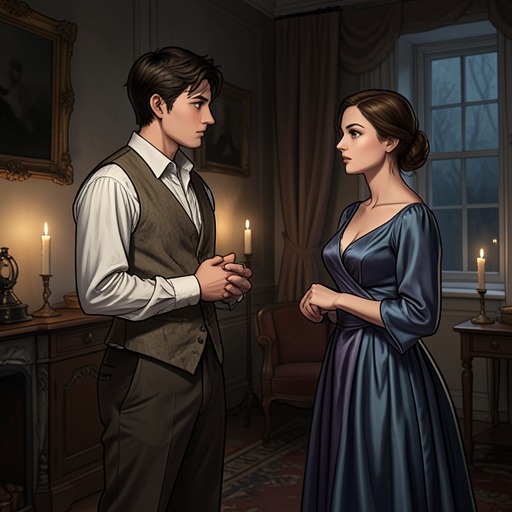
In a late conversation, Dora asks to see Agnes Wickfield, explaining that she wants to see her after hearing that Mr. Wickfield is unwell. Dora then turns to the meaning of her marriage and says she fears she was too young. She believes that David could not have loved her better with more years, but also that she might have tried and disappointed him; for her, the marriage is better as it was. This is a strikingly clear judgment from a character whom others have treated as a pet child. Dora voices both her affection for David and her recognition of the mismatch between their youth and the demands of married life.
Narrative Role
Dora’s story is shaped by the difference between David’s early idealization and his later capacity to remember its limits. At first, her beauty and charm overwhelm his judgment; courtship is narrated as rapture, and the possibility of a shared life is imagined in terms of access, letters, and devotion. Their engagement later brings money and work into view, while domestic life exposes how Dora is regarded by the people around her. Her own final reflection brings these strands together: love is real, but it does not erase her youth or guarantee that a longer marriage would have made them more compatible.
The retrospective account consequently neither dismisses David’s youthful passion nor treats it as a complete understanding of Dora. He preserves the comedy of his own awkwardness, the tenderness of their companionship, his distress at her unhappiness, and the image of her as Little Blossom. Dora’s words complicate that image from within. She is remembered as childlike, but she also interprets the emotional terms of the marriage and reaches her own conclusion about what its duration meant. Her significance lies in that double portrait: she is the cherished figure of David’s romantic memory and, in the final account, a person capable of naming the limits that his earlier ideal could not see.