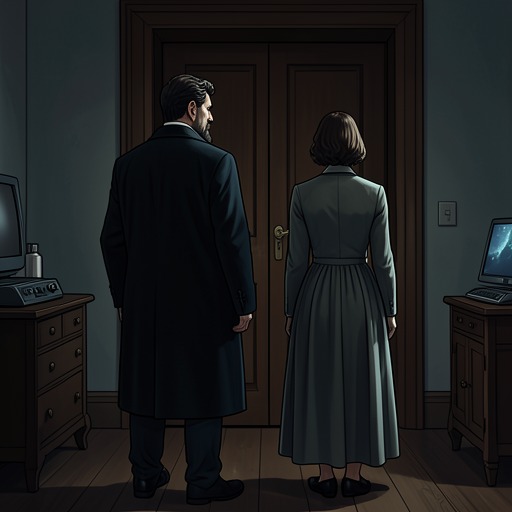
Edward Murdstone
David CopperfieldEdward Murdstone is David Copperfield’s stepfather and the principal force behind the harsh discipline that shapes David’s childhood. He presents control as care and severity as correction: in practice, he takes command of the household, weakens Clara Copperfield’s authority, and sends her son away from home. David’s retrospective account makes the gap between Murdstone’s language of firmness and its damaging effects central to his character.
Identity and Household Authority
Murdstone first appears in David’s childhood as an adult who can seem sociable and reassuring. One autumn morning he rides past the front garden, greets Clara Copperfield, and offers to take David on horseback on his way to Lowestoft. The invitation belongs to the same domestic world in which David comes to know him as his mother’s husband, but it precedes the child’s recognition of the power Murdstone will exercise over him.
That power becomes visible in the parlour, where Clara Copperfield and Murdstone sit on opposite sides of the fire. When David enters, his mother rises hurriedly, though timidly, while Murdstone questions the boy about how he would handle an obstinate horse or dog. The comparison frames discipline as the management of resistance. It also anticipates the unequal terms of the household: Murdstone treats David less as a child to be understood than as a disposition to be corrected.
Murdstone extends his authority beyond David’s treatment to the running of the home. He tells Clara Copperfield that she is too pretty and thoughtless to have duties he can undertake, then asks her to hand over her keys so he can manage household matters. She gives way, but not without protest. When Jane Murdstone lays out domestic plans and her brother approves them, Clara Copperfield cries that she should have been consulted. The episode shows a transfer of practical authority presented as a kindness, while leaving Clara with diminishing say over her own household.
The Doctrine of Firmness
David’s adult narration identifies firmness as the principle on which Murdstone and Jane Murdstone build their authority. In the child’s understanding, the word is another name for tyranny. David describes a system in which Murdstone alone is permitted to be fully firm; others must bend to him. Jane Murdstone may share in firmness through her relationship to her brother, while Clara Copperfield is expected to endure it and accept that no other authority exists. The principle is therefore not a neutral standard of self-control. It legitimizes a hierarchy in which Murdstone’s will sets the measure for everyone else.
The household’s lessons make that hierarchy especially consequential. Although Clara Copperfield nominally presides over David’s education, Murdstone and Jane Murdstone are always present and use the lessons to instruct her in their version of firmness. David remembers that he had learned willingly when he and his mother lived alone together, including learning the alphabet at her knee. Under the new regime, lessons become an occasion for authority to be asserted over both mother and son. David’s memory contrasts the earlier intimacy of learning with the pressure imposed after Murdstone’s arrival.
Murdstone’s treatment of resistance is not limited to instruction. During a confrontation, he holds David’s head and beats him after David pleads with him to stop. David bites Murdstone’s hand. The incident marks a rare physical counteraction by the child against an adult who has him under control; it does not reverse the power imbalance, but it reveals the extremity of the conflict generated by Murdstone’s discipline.
David’s Expulsion from Home
The novel traces Murdstone’s authority from domestic discipline into the institutions to which David is sent. David is sent to Salem House during a holiday, as punishment for his misdoing, and finds the school nearly empty because the other boys are at their homes. The timing makes his isolation plain: what is presented as education is also a penalty that separates him from ordinary family and school life.
After David returns home, he approaches Murdstone and apologizes for what he has done, but Murdstone gives no sign of recognizing him. Later, when David has withdrawn to his room, Murdstone demands that he be present and obedient in the household. He insists that David must conform to his requirements. The exchange sets apology and submission side by side: David seeks forgiveness, while Murdstone makes obedience, rather than reconciliation, the condition of family life.
After Clara Copperfield’s death, Murdstone is shown sitting by the fire, weeping silently and thinking. Jane Murdstone, meanwhile, asks David whether he has been measured for mourning. The scene records Murdstone’s visible grief but does not erase the history of his authority over Clara Copperfield and David. Later, Betsey Trotwood directly accuses him of having tyrannized Clara Copperfield and broken her heart. Her condemnation is her judgment, but it gives explicit voice to the harm David’s account has associated with Murdstone’s rule.
Murdstone then declares that David is to go to London with Mr. Quinion and begin life on his own account. He describes the boy as needing correction and presents work as a means of bending him to the ways of the working world. David’s retrospective account stresses the consequence: at ten years old, he becomes a child laborer in the service of Murdstone and Grinby. He is left to support himself on a small weekly allowance, buying a penny loaf and milk for breakfast and keeping bread and cheese for supper. From Monday morning until Saturday night, he recalls receiving no counsel, encouragement, consolation, or assistance. Murdstone’s language of preparing David for life thus ends in abandonment, not supported independence.
Conflict with Betsey Trotwood and Narrative Significance
When David reaches Betsey Trotwood’s home, his fear of being returned to Murdstone is immediate. Murdstone arrives intending to take him back unconditionally and asserts his right to decide how the boy should be treated. He characterizes David as sullen, rebellious, violent, and intractable, presenting the conflict as a defect in the child rather than a consequence of his own rule. He also warns Betsey Trotwood that intervening would mean taking David’s side permanently. The confrontation makes the stakes clear: Murdstone seeks to recover the authority he has exercised at home, while Betsey Trotwood must decide whether to protect David from it.
Betsey Trotwood refuses to yield to Murdstone’s account of the boy. She challenges his treatment of Clara Copperfield and rejects the idea that David’s welfare can be trusted to the man who, in her judgment, harmed his mother. Her intervention breaks Murdstone’s immediate claim over David and provides the alternative care the boy has lacked.
Murdstone’s narrative function rests on the contrast between the order he claims to impose and the insecurity his actions produce. The recurring doctrine of firmness links household governance, education, punishment, and work: in each setting, Murdstone defines care as submission to his judgment. Because David recounts these events as an adult, the childhood scenes carry both the child’s vulnerability and the narrator’s later recognition of the system behind it. Murdstone is not merely a severe stepfather in this account; he is the figure through whom private domestic authority becomes a route to a child’s isolation and exploitation.