Grief Transformed into Strength and Creative Work
David CopperfieldGrief Transformed into Strength and Creative Work names a turning in David Copperfield’s recovery: bereavement does not simply pass, but is met with Agnes Wickfield’s confidence, renewed contact with the world, and disciplined work. Her letter gives David a way to understand suffering as something that may deepen rather than diminish him. In Switzerland, he tries to live up to that faith, and the effort becomes visible in his health, friendships, and writing.
Agnes’s faith and David’s response
Agnes writes chiefly about David, while saying little of her own life beyond that she is happy, useful, and prospering as she had hoped. Her message is not a list of duties or practical instructions. Instead, she expresses trust in his character and in his capacity to turn affliction to good. She expects trial and emotion to strengthen him, and believes that the grief he has endured can give his purposes a firmer and higher direction.
Her confidence reaches back to David’s childhood. The endurance required in those earlier years, she believes, helped make him what he is; greater calamities may likewise nerve him to become better. She connects this resilience not only to his private character but to what he may offer others: experiences that have taught him may also enable him to teach. Her faith therefore gives his suffering a possible future use without denying its cost.
Agnes commends David to God after the loss of his innocent darling and describes herself as remaining beside him wherever he goes, with sisterly affection. She is proud of what he has already done, but still more proud of what he may yet do. The emphasis falls on both companionship and expectation: David is not asked to recover alone, yet his future remains his work to undertake.
David reads the letter outside the village, after a long interval in which he had written little beyond brief reports that he was well and had reached a particular place. He puts Agnes’s letter in his breast and reflects on how recently his state of mind had been dark. As evening fades and the mountain snow recedes into the pale night sky, he feels that the shadows in his mind are clearing. The scene marks a change in his feeling toward Agnes: his love for her becomes dearer than before, though he does not at this point explain its full history or meaning.
From intention to practice
David reads the letter repeatedly and writes to Agnes before going to sleep. He tells her that he had sorely needed her help, that he had not been what she believed him to be, but that she inspired him to try to become so. Her confidence thus does not function as proof that he is already strong. It gives him a standard and an encouragement that he consciously accepts, while leaving the effort to him.
He does not answer grief with an immediate set of resolutions. With three months remaining before a year has passed since the beginning of his sorrow, David decides to make no resolutions until that interval is over and, in the meantime, simply to try. He stays in the valley and its neighborhood throughout those months. The deliberate pause contrasts with Agnes’s forward-looking belief: recovery begins not as a declaration of mastery, but as sustained effort through a period David allows himself to endure.
After the three months, he chooses to remain away from home longer and settle for the present in Switzerland, which has become dear to him through its association with that evening. He resolves to resume his pen and work. He also seeks out Nature and admits human interest back into his life after having lately shrunk from it. The change is social as well as inward: before leaving the valley for Geneva ahead of winter, and returning in spring, he has made many friends there, nearly as many as in Yarmouth. Their cordial greetings feel homelike to him even though they are not spoken in English.
Work, recovery, and renewed connection
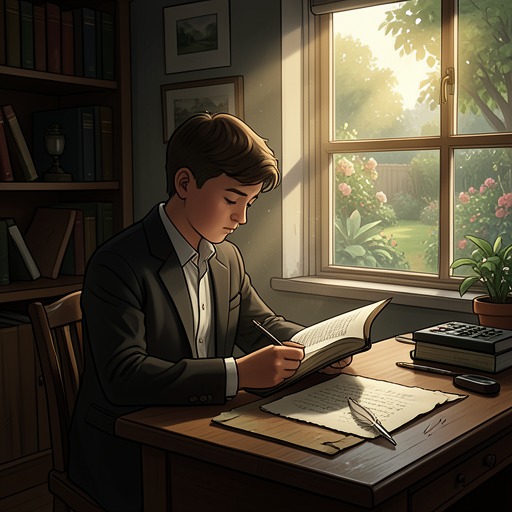
David’s return to writing is described as practical labor rather than a sudden cure. He works early and late, patiently and hard. His first Story grows from a purpose connected with his experience; he sends it to Thomas Traddles, who arranges for its publication on advantageous terms. Reports of David’s growing reputation reach him through travelers he encounters by chance. The sequence connects inward recovery with outward work: the experience that has burdened him becomes material for a purposeful piece of writing, and publication brings signs that the work is finding an audience.
After rest and change, David turns with renewed ardor to a new imaginative undertaking that takes strong hold of him. As he advances, he feels its claims more keenly and summons his utmost energies to execute it well. This is his third work of fiction. It is only half written when, during an interval of rest, he begins to think of returning home. The account distinguishes the completion of neither his grief nor his literary career; instead, renewed creative absorption and the possibility of homecoming emerge together.
His recovery is also physical and intellectual. While studying and working patiently, David has accustomed himself to robust exercise, and the health that was severely impaired when he left England is now restored. He has seen much, traveled in many countries, and hopes that his store of knowledge has grown. These gains widen the account beyond the act of writing: rebuilding involves the body, observation, learning, and renewed capacity for effort as well as artistic production.
Meaning within the retrospective narrative
The episode presents grief as capable of becoming strength, but not through suffering alone. Agnes offers faith in David’s future; David recognizes that he needs her help, answers her, and undertakes the work of trying. His time in Switzerland supplies the conditions in which that effort can take form: a stay in the valley, exercise, contact with Nature, new friendships, and patient labor. The change is therefore relational and active, not an automatic benefit supposedly delivered by pain.
The movement from letter to writing also gives the recovery a narrative shape. Agnes imagines that David’s hardships may teach him to teach others; he subsequently writes a story with a purpose growing from his experience. The account does not claim that the work erases the loss, or that fame is the measure of healing. Rather, it shows grief entering a continuing life of affection, creation, and effort, while the choice to return home remains ahead.