King's Bench Prison
David CopperfieldKing's Bench Prison, in the Borough, is the setting of Mr. Micawber’s arrest and confinement for debt. In David Copperfield’s account, it is not only the destination of a legal process: its rooms and routines briefly become part of the Micawber household, while the prison’s proximity gives David a way to remain close to the family. Its narrative significance lies in that uneasy combination of confinement, improvised domestic life, and companionship amid financial distress.
Debt and Arrival
Mr. Micawber’s creditors have been pressing him for payment, and Mrs. Micawber says they cannot obtain money from him at that moment. When his difficulties reach a crisis, he is arrested early one morning and taken to King's Bench Prison. His dramatic response to the reversal gives way, in David’s later recollection, to the comic report that Micawber was playing skittles before noon. The contrast marks the gap between his declarations of despair and the practical, sociable habits he maintains even in adversity.
David visits on the first Sunday after the arrest. He has been given a sequence of directions to follow, and the approach ends at a turnkey and the prison gate. The encounter frightens him: he remembers a scene from a novel about a debtor’s prison, and the turnkey seems to swim before his dimmed eyes. Once inside, however, Mr. Micawber is waiting for him. The visit turns the institution from an intimidating destination into a place where their friendship can continue, though not without confronting the reality of Micawber’s confinement.
Rooms and Daily Life
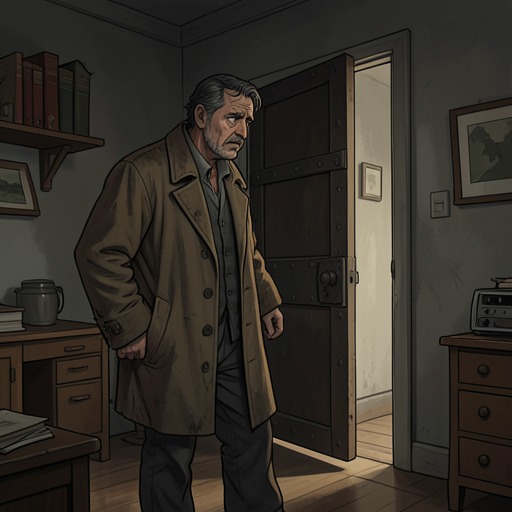
Micawber’s first room is on the floor below the top. He and David sit by a small fire in a rusted grate, with bricks placed at its sides to limit the coal it burns. Their meal comes from a shared supply: another debtor, who shares Micawber’s room, brings a joint portion of mutton from the bakehouse. These details show how meals and accommodation are organized within the limits of imprisonment, without making the prison a purely private misfortune.
The visit also brings David into contact with Captain Hopkins, who occupies the room above. Micawber sends David to borrow a knife and fork; the brief errand gives the child a glimpse of another prisoner’s cramped household, including Hopkins’s daughters and their living arrangements. David returns with the utensils and an impression of the family’s circumstances. The scene extends the prison’s human world beyond Micawber: confinement brings together people whose domestic lives and resources are precarious, while even a borrowed place setting becomes necessary to share a meal.
Family Life at the Prison
Outside the prison, the Micawber household’s furniture is sold, leaving only a bed, a few chairs, and the kitchen table in the emptied parlors of their home in Windsor Terrace. The family lives there together for a time. When Micawber secures a room to himself inside King's Bench Prison, Mrs. Micawber decides to move there with the children. The furniture that remains is transferred to the prison, while David’s bed is not: he rents a small room nearby, and the family’s companion also finds inexpensive lodging in the neighborhood.
The move makes the prison a temporary center of family life, but David remains outside its walls. He is relieved that the Micawbers’ distress no longer rests so heavily on him, yet he continues to share their routines. Often up at six, he waits for the gates to open and spends the interval in a stone recess on old London Bridge, watching passersby or the light on the water and the Monument. He breakfasts with the Micawbers, returns to the warehouse where he works, and in the evening walks with Mr. Micawber on the prison parade or plays cards with Mrs. Micawber. The arrangement lets friendship and habit persist across the boundary between prison and neighborhood, even as David’s own labor and loneliness continue.
Release and Narrative Significance
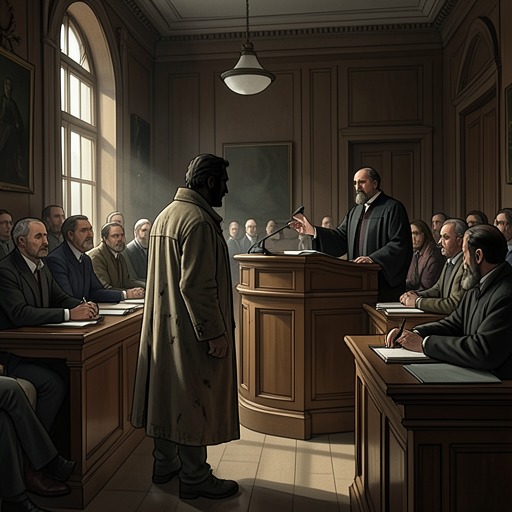
Micawber’s confinement is prolonged by financial and legal complications. Mrs. Micawber reports that the family has decided he should seek release under the Insolvent Debtors Act, and that the process is expected to take about six weeks. When his petition is heard, he is ordered discharged under the Act. The creditors are not portrayed as uniformly merciless: one creditor, a boot-maker, says in court that he bears Micawber no malice but wants money owed to him to be paid. The account presents the debt as both a personal crisis and a matter governed by formal procedure and creditor claims.
Even after the order, Micawber returns to King's Bench Prison to settle fees and complete formalities before he can actually leave. The prison club welcomes him, and an evening gathering is held in his honor; Mrs. Micawber and David share a private meal with the sleeping family. The sequence makes release a process rather than a single moment, while the celebration demonstrates the social bonds that have formed during confinement. For David, the prison is also a place where he witnesses debt’s effects on housing and family arrangements, without escaping the degrading work that continues outside. Its rooms are at once a site of legal constraint, shared hardship, and temporary belonging.