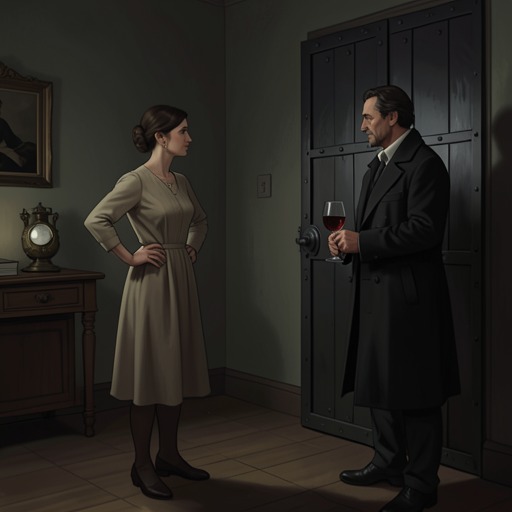
Littimer
David CopperfieldLittimer is James Steerforth’s servant, a figure whose unvarying decorum first disarms and diminishes David Copperfield, then becomes part of the machinery of Emily Peggotty’s disappearance. His importance lies in that contrast: the manner that makes him seem beyond suspicion is precisely what enables him to move through the household and its social encounters while serving a concealed purpose.
Identity and the Performance of Respectability
Littimer came into James Steerforth’s service at the University. David describes him as taciturn, soft-footed, quiet, deferential, observant, and always available when wanted, yet never conspicuously present when not. His appearance reinforces the impression: a stiff neck, close-fitting hair, and a soft manner of speaking, with an unusually distinct whispering of the letter S. David’s account repeatedly turns these details into a comic measure of how completely Littimer seems to embody respectability. Even a feature that might otherwise count against him, such as an upside-down nose, David imagines would somehow have been made respectable in his presence.
The impression extends to what is unknown. Nobody in the household seems to know Littimer’s Christian name, and David treats even that absence as another element in the servant’s air of impeccable propriety. His surname alone seems sufficient, while his age is equally hard to estimate: he might appear thirty or fifty. The character is thus introduced less through personal history than through the carefully observed surface he presents to others.
David’s Unease in His Presence
Littimer’s effect on David is unusually strong because it persists in ordinary, repeated encounters. Each morning he brings shaving water and lays out David’s clothes; their exchange never varies. Even when David feels that James Steerforth’s companionship, Mrs. Steerforth’s confidence, or Rosa Dartle’s conversation has brought him nearer to adult life, Littimer’s presence makes him feel like a boy again. His respectful correction of David’s manners is slight, but David experiences it as a reminder of his own youth and inexperience.
That effect reaches beyond the morning ritual. James Steerforth arranges horses for the young men, provides foils, and gives David instruction in riding, fencing, and boxing. David is willing to be a novice before James Steerforth, but cannot bear to display the same lack of skill in Littimer’s presence. There is no evidence that Littimer claims expertise in these pursuits; the pressure comes from the authority David attributes to his manner. In retrospect, David singles him out because the impression was so marked and because of what happened later.
At Yarmouth, James Steerforth says that he will leave Littimer behind to oversee the fitting out of the boat, so that he can be sure it is complete. Littimer has come down that morning carrying a letter from Mrs. Steerforth. At dinner, when David asks after Mrs. Steerforth and Rosa Dartle, Littimer replies with formal courtesy and passes on their compliments. The exchange is brief, yet David feels that the servant’s bearing silently reduces him to a very young man. His manners continue to shape the scene even when he says little.
The Respectable Servant in David’s Household
Littimer’s influence becomes especially visible during a meal at David’s rooms, where David, Thomas Traddles, Mr. Micawber, and Mrs. Micawber are cooking and eating together. Littimer appears, hat in hand, and asks whether his master is there. When David continues holding a fork at the gridiron, Littimer politely asks him to sit down and takes the fork from him, then attends to the cooking and serving with grave efficiency.
The visitors’ behaviour changes at once. Mr. Micawber subsides into his chair; Mrs. Micawber puts on her gloves and adopts a genteel air; Thomas Traddles becomes visibly self-conscious. David feels like an infant at the head of his own table. Littimer serves the mutton, clears the plates, brings out the cheese and wine glasses, and carries the dishes away, all without raising his eyes from his work. The meal continues, but its earlier ease has vanished. The episode shows how his composure can make other people feel observed and judged, even though he does not openly accuse or challenge them.
After Littimer leaves, the company relaxes. David, however, is troubled by the thought that he had distrusted James Steerforth and by a vague fear that the servant might discover it. He cannot account for feeling exposed when he believes there is little for him to conceal. Mr. Micawber, by contrast, praises Littimer as an admirable and respectable servant. That response makes the scene’s irony sharper: the very quality that reassures Mr. Micawber also intensifies David’s apprehension.
Role in Emily Peggotty’s Disappearance
The later account of Emily’s departure gives Littimer’s earlier appearances a darker significance. Ham Peggotty reports that a gentleman and a servant connected to each other have been around the area. The servant has been seen with Emily, has apparently been hiding nearby, and has repeatedly gone to a carriage waiting on the Norwich road. Emily is near him when he returns to it; the gentleman is inside. Ham’s account identifies a coordinated departure, though at first it does not explain the full arrangement.
Miss Mowcher later supplies a crucial part of that explanation. She says that Littimer had misled her by presenting David as the young man who had fallen in love with Emily and by representing James Steerforth as concerned that no harm should come to her. Believing this account, Miss Mowcher gave Emily a letter that she now thinks began Emily’s communication with Littimer. She concludes that Littimer had been deliberately left behind. Her disclosure recasts his earlier discretion: he was not merely a restrained attendant in the background, but part of a plan that used another person’s confidence to facilitate access to Emily.
The evidence establishes Littimer’s role through what others observe and later understand: his connection to James Steerforth, his presence with Emily, his involvement in the carriage arrangements, and Miss Mowcher’s account of the deception. The exposure does not erase the precision of his manners; instead, it changes their meaning. His polished service and apparent harmlessness stand in stark opposition to the betrayal they helped conceal.
Narrative Function
Littimer is constructed around a consistent public manner, but that consistency becomes dramatically unstable once David learns what lies behind it. His repeated routines make him recognizable, while the delayed disclosure turns those same routines into clues that had been misread. The effect depends on the difference between visible conduct and hidden purpose: readers, like David, encounter the servant first through an appearance that invites trust, then must reconsider how that trust was exploited.
His story also makes respectability a matter of performance rather than proof of character. Littimer’s careful speech, service, and self-control command deference from David and admiration from Mr. Micawber, but none of these qualities guarantees honest conduct. The servant’s quiet presence, at first comic in its power to make an adult feel like a child, becomes consequential when his discretion serves James Steerforth’s scheme. Through that reversal, Littimer functions as a human instrument of deception and as one of the novel’s clearest examples of decorum masking complicity.