London Doctors' Commons
David CopperfieldLondon Doctors' Commons is the cluster of ecclesiastical courts and professional offices in which David Copperfield begins his legal career as a proctor’s clerk. It handles matters that reach directly into private life—wills, probate, marriage licences, and disputes involving clergy or ships—yet Dickens presents its venerable forms alongside practical absurdities, opaque paperwork, and arrangements that frustrate reform. The place is at once David’s workplace, a stage for changes in his fortunes, and a small-scale portrait of institutions that claim authority over intimate affairs.
Setting and jurisdiction
Steerforth introduces London Doctors' Commons to David as an old legal enclave near St. Paul’s Churchyard, responsible for ecclesiastical law. His description ranges across its business: wills and marriages, as well as disputes about ships and boats. The same court personnel may appear in apparently unrelated cases, and the mixture of jurisdictions seems bewildering to the young David. Steerforth makes the institution sound antiquated and self-contained; David, however, is not wholly put off by that account. He associates the place with the gravity of age and takes seriously Betsey Trotwood’s suggestion that he train there.
The approach gives the courts a distinctive physical separation from the surrounding city. A low archway and a succession of narrow ways lead to the offices, where the city’s noise seems to recede. At the office of Spenlow and Jorkins, clerks copy documents in the vestibule, and bundles of papers are marked for different courts, including the Court of Arches, the Consistory Court, the Admiralty Court, and the Prerogative Court. Affidavit evidence is gathered in large, heavily bound books, one set to a cause. To David, each case seems to acquire the scale and density of a written history; the paperwork makes the institution’s reach visible while also making its processes hard for an outsider to grasp.
David’s entry into legal work
Betsey Trotwood’s proposal for David’s future becomes a practical arrangement when he visits the office with her. On the way, they stop in Fleet Street to watch the figures at St. Dunstan’s strike the bells. Near Ludgate Hill, a man who has been following them frightens Betsey; after a private encounter, she returns shaken and tells David not to ask about it. The interruption delays their business but does not prevent them from reaching the office, where the ordinary routines of the courts resume.
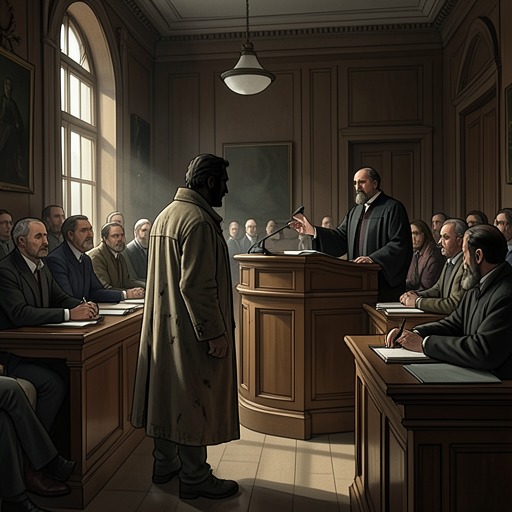
Mr. Spenlow is away in court, and the office clerk explains that it is a Court of Arches day. After speaking with him, the family settles on a month’s probation for David, with the formal articles to follow and be sent to Betsey for signature. Mr. Spenlow then takes David into court. There, advocates sit in red gowns and grey wigs above proctors in black gowns with white fur, while a judge presides from the curve of a raised, horseshoe-shaped platform. David watches a lawyer work through a library of evidence and arguments. The scene brings him from the paper-filled office into the public performance of legal authority, but it also exposes the distance between that authority’s solemn appearance and the languid, sometimes awkward proceedings he observes.
The career places David among wills and marriage cases from the start. Betsey has visited her own proctor there to settle her will in David’s favour, so his apprenticeship is connected to the provision she intends to make for him. Later, after Barkis dies, David takes charge of Peggotty’s affairs: he proves the will, settles the matter with the Legacy Duty-office, and brings the arrangements into order. That work is what brings Peggotty to the office to pay her bill. Legal practice is therefore not only an occupation for David; it gives him a way to manage a consequential family obligation at a moment of bereavement.
Fees, custom, and legal oddities
The office’s professional customs appear in the treatment of clients. David recalls that the clerks behaved like undertakers during probate work for people in mourning, while presenting a lighter manner to clients seeking marriage licences. The contrast is a workplace convention, but it also measures how the same office accommodates grief and courtship as routine business. When Peggotty pays her account, Mr. Spenlow says he would have preferred to limit the charges to actual expenses but cannot act on that wish because he has a partner, Mr. Jorkins. His gentle regret makes the bill sound almost optional, although the charge is paid all the same.
David also witnesses a divorce case involving Thomas Benjamin. Having taken out his marriage licence under the name Thomas, Benjamin later claims that his full name makes the marriage invalid; the Court accepts the argument. David doubts the justice of the result. Mr. Spenlow answers by treating good and evil in ecclesiastical law as parts of a larger system, a defence that asks David to accept institutional contradiction rather than correct it. The case distils the difference between a legal form’s capacity to determine status and its capacity to deliver fairness.
David’s more sustained criticism concerns the Prerogative Office, which holds original wills for the extensive province of Canterbury. He objects that the registry occupies a building never designed for its purpose, is not established as fireproof, and is congested with important documents. He also challenges the system of fees and sinecures: senior officeholders profit while poorly rewarded working clerks perform significant labour in a cold, dark room. The complaint moves beyond inconvenience to public responsibility. People are compelled to entrust their wills to the registry, David argues, so the institution should provide safe storage and decent working conditions rather than treating public records as a source of private gain. Mr. Spenlow discourages reform as unbecoming to David’s gentlemanly character, exposing the pressure to mistake professional respectability for a reason to leave defective arrangements alone.
Personal consequences and narrative significance
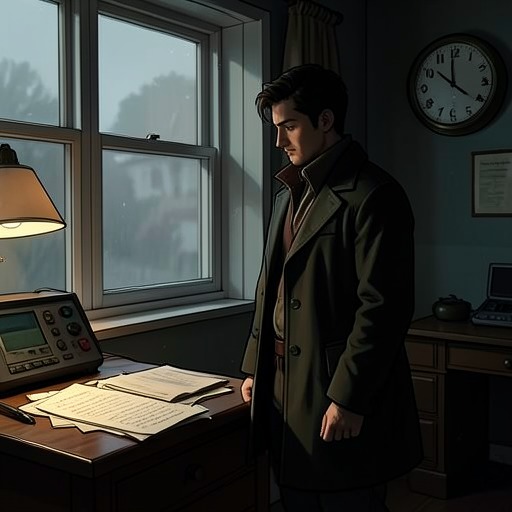
London Doctors' Commons remains tied to David’s changing circumstances. When Mr. Spenlow dies, David and Mr. Jorkins join Tiffey to search desks and drawers for a will and seal the deceased’s private papers. David is anxious to learn what will become of Dora Spenlow, and the search gives him access to information about her prospects and guardianship. The institutional work is methodical—private papers separated from office papers, personal effects handled quietly—but its stakes are intimate. The archive is not abstract: its contents may determine the future of a person David loves.
After Mr. Spenlow’s death and the change in David’s position, David approaches Mr. Jorkins about his case, having first asked Mr. Spenlow whether he could raise the matter. The encounter overturns the intimidating reputation Mr. Jorkins has acquired in the office. David finds him mild and unassuming, rather than the ruthless force suggested by Mr. Spenlow’s repeated appeals to his supposed intransigence. The partnership’s division of roles has made Jorkins a convenient explanation for decisions Spenlow presents as against his own wishes; David’s meeting reveals the gap between that professional story and the man himself.
Through these episodes, London Doctors' Commons connects inheritance, marriage, bereavement, and employment within one institutional setting. David’s progress there is marked by learning the practical handling of legal affairs, but also by developing doubts about the rules and customs he encounters. Its old courts give him a profession and a position from which to help others; their paperwork and rituals also show how formal procedure can preserve injustice, obscure responsibility, and make private lives answer to an impersonal system.