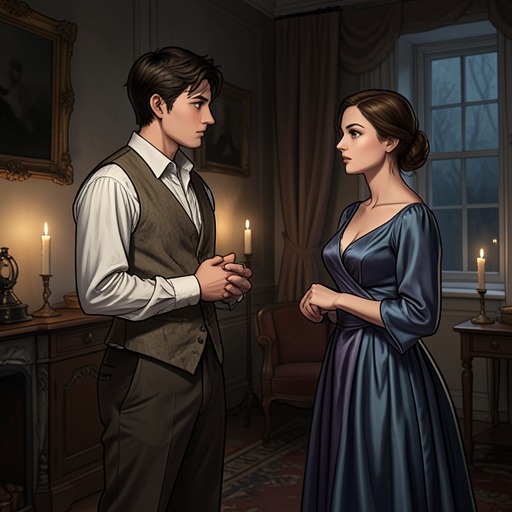
Miss Lavinia Spenlow
David CopperfieldMiss Lavinia Spenlow is the younger sister of Francis Spenlow and an aunt of Dora Spenlow. After Francis’s death, she takes a leading part in deciding whether David Copperfield may visit Dora, treating the proposed courtship as a matter to be assessed and regulated by the family. Her brief appearance is defined by the contrast between that precise public negotiation and her later assistance in bringing the young couple together privately.
Identity and Family Position
Miss Lavinia appears with her sister, Miss Clarissa Spenlow, when David comes to ask permission to visit Dora. The two women are dressed alike and carry themselves with marked formality. David observes a six- or eight-year difference between them and describes the younger sister as managing the conference: she holds his letter and consults it through an eyeglass. The meeting is thus organized around Lavinia’s reading of the written request and her control of the discussion, even though Clarissa also intervenes.
The sisters describe their relationship with their late brother as distant but not openly divided: Francis had followed his own course, while they followed theirs. His death, Lavinia explains, has changed Dora’s position and therefore altered how the sisters regard their brother’s former opinions about her. The decision is not presented as a simple continuation of Francis’s authority. Instead, Lavinia frames it as a new family judgment, made by the aunts who now have to decide what access to their niece will be allowed.
The Conditions on David’s Visits
Lavinia does not immediately accept David’s account of his love for Dora as sufficient proof. She tells him and Thomas Traddles that the sisters have no reason to doubt his good qualities or honourable character, nor that he believes himself to love Dora; what they lack is personal evidence by which to judge the feeling’s reality. She therefore proposes to test it through observation and agrees that David may visit.
Permission comes with restrictions. Lavinia says the visits are to be regarded, for the time being, as visits to the aunts, not as recognition of a settled engagement. She requires David to promise on his word of honour that he will have no communication with Dora without the sisters’ knowledge and will submit any project concerning her to them for approval. Clarissa briefly corrects Lavinia on who should receive that submission; Lavinia accepts the correction and continues the stipulation. The exchange shows both sisters participating in the decision, while Lavinia conducts its terms and makes the promise explicit.
David agrees at once, calling Traddles to witness and binding himself to the undertaking. Lavinia’s conditions make family oversight the price of his access to Dora. Her decision is cautious rather than prohibitive: she neither treats David’s declaration as proof nor bars him from visiting, but places the relationship under the aunts’ supervision until they can judge it for themselves.
From Formal Gatekeeper to Facilitator
Once the terms have been settled, Lavinia asks Traddles to excuse them and takes David into another room. There Dora is waiting behind a door with her ears stopped; her little dog, Jip, is in a plate-warmer with a towel tied around his head. Dora at first sobs and refuses to come out. Lavinia’s action has carried David past the formal interview and into a reunion that the meeting’s rules had kept at a distance.
The contrast gives her role its particular shape. In the conference she insists on controlled, disclosed communication; in private she makes the meeting possible, and David, Dora, and Jip are reunited. The text does not describe Lavinia as abandoning the conditions she has just set, or explain the precise arrangement by which this encounter fits them. It does show that she is not only an obstacle or examiner: after securing the aunts’ terms, she personally conducts David to Dora.
Narrative Role
Lavinia’s scene brings the consequences of Francis Spenlow’s death into David and Dora’s courtship. The family’s authority has shifted, and the sisters respond by requiring evidence, supervision, and a formal promise before allowing visits. Through Lavinia, the narrative stages the difference between declaring affection and having it recognized by those who control access to Dora.
Her composed handling of the interview also sharpens the emotional turn that follows it. The orderly letter, eyeglass, notes, and stipulations give way to Dora’s tears and the comic detail of Jip in the plate-warmer. Lavinia links those registers: she administers the family’s caution, then opens the door to the reunion that makes the permission meaningful.