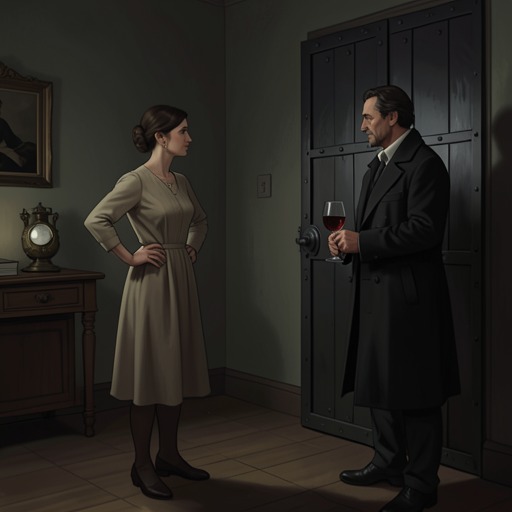
Miss Mowcher
David CopperfieldMiss Mowcher is a dwarf and a working professional whose comic public manner conceals the pressures of earning a living in a world that treats her as an amusement. Her appearances move from a lively introduction in J. Steerforth’s company to a serious explanation of how she has learned to perform for other people, then to a pledge to help Emily Peggotty. That shift makes her more than a comic interruption: she challenges David Copperfield’s first impressions and exposes the costs of being made into a spectacle.
Identity and Livelihood
Miss Mowcher works in personal grooming, including trimming J. Steerforth’s whiskers. Her business also draws on a more unusual credential: she cuts a prince’s nails and keeps the clippings to give to young women in albums. She says that, in genteel households, this token introduces her more effectively than her other talents. Her account turns a tiny professional object into evidence of how status circulates: the nail clippings function as proof of access to a fashionable client and help make her services acceptable to prospective customers.
The work is not merely a pastime or a source of comic business. Miss Mowcher explains that she has laboured all day for years to support her sister and brother, who share her physical condition, and that she must earn enough to live. She presents her family responsibilities as part of the practical circumstances behind her profession. The novel thus gives her an economic life and obligations beyond the social role others assign her.
First Appearance in J. Steerforth’s Circle
At dinner with J. Steerforth, David first hears that Miss Mowcher has arrived from Littimer, who announces her with formal composure. Her entrance surprises David: he initially looks toward the doorway without seeing her, before she comes around the sofa. She greets J. Steerforth with teasing familiarity and a rapid flow of talk, and the conversation establishes her as an experienced visitor who is not easily excluded from his company.
Her banter ranges from J. Steerforth’s conduct to his mother and to the young woman David once admired. She questions whether that woman is David’s sister, and J. Steerforth answers for him, teasing him about his former admiration. Miss Mowcher then uses a word game to connect Emily Peggotty with an elopement. The joking manner makes the exchange seem light, but its subject is not: she identifies the rupture in Emily Peggotty’s life before David has fully confronted its consequences. In the same encounter, she tells J. Steerforth that she understands him and his character. Her familiarity reads as comic repartee at first, yet it also suggests that she sees through him.
Performance and David’s Changed Judgment
David’s early view of Miss Mowcher is shaped by the spectacle of her entrance and by the quick, knowing performance she offers in J. Steerforth’s presence. When she later visits David, however, her manner is markedly earnest. She arrives struggling with an umbrella that she cannot shut, then sits apart from the playful ease David associates with their first meeting. The contrast makes him reconsider his response to her rather than treating the earlier encounter as a complete account of who she is.
Miss Mowcher explains that people who are physically different are often treated as toys: others make them a source of amusement, discard them when bored, and then act surprised when they have serious feelings. She says her father, sister, and brother share her condition, and that she has worked hard for their support. Because she must live and cannot rely on people who make a joke of her to listen to a straightforward appeal, she has learned to make a joke of herself and of them. She asks, in effect, whether this adaptation is her fault or a response to the treatment she receives.
That explanation changes the meaning of her earlier wit. Her self-mockery is not evidence that she feels nothing, nor proof that she exists for other people’s entertainment; she presents it as a means of getting by and being heard. She also cautions David against assuming that bodily difference implies a difference in mind. The novel gives her direct authority to interpret the social conditions of her own performance, while David acknowledges that his judgment had been mistaken.
Promise to Help Emily Peggotty
After Emily Peggotty has been betrayed, Miss Mowcher comes to David with news and an offer of assistance. She says she has reason to suspect that J. Steerforth and Littimer have gone abroad, while making clear that this is a suspicion rather than confirmed knowledge. Because her work takes her among people and her ears are always open, she expects she may learn if either returns. She promises to pass on what she discovers and to help Emily Peggotty if she can.
Miss Mowcher’s pledge gives her earlier wordplay a different weight. The person who had joked about Emily Peggotty’s elopement now speaks as a potential ally to the young woman left to bear its consequences. She also warns that Littimer should not underestimate her determination. David says that the earnestness accompanying her promise persuades him to trust it. The evidence establishes the promise and David’s confidence, not a later action by Miss Mowcher or a confirmed outcome of her efforts.
Narrative Role
Miss Mowcher’s brief appearances create a deliberate contrast between public performance and private feeling. In J. Steerforth’s company, her verbal agility can be consumed as entertainment; in her conversation with David, she explains the labour and vulnerability behind that display. The reversal asks readers to notice how easily a socially conspicuous body can become the basis for other people’s assumptions, and how little those assumptions reveal about the person being watched.
Her role also connects livelihood to social access. The prince’s nail clippings, the work she performs in private households, and her reliance on quick humour all show different ways she negotiates a world in which a fair hearing is not assured. She does not simply reject performance: she describes using it because ordinary seriousness might go unheard. By allowing her to explain that strategy herself, the novel shifts attention from a comic exterior to the constraints that make such an exterior useful, and gives her a credible place in Emily Peggotty’s story without claiming more of her eventual fate than the narrative establishes.