Mr. Dick’s Memorial
David CopperfieldMr. Dick’s Memorial is an unfinished appeal about its writer’s affairs, addressed to the Lord Chancellor, whose composition is persistently derailed by Mr. Dick’s fixation on King Charles the First. The manuscript never reaches completion, yet it is more than a comic emblem of distraction: it occupies his daily labor, supplies material for his kite, and becomes the measure against which a practical opportunity to work is devised. Its repeated failure and its eventual coexistence with paid copying reveal how an apparently fruitless pursuit can remain meaningful while a different task offers Mr. Dick a concrete way to help those he loves.
Purpose and Composition
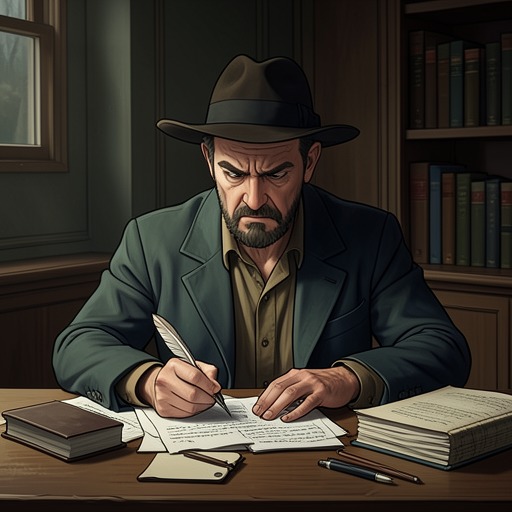
Mr. Dick works at the Memorial every day, laboring over a document intended to memorialize the Lord Chancellor, or another high official, about his affairs. Betsey Trotwood explains that the writing has not yet been successfully composed because Mr. Dick keeps introducing his own unusual way of expressing his illness and distress. She considers that language unsuitable for a businesslike petition and insists it must not appear in the document. The Memorial thus has a practical destination and an intended subject, but its author’s mode of expression repeatedly obstructs the formal account he is trying to produce.
The manuscript is not a single stable text. Whenever King Charles the First enters it, Mr. Dick abandons that attempt and begins another. David learns that this has continued for more than ten years: Mr. Dick has tried again and again to keep the king out, only for him to find his way back in. The difficulty is not a momentary lapse that can be corrected with one revision. It defines the Memorial’s whole history, turning persistent effort into a cycle of writing, intrusion, and renewed beginnings.
Mr. Dick’s pages are described as closely and laboriously written. On the large kite he has made, he pastes manuscript covered with writing, including old leaves from abortive versions of the Memorial. His room contains bundles of papers and many pens, fitting the impression of a project that generates abundant labor without reaching a finished form. The writing accumulates, but accumulation does not resolve the central problem: King Charles the First returns, and the work is once more thrown aside.
Repetition and the Kite
For Mr. Dick, the Memorial’s failure has a counterpart in the kite’s imagined purpose. He explains to David that the kite carries its written statements high and disperses them; where they may come down depends on circumstances and the wind. The image converts the pages’ lack of practical direction into a kind of release. The manuscript cannot be made into a completed petition, but fragments of it can leave the room and rise into the air.
David later remembers the kite-flying as one of the ordinary pleasures of his growing friendship with Mr. Dick. After the day’s work on the Memorial, they often go out together with the great kite. Mr. Dick labors at the document every day, but it never advances: sooner or later King Charles the First wanders in, throws the text out of shape, and forces another beginning. David is struck not only by the recurrence but by Mr. Dick’s patience, his mild awareness that something is going wrong, and his repeated efforts to prevent it.
The kite gives the unfinished pages a different setting and rhythm. When it is high in the evening sky, Mr. Dick appears serene, watching it tug at the string. David imagines that the kite lifts Mr. Dick’s mind out of its confusion. As it is wound down and comes to rest on the ground, Mr. Dick seems to return gradually from that calm. The kite does not complete the Memorial or remove its recurring interruption; instead, it makes the writing’s fragments part of a shared activity that brings companionship and temporary composure.
A Project Without an Ending
The Memorial has no clear prospect of completion. David doubts that Mr. Dick knows what would happen to it if it were finished, where it would go, or what it would accomplish; in David’s view, it is certain that it will never be finished. That judgment matters because the text presents the project not as a delayed document approaching a final solution, but as an enduring routine whose failure is already familiar to those around Mr. Dick.
Betsey Trotwood accepts that the Memorial is not businesslike, but she also defends Mr. Dick’s freedom to pursue his habits. She understands his descriptions of illness as allegorical and objects to including them in a formal petition; she does not therefore insist that he abandon his way of speaking or stop flying his kite. Her account distinguishes the standard the document would need to meet from the value of keeping Mr. Dick occupied. The Memorial’s practical inadequacy and its personal importance are allowed to remain side by side.
David’s view also changes through observation. At first, he sees Mr. Dick at work and supposes that, if he continues at that rate, he must be making good progress. He soon understands the recurring failure. Later, as a friend, he watches the same pattern unfold over many days and years. The remembered episodes make the Memorial’s futility concrete: not an abstract judgment about Mr. Dick’s capacity, but the visible result of repeated labor, discarded attempts, and the returning subject that unsettles each new version.
From Manuscript to Useful Work
When Betsey Trotwood’s financial ruin leaves the household anxious, Mr. Dick turns to the Memorial as a possible resource. He asks David what they can do and points to the document. David agrees that it is there, but advises him to keep a cheerful countenance and not let Betsey see their worry. Mr. Dick tries to follow this advice, though his concern shows in his watchfulness, his fear that Betsey is growing thin, and his saving fragments of bread and cheese in case the household reaches want. In this crisis, the Memorial is still the work he can name, even though it cannot immediately answer the need for income.
David and Thomas Traddles then look for a task Mr. Dick can actually perform. Traddles proposes that he copy writings, but Mr. Dick is doubtful because of the difficulty the Memorial presents. David explains that King Charles the First repeatedly enters Mr. Dick’s manuscripts. Traddles sees a possible distinction: the legal writing he has in mind is already complete, so Mr. Dick would not need to compose it himself. Their scheme gives him finished copy to reproduce while leaving the unfinished Memorial available for the recurring subject that would otherwise interrupt him.
The trial takes place at a table by the window in Buckingham Street. On one table lies legal work Traddles has obtained, a document concerning a right of way; on another is the unfinished original of the Memorial. Mr. Dick is instructed to copy exactly from the completed document and to turn to the Memorial if he feels the need to allude to King Charles the First. At first, he divides his attention between the two tasks, like a man playing the kettle-drums. Once he finds that this confuses and tires him, he settles into orderly copying and puts the Memorial aside for a more convenient time.
By the following Saturday night, although he had not begun at the start of the week and had not been given more work than was good for him, Mr. Dick has earned ten shillings and ninepence. He goes to the neighborhood shops to change the money into sixpences, then presents the coins to Betsey arranged in the form of a heart on a waiter. His tears of joy and pride, and his determination to provide for her, mark a sharp contrast with the Memorial’s endless drafts: copying has a completed source, a measurable result, and a visible use. The old project is not resolved, but Mr. Dick can now set it aside without surrendering it, because another kind of work has made him useful to his household.