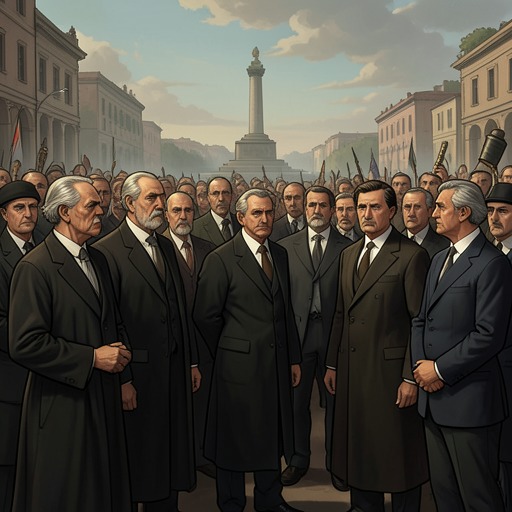
Mr. Jorkins
David CopperfieldMr. Jorkins is the junior-in-presence but supposedly immovable partner in Spenlow and Jorkins, the legal firm where David Copperfield begins training. He becomes a recurring explanation for the firm’s hard terms: Mr. Spenlow presents himself as generous but constrained by his partner, while Jorkins is kept at a distance until David meets him. That encounter complicates the image. The man said to block every concession proves mild and hurried, and the contrast makes him both a comic character and a device for exposing how responsibility is shifted inside the firm.
Identity and Introduction
When David considers entering the profession, Mr. Spenlow explains that he has discussed the vacancy with Betsey Trotwood, who is seeking a respectable occupation for her nephew. The proposed arrangement begins with a month of probation, after which David may decide whether to bind himself to the firm. Its cost, however, is fixed: the premium, including the stamp, is one thousand pounds. Mr. Spenlow says that he would prefer to ask less, but attributes the amount to Jorkins, who considers a thousand pounds too little. Jorkins is thus introduced not through a decision David sees him make, but through the partner’s report of his views.
The same arrangement defines Jorkins’s reputation before he has appeared. When David tentatively asks whether a clerk who became thoroughly useful might receive a salary in the later years of his articles, Mr. Spenlow avoids promising anything and again names his partner as the obstacle. David is dismayed by the idea of this supposedly immovable man. Jorkins’s power in the conversation is therefore disproportionate to his presence: his name closes off a possibility even while he remains unseen.
The Firm’s Convenient Obstacle
David later describes the division of character that Mr. Spenlow’s explanations create. In the story Mr. Spenlow tells, Jorkins is the one who would refuse a clerk’s request for higher pay or insist that a slow-paying client settle a bill. Mr. Spenlow, by contrast, is represented as willing to give, but restrained by the partner’s opinions. The arrangement makes the firm’s decisions sound like the work of one difficult individual rather than the shared conduct of a partnership.
David’s retrospective account overturns the alarming first impression. Jorkins is a mild man of a heavy temperament; his place in the business, David concludes, is to remain in the background while being exhibited by name as the most obdurate person in it. The explanation extends beyond David’s apprenticeship: looking back, he recognizes the same business principle in other houses. The joke therefore has a social edge. A repeated appeal to an unseen authority can make refusal appear unavoidable while preserving the speaker’s appearance of personal kindness.
Fees, Requests, and an Actual Encounter
The arrangement is not limited to the premium. When Peggotty receives a bill from the firm, Mr. Spenlow reviews its items with a regretful air and says he would have been happy to restrict the charge to actual expenditure, were he free to follow his own wishes. He again places the limit on Jorkins. David pays the amount in banknotes on Peggotty’s behalf. The scene gives the familiar explanation a practical consequence: the firm collects its charge, while Mr. Spenlow presents himself as unable to reduce it.
David eventually tries to approach Jorkins directly about the matter under discussion. He asks whether speaking to the partner might advance his request, having been led to believe that Mr. Spenlow expects Jorkins to object. Jorkins says that he cannot help, mentions an appointment at the Bank, and rises hurriedly to leave. At the door he confirms that he objects, then looks back to add that David must understand what follows if Mr. Spenlow objects. His brief, restless exchange gives David little clarification about where the decision lies; instead, responsibility seems to pass back and forth between the partners.
Characterization and Narrative Function
Jorkins’s reputed severity sits against the small, shabby details David supplies about his daily presence. He lives alone in a house near Montagu Square that badly needs painting, arrives late and leaves early, and is never apparently consulted about anything. His private upstairs office is a dingy little black hole where no business is done. On its desk lies a yellow cartridge-paper pad, reportedly twenty years old and still unmarked by ink. These details do not depict a commanding executive visibly directing the firm; they make his alleged authority seem hollow, even as his name continues to affect what David can ask for.
The gap between reputation and appearance is the point of Jorkins’s characterization. Mr. Spenlow invokes him to explain a high premium, the absence of a clerk’s salary, and a bill he claims he would otherwise reduce. When David meets him, Jorkins neither supplies a forceful justification nor offers a counter-account of the partnership: he nervously declines, hurries away, and refers back to Mr. Spenlow. The resulting uncertainty is comic, but it also sharpens the portrait of professional respectability as a performance in which apparent benevolence and apparent obstruction work together. Jorkins is less a fully disclosed participant in the firm’s decisions than the name through which those decisions are made to seem somebody else’s responsibility.