Murdstone and Grinby's warehouse
David CopperfieldMurdstone and Grinby's warehouse is the setting of David Copperfield’s forced entry into working life at the age of ten. A decaying riverside workplace where he sorts and prepares bottles, it turns the neglect of his childhood into labor and becomes the bleak boundary between his early home life and the life he tries to escape. In his later account, the warehouse remains so painful that he recalls it only briefly before letting the memory close again.
Setting and Physical Character
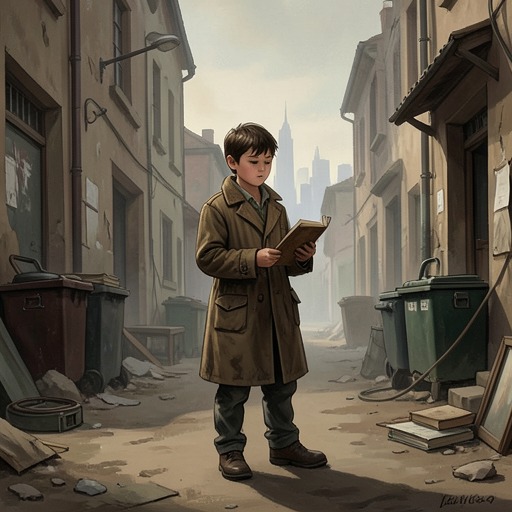
The warehouse stood in Blackfriars, at the bottom of a narrow street that curved downhill toward the river. It was the last house in the street, with its own wharf and steps where people took boats. The tide altered the ground at its edge: the wharf met the water when the tide was in and the mud when it was out. The building itself was old and deteriorated, with panelled rooms darkened by dirt and smoke, decaying floors and stairs, and rats in the cellars. Its situation joined commercial activity to a neglected, unstable urban environment.
The setting is not merely a backdrop to David’s employment. The warehouse’s worn structure and position beside the river give physical form to the insecurity of the life imposed on him. David recalls arriving there with his trembling hand in Mr. Quinion’s, and describes the place as remaining vivid in memory long after the events themselves.
Work and David’s Entry into Labor
An important branch of the firm’s trade supplied wines and spirits to packet ships. The business generated large numbers of empty bottles, which workers examined against the light, rejected if flawed, rinsed, and washed. When empty bottles ran short, they pasted labels on full ones, fitted corks, sealed them, and packed completed bottles into casks. David was one of the boys assigned to this work.
He entered the warehouse at ten, described in retrospect as a child of strong abilities and quick observation who was easily hurt, yet with nobody making a sign on his behalf. His placement there therefore signifies more than a change of occupation: it exposes how completely the adults responsible for him have failed to protect him. The warehouse gives that abandonment a daily form, as his time and effort are put to commercial use while his childhood needs go unheeded.
Escape and the Warehouse as a Threshold
After the Micawber family departed, David returned to his weary days at the warehouse but resolved not to remain there much longer. He decided to run away into the country and seek his only relation, Betsey Trotwood. The decision was tied to a memory of his mother’s story about his birth, which gave him a faint, uncertain hope that his aunt might receive him. The warehouse was thus the place he had to leave before that possibility could be tested.
David waited until Saturday night to go, believing he should not abandon his work before then. Because he had been paid a week’s wages in advance when he first arrived, he did not go to the counting-house for the usual payment. Instead, while the workers waited to be paid, he said goodbye to Mick Walker, asked him to tell Mr. Quinion that he had gone to move his box, and left. His preparation was small and precarious: the box was at his old lodging, and he carried a direction for it to be left at the Dover coach office. The warehouse was not simply where David worked; it was the point from which he made his first deliberate attempt to reclaim his future.
Memory and Narrative Significance
After David begins a new life under the name Trotwood Copperfield, he describes a curtain as having fallen on his life at the warehouse. The former life at Blunderstone has receded into distance, but the warehouse period remains associated with pain, mental suffering, and lack of hope. He declines to establish how long it lasted, whether a year or more or less, and leaves the duration unresolved. That refusal makes the episode’s emotional weight more prominent than its chronology: the place is remembered as a closed, painful interval rather than a stage he can calmly measure.
The warehouse also anchors the novel’s account of child labor in a specific workplace and trade. Its commercial routine depends on boys performing repetitive tasks around bottles and packing, while David’s personal circumstances leave him without an adult who intervenes for him. The contrast between the organized movement of goods and the absence of care for the child handling them makes the warehouse a concentrated image of exploitation and social neglect.