Murdstone’s Rules for Disciplining David
David CopperfieldMurdstone’s Rules for Disciplining David are a set of household commands enforced in the name of firmness, but experienced by David Copperfield as a system of obedience, surveillance, and isolation. Mr. Murdstone demands that David remain in the parlour, show prompt respect, and give up the comfort of the kitchen and Clara Peggotty’s company. The rules reach beyond a child’s manners: they help Jane Murdstone and Mr. Murdstone claim authority over the home while making Clara Copperfield afraid to oppose them or show her son affection.
Household Authority and the Language of Firmness
The rules take shape within a household whose authority is already being rearranged. On the first morning after Jane Murdstone arrives, she tells Clara Copperfield that she has come to relieve her of household duties and asks for her keys. From then on, Jane keeps them throughout the day and under her pillow at night. The transfer gives practical force to Jane’s position: control of the household’s keys, like control of David’s behavior, is removed from Clara and placed with the Murdstones.
Clara does not surrender her authority without protest. When she objects that she should have been consulted about a household plan, Mr. Murdstone rebukes her for challenging him. Her brief resistance shows that the household’s new arrangements are contested, even as his response makes the cost of dissent plain. The rules applied to David belong to this larger pattern: authority is not negotiated among family members but defined by Mr. Murdstone and made binding on the others.
Firmness is the Murdstones’ stated principle. David’s retrospective account interprets it as a name for tyranny: Mr. Murdstone may impose his firmness on everyone, while Jane is allowed a lesser authority by virtue of her relationship to him. Clara, by contrast, is expected to endure their firmness and to accept that it is the only legitimate kind. This hierarchy explains why their discipline is not simply a demand for good behavior. It makes submission the standard by which a person’s character and place in the family are judged.
The Commands Imposed on David
Mr. Murdstone presents David’s withdrawal as a defect of character. When David tries to leave the parlour, Mr. Murdstone calls him sullen, and Jane reinforces the accusation. He then tells David that he must change and that the adults will undertake to change him. David’s attempt to deny that he has meant to be sullen is treated not as an explanation but as a lie, with Mr. Murdstone warning him against taking refuge in one.
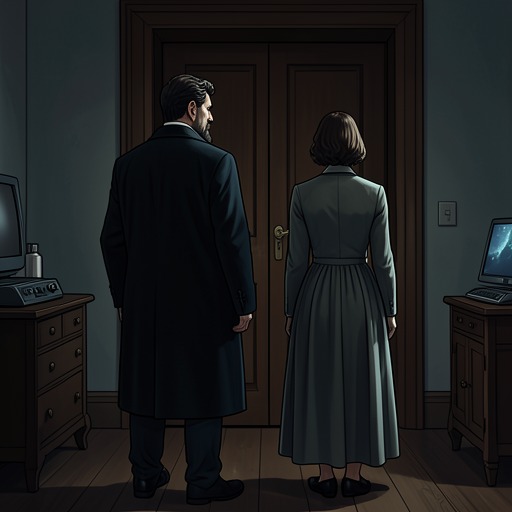
The instructions are specific. David must stay in the parlour instead of withdrawing to his bedroom; he must bring obedience into the room and show respect promptly toward Mr. Murdstone, Jane, and his mother. Mr. Murdstone orders him to sit down, and David describes himself as obeying as a dog obeys. The language and gesture reduce the encounter to command and compliance: David is not invited to explain his feelings or decide how to behave, but is told what bearing he will display.
The rules also govern David’s relationships. Mr. Murdstone disapproves of his preference for the company of servants and forbids him to associate with them. In particular, David must stop taking refuge with Clara Peggotty in the kitchen. Mr. Murdstone dismisses David’s attachment to her as an unsuitable preference and makes obedience to the prohibition explicit. The kitchen had offered David a place where he could feel comfortable and unafraid to be himself; the order removes that refuge as surely as the parlour order confines him to the company he dreads.
Enforcement and Effects on the Household
David understands that disobedience will have consequences and follows the commands to the letter. He no longer retreats to his bedroom or sits with Clara Peggotty in the kitchen. Instead, he spends day after day in the parlour, weary and waiting for night. Compliance therefore does not show that the rules have improved his disposition; it shows how effectively their threat has narrowed his choices.
The room becomes an environment of enforced stillness and scrutiny. David fears moving a limb lest Jane complain of his restlessness, and fears that even a look may invite a new complaint. The ticking clock, Jane’s steel beads, and the divisions in the chimney-piece become the details he attends to as he sits for hours. On solitary walks through muddy winter lanes, he carries the parlour and the Murdstones’ presence with him as a burden. The restrictions reach beyond the hours spent under their gaze: they shape his experience of solitude as well.
David’s presence also makes Clara Copperfield more anxious. When he enters a room where she has seemed cheerful, her face clouds; she fears that kindness toward him will offend the Murdstones and bring a reprimand. David recognizes that she is watching their expressions and worrying not only about her own actions but about his. He tries to keep out of their way, yet the rules do not permit him simply to remove himself: Mr. Murdstone insists that he remain in the parlour rather than retreat to his room or the kitchen.
Clara’s submission is presented as part of the same discipline. When she attempts to defend herself or David, Mr. Murdstone describes her judgment as weak and inconsiderate and tells her to keep watch over herself. She responds timidly and says nothing aloud. Later, she explains her husband’s severity as care intended for another person’s good and blames herself for failing to be sufficiently thankful and submissive. The rules thus work through more than direct orders to David: they also train his mother to distrust her own perceptions and to interpret resistance as personal weakness.
Significance
The rules make the Murdstone home a place where authority is repeatedly asserted through observation, criticism, and restrictions on association. David is expected to demonstrate obedience in his posture and company, while Clara is constrained in her ability to defend him. Jane helps police the household and intensifies the pressure on David, but the account distinguishes her subordinate firmness from Mr. Murdstone’s governing power.
David’s later description gives the rules their clearest interpretation. The adult narrator can name the contradiction that the child endured: firmness is praised as a virtue while being used to require everyone else’s submission. The contrast between David’s inward discomfort and outward compliance exposes the limits of this disciplinary project. The commands produce silence, isolation, and self-monitoring; they do not establish mutual trust or make the home a refuge for the child.