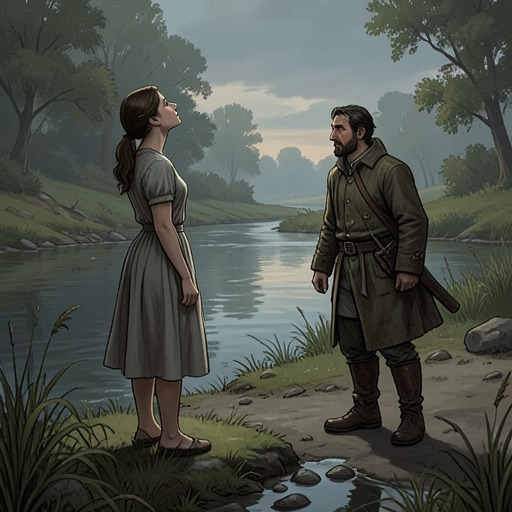
Pegotti's boat house
David CopperfieldPeggotty's boat-house is a converted, grounded vessel on the outskirts of Yarmouth, and one of the defining homes of David Copperfield's childhood. Its humble rooms and close-knit household offer welcome and intimacy, but David's return reveals that a place can remain outwardly unchanged while the person remembering it has been transformed by absence, growing up, and loss.
Setting and Construction
On his first journey to Yarmouth, David sees a flat, damp expanse and initially wonders why the landscape is so level. Approaching the town, he notices how little seems to separate land from sea, then revises his first judgment as the street's fish, pitch, oakum, and tar, its sailors, and its busy carts reveal a working maritime place. The route continues past gasworks, rope walks, boat-builders, shipwrights, ship-breakers, caulkers, riggers, and smiths before opening onto the waste at the town's edge.
There, Ham Peggotty carries David and a small box while Clara Peggotty carries another. Ham points out the house, but David cannot initially distinguish any dwelling in the open landscape. What he can see is a black, old boat, high and dry on the ground, with an iron funnel for a chimney and smoke rising from it. The modest, improbable home is thus first encountered not as a conventional house but as a vessel repurposed for domestic life: the chimney makes its smoke a sign of warmth and habitation in an otherwise exposed setting.
Household and First Visit
The boat-house is not merely a curious structure; it is the center of a household. Daniel Peggotty welcomes David, and Ham carries him home on his back. The domestic world David enters includes Mrs. Gummidge and Emily Peggotty, with the boat and its surroundings shaping even the arrangement of daily life. In the out-house, David recognizes the familiar collection of lobsters, crabs, and crawfish. Small objects and ordinary creatures make the dwelling legible to him as a home, not simply as a boat stranded on land.
The house also joins domestic refuge to the region's working coast. Its residents belong to a community of boatmen and maritime laborers, while the town's yards and workshops make visible the work that surrounds them. Later, J. Steerforth buys a clipper in Yarmouth and leaves Daniel Peggotty to command it in his absence. That vessel is distinct from the grounded boat-house, but the episode reinforces how boats in this setting can be homes, livelihoods, and the means of departure or return.
Return and Changed Memory
When David comes back, the boat-house appears much as before. Mrs. Gummidge waits at the door, the seaweed remains in the blue mug in David's bedroom, and the creatures in the out-house seem to occupy their old corner. Yet the familiar scene does not restore his earlier feeling. David thinks the place may have shrunk in his eyes and recognizes that its diminished effect may have something to do with Emily Peggotty's absence: she is at school, and the household feels her loss.
David goes out along the path to meet her. Their reunion carries the change that the unchanged rooms cannot show. Emily is still small in stature but has grown; she runs away laughing, and David follows. His remembered intimacy with the boat-house is therefore inseparable from the people who once made it alive. It was not only the shelter he missed, but the childhood relations and routines that had seemed to belong naturally within it.
Sea, Sound, and the Meaning of Home
At night David lies in the old little bed in the stern of the boat. The wind moving across the flat recalls earlier nights, but its meaning has changed: instead of imagining the sea lifting the boat, he thinks of the sea as having risen and drowned his happy home. The altered sound turns the boat-house into a measure of remembered security and subsequent loss. In that intimate room, he prays that he may grow up to marry Emily, joining the home he remembers to a future he imagines.
The boat-house's meaning does not depend on its permanence or grandeur. It is a shelter made from a vessel, set beside a town shaped by maritime work and exposed to the sounds and power of the sea. In the later storm, Ham Peggotty goes into the waves in an attempt to reach a wrecked ship; the danger belongs to the same coastal world that surrounds the household, though the rescue takes place at the shore rather than at the house. Across David's visits and memories, the boat-house holds these contrasts together: a grounded vessel made homely, a familiar refuge changed by absence, and a childhood home whose meaning deepens as the remembered sea becomes inseparable from loss.