Port Middlebay
David CopperfieldPort Middlebay is the Australian town that gives concrete form to the emigrants’ hope of beginning again overseas. In David Copperfield’s retrospective account, it is not merely a destination: it is where Wilkins Micawber’s precarious search for work ends in public standing, and where the dispersed emigrants build a life beyond the Bush.
Setting and Settlement
The town is identified through Port Middlebay Harbour. By the time David Copperfield hears of it, Daniel Peggotty explains that the families have left the Bush and gone around to the harbor, where there is what they call a town. The account establishes Port Middlebay as a place of settlement, but supplies little about its layout or daily life beyond that distinction between the inland Bush and the harbor town.
From Emigration to a New Life
Port Middlebay belongs to the later outcome of plans first shaped by financial necessity and the hope of finding work. Before the emigration, Emma Micawber describes her family’s view that Wilkins Micawber should leave London and use his talents in the provinces; a subsequent attempt to find an opening in the Medway coal trade fails for lack of capital. Later, Wilkins writes that he is establishing himself in a provincial town in connection with one of the learned professions, and that Emma and their children will accompany him. Daniel Peggotty’s account eventually locates the family in Port Middlebay Harbour, after their earlier life in the Bush.
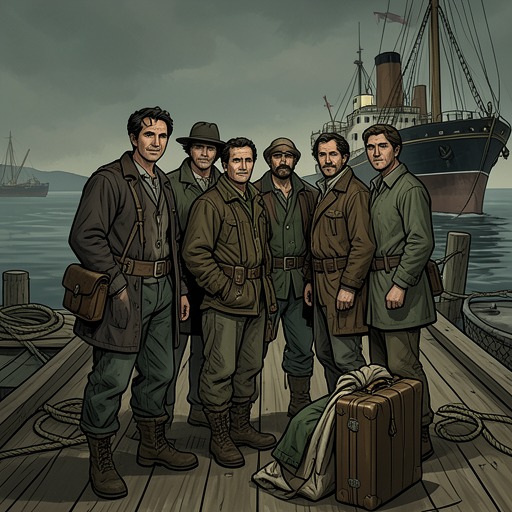
The emigration itself is shown as a departure rather than as a narrated arrival in the town. At Gravesend, David and his old nurse visit the ship before it sails, where the emigrants are crowded among their berths, chests, bundles, and other belongings. The later news of Port Middlebay completes that movement: the families have traveled overseas and onward from the Bush to a harbor settlement.
Micawber’s Public Standing
The town’s clearest portrait comes through a newspaper report of a public dinner honoring Wilkins Micawber as Port Middlebay District Magistrate. The dinner is held in the hotel’s large room; the report estimates that at least forty-seven people were seated at once, apart from those in the passage and on the stairs. Its crowded celebration marks a sharp change from Micawber’s earlier financial embarrassment and uncertain attempts to secure employment.
The report presents Micawber as both a civic figure and an accomplished speaker. In his address, he traces his success to its source and warns younger listeners against taking on debts they cannot repay. The scene makes his new authority legible through public recognition: the man once defined by unsettled obligations is now praised for caution about debt and honored by the town.
A Community Beyond the Bush
The newspaper also links Micawber’s success to a wider local network. Samuel Mell, formerly a poor usher in England, presides at the dinner as Doctor Mell of the Colonial Salem-House Grammar School in Port Middlebay. The report further notes Micawber’s son among the guests and describes his musical and social prominence. These details place the emigrants within an emerging civic and educational community rather than leaving them as isolated settlers.
Port Middlebay’s significance rests on this contrast between precarious departure and public incorporation. The town is presented through the emigrants’ own later testimony and a celebratory newspaper account, so its promise is measured chiefly by the work, recognition, and community its residents have found there. The narrative confirms a new beginning for the Micawbers and Peggottys without offering a broader description of the town or of the lives of people beyond their circle.