Salem House
David CopperfieldSalem House is the boarding school where David Copperfield is sent after his childhood home becomes hostile, and where punishment is made both physical and public. Its holiday-time emptiness, grim schoolroom, and placard branding David as a biter establish the school as a place of isolation before Mr. Creakle’s regime begins in earnest. Yet later recollections complicate this first impression: the school is also the setting of David’s friendship with Steerforth and Traddles, and of memories that return in adult life with both affection and anger.
Arrival and setting
David’s education at home has already been reshaped by the Murdstones. Although his mother nominally presides over his lessons, Edward Murdstone and Jane Murdstone are always present, using them to impose what David calls a miscalled firmness. He remembers that he had been willing and able to learn when he and his mother lived alone, including beginning the alphabet at her knee; under the new arrangement, lessons become another means of control. Boarding school has been discussed, but nothing has yet been settled when Salem House enters his life.
Mr. Mell identifies himself as one of Salem House’s masters, and leads David there. The school is enclosed by a high brick wall; its doorway bears the name SALEM HOUSE, and a gruff, wooden-legged man surveys visitors through the grille before opening the door. Inside, the square brick building has wings and looks bare and unfurnished. Its stillness initially makes David suppose that the boys are out. Mr. Mell explains that it is holiday-time: the pupils have gone home, Mr. Creakle, the proprietor, is at the seaside with Mrs. and Miss Creakle, and David has been sent in their absence as punishment for his misdoing.
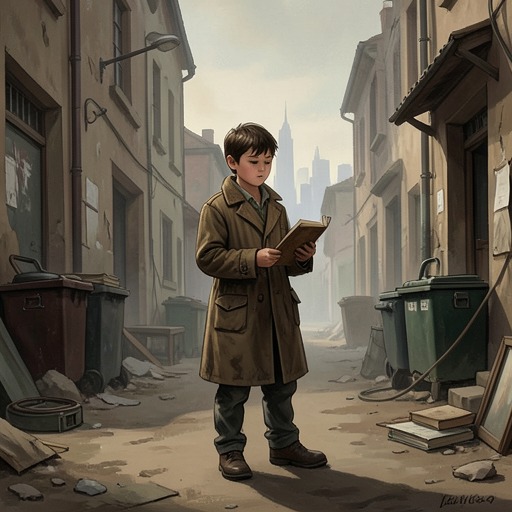
The schoolroom makes that punishment feel like abandonment. David remembers three long rows of desks, six rows of forms, and pegs for hats and slates bristling around the room. Scraps of copybooks and exercises litter the dirty floor; silkworm houses sit on the desks. Two white mice left behind by their owner run through a pasteboard-and-wire castle, while a caged bird can do little more than hop on its low perch. David recalls the stale, unhealthy smell and the room’s desolation. In this empty setting, the small creatures’ confinement echoes his own powerlessness without making the room merely a symbol: they are concrete signs of a school emptied of its children, and of a child left there alone.
The placard and Mr. Creakle’s discipline
While Mr. Mell is away, David finds a neatly written pasteboard placard on a desk. It reads, “TAKE CARE OF HIM. HE BITES.” He initially encounters the message without understanding it as a sentence about himself. Mr. Mell explains that it is not a warning about a dog but an instruction to put the placard on David’s back. Though apologetic, he ties it on like a knapsack. David must carry the label wherever he goes, so an episode of childhood defiance is turned into a public identity imposed by the school.
The label’s humiliation precedes David’s formal reception as a pupil. He spends the holiday period under supervision, doing long daily tasks with Mr. Mell and walking around the grounds before and after them. His recollection fixes on dampness, cracked green flagstones, a leaky water-butt, and discoloured trees; meals take place with Mr. Mell at the end of a long, bare dining-room, and David drinks tea from a tin pot while his master uses a blue cup. The detail makes the school’s routine legible as a sequence of confinement, labour, and separation, rather than as an abstractly unpleasant childhood memory.
When Mr. Creakle returns, David is summoned before him. Creakle addresses him as the boy whose teeth are to be filed and orders him to be turned round. School begins in earnest the next day. David remembers the schoolroom’s roar of voices falling silent when Creakle appears in the doorway, surveying the boys like captives. He then makes David’s placard the pretext for punishment: saying that he is famous for biting too, Creakle displays his cane and repeatedly strikes David while asking whether it is a sharp or deep tooth. David is soon in tears. The discipline is not corrective instruction in any meaningful sense; the cane makes the master’s power immediate, while the language of biting converts David’s label into a taunt.
Mr. Creakle’s severity also shapes what the placard can do. Steerforth’s protection means that other boys do not dare annoy David, but it does not shield him from Creakle. When the placard gets in the way as Creakle passes behind David’s form and wants to strike him, it is removed, ending David’s forced display of the sign but not the beatings. The distinction is telling: a label can be taken off, while the authority and bodily punishment that sustain the school’s regime remain.
Schoolmates, protection, and remembered life
David is not considered formally received into Salem House until J. Steerforth arrives. Older, handsome, and reputed to be a great scholar, Steerforth examines David’s punishment beneath a shed in the playground and calls it “a jolly shame.” David becomes devoted to him. Steerforth’s protection gives David some security among the boys, though it does not challenge the schoolmaster’s violence; after harsher treatment, Steerforth encourages David by saying that he needs more pluck and that he himself would not have endured it. David takes this as kindness, a judgement that registers his need for a friend as much as Steerforth’s influence.
The school’s punishments affect other pupils too. Traddles later recalls being caned for crying about Mr. Mell. As adults, he and David remember nights in the bedroom, shared suppers, and the stories David used to tell. Traddles also recalls drawing skeletons and making paper models of elephants’ dens to hold flies, small acts of invention that helped him comfort himself under ill usage. David sees the pleasure of those memories alongside the harm: when Traddles looks back with humour and says he would like to see Creakle again, David insists that the schoolmaster was a brute to him. Traddles allows that Creakle may have been rather so, but adds that it is long over. Their exchange preserves two registers at once—Traddles’s capacity to remember play and make light of the past, and David’s continuing moral recognition of what the school did to him.
Salem House remains present in David’s later life through the people and memories formed there. At a later gathering, hearing the name Traddles sends David’s mind back to the boy who drew skeletons. Their adult friendship carries traces of the earlier schoolmate, including Traddles’s art and the ways he endured mistreatment. David and Steerforth, too, speak together later of Traddles and their old school days. The school is therefore not simply an episode that disappears when David leaves: it supplies the remembered scenes through which he measures loyalty, suffering, and the distance between childhood experience and adult recollection.
The school and institutional authority
David’s adult narration makes Salem House part of a wider concern with how institutions treat the vulnerable. He remembers himself as a perceptive, sensitive child of ten, yet says that no one made a sign on his behalf before he became a labourer in the service of Murdstone and Grinby. That later abandonment gives the school episode its place in a chain of childhood exposure: at home, authority is imposed in the name of firmness; at school, Creakle’s discipline becomes public ridicule and blows. The accounts do not present Salem House as an isolated misfortune detached from the adults and arrangements governing David’s life.
The contrast sharpens when David and Traddles later visit the immense, solid prison where Creakle is powerful. Approaching it, David thinks of the money spent on the prison and imagines the public uproar that would follow if half that sum were proposed for an industrial school for the young or a refuge for deserving old people. The passage does not say that Salem House became the prison; rather, the former schoolmaster’s authority in the prison links the remembered school to a later institutional setting. David’s comparison turns childhood memory into social criticism: public resources can be committed on a vast scale to confinement, while the care and education of the young remain a neglected alternative. Salem House thus matters both as a particular place of fear and companionship and as an early scene through which the novel examines discipline, neglect, and the uses of institutional power.