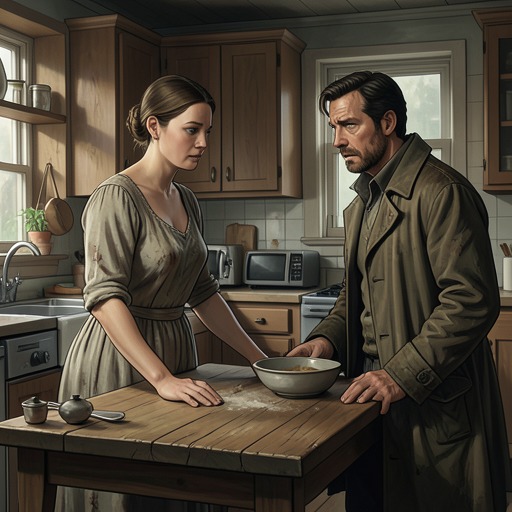
The Candle in the Window
David CopperfieldThe Candle in the Window is the light Daniel Peggotty places in his window for Emily Peggotty, first as a practical guide home and then as a pledge that her place in the household remains hers. After she disappears, the ritual takes on a deeper force: it preserves the welcome she may need if she returns, even when the family cannot know where she is or whether she will come back.
The nightly signal of home
Daniel explains the custom when David Copperfield visits the family’s home. At the hour Emily would ordinarily be coming back, he sets a candle in the window so that the dark path will seem less forbidding. The light carries two assurances at once: Emily can recognize her home, and she can know her uncle is there. The gesture is modest and repeated, but its meaning depends on the constancy behind it. Daniel does not merely illuminate the path; he makes his presence visible.
The ritual is embedded in the household’s familiar evening life. Daniel trims and places the candle after Mrs. Gummidge has been distressed by the thought that she is unwanted. He turns from that painful exchange to this loving custom, explaining it with cheerfulness. The candle thus belongs to a home where affection is expressed through acts of care: attending to another’s feelings, keeping a light ready, and expecting a loved one at the door.
Childhood, memory, and attachment
Daniel’s devotion to Emily is also bound to their shared childhood. He recalls playing with her when she was so small she came only to his knee, making believe that they were Turks, French people, sharks, lions, whales, and other imagined figures. That history helps explain why he treats the small belongings in her room with extraordinary delicacy, handling her bonnets as though roughness toward them would be roughness toward Emily herself. The candle is one object among many in a home saturated with her presence, but unlike a bonnet or an old seat, it is renewed each night as an action.
The flame also reveals the gap between the family’s expectation and the actual evening. Seeing it sparkle, Daniel imagines Emily looking toward it and coming home; the person who appears is Ham Peggotty. The mistaken welcome briefly exposes the danger beneath the ritual: the light can summon hope without confirming that its intended recipient is near. Still, Daniel does not abandon the practice. Its value rests not on certainty but on the welcome it keeps available.
A welcome maintained through absence
After Emily’s flight, Daniel insists that the family home should continue to look as it did when she knew it. He does not want the old place to seem to cast her off. He imagines her wandering back in bad weather, looking through the window toward her old seat by the fire, and perhaps finding courage to come inside and rest in her former bed. In this vision, the home does not demand an explanation before offering shelter. Its familiar appearance is meant to invite her closer when she is most vulnerable.
Daniel makes the candle part of that promise: it is to stand in its old windowpane every night, as regularly as night comes. He imagines its message as an invitation to return, and gives Ham a particular instruction for the possibility of a soft knock after dark: Ham must not go to the door; Emily should be the one to see her father. The detail preserves her agency within Daniel’s hope. He longs for her return, but wants the first encounter to be hers, not an interception by someone else.
Forgiveness against public disgrace
The candle’s meaning sharpens against the shame attached to Emily’s disappearance. When Daniel confronts Mrs. Steerforth, he speaks of loving Emily as a father loves a child and insists that riches could not buy her back. His appeal is not to punish her or restore the family’s public standing. He says that the people who raised and loved her would accept distance, trust her to the life she has made, and wait rather than add to her disgrace. The nightly candle makes a different but complementary promise: although Daniel may accept separation, he will not make the family home appear to reject her.
Later, Martha’s despair over the river brings the social cost of disgrace into view. She imagines the river as the company of someone like herself, moving from places where there was once no harm into streets made miserable, and then onward toward a troubled sea. She also grieves that people may think she corrupted Emily, although she says Emily had always treated her kindly and that she would have died to restore Emily’s good name. Against this imagery of exile and irreversible movement, the candle stands for a home that remains fixed and recognizable. It cannot undo the harm or guarantee a return, but it preserves the possibility of refuge without making forgiveness conditional on Emily’s recovery of respectability.
Narrative significance
The candle gathers the novel’s concerns with bereavement, memory, and belonging into a recurring domestic image. David Copperfield knows what it is to feel orphaned in a wide world, and his defense of Clara Peggotty recalls the shelter and loyalty he received from those who loved his mother. Daniel’s window offers another form of that fidelity: care made legible through a repeated act, rather than secured by a promise that circumstances will turn out well.
Its force lies in the distinction between waiting and possession. Daniel continues to hope for Emily, preserves her room and its familiar signs, and leaves the light in place; yet he imagines her returning at her own pace, even as a trembling stranger. The candle cannot bring her back, and its appearance does not settle what the future holds. It marks the boundary between absence and welcome, keeping that boundary open night after night.