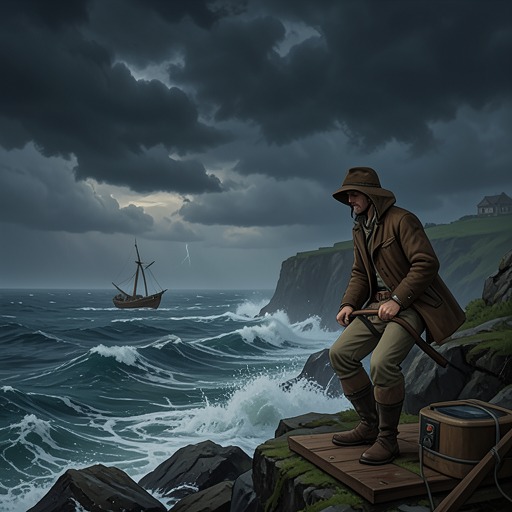
The Storm and Its Foreshadowing of Shipwreck
David CopperfieldThe Storm and Its Foreshadowing of Shipwreck is both a physical catastrophe and a structural turning point in David Copperfield’s life story. Through the remembered approach of the gale, the ship breaking apart, and Ham Peggotty’s attempt to reach the wreck, the novel brings earlier images of the sea and its hazards to their devastating culmination. David Copperfield does not present the disaster as an isolated surprise: he describes it as an event whose shadow had been lengthening across the narrative, and whose memory continues to return long after the storm has passed.
Yarmouth and the Maritime World
The storm’s force depends on the world it threatens. When David Copperfield first travels to Yarmouth with Peggotty, the town initially seems low, flat, and almost indistinguishable from the surrounding waste. The journey’s slow detours and deliveries leave him tired, and he wonders at a landscape in which land, river, and tide appear crowded together. Yet the streets’ smells of fish, pitch, oakum, and tar, their sailors and carts, and the extensive yards for boatbuilding, shipwrights, shipbreaking, caulking, and rigging revise his first impression. Yarmouth is not merely a bleak coastal backdrop: it is a working maritime community whose daily life is bound to boats and the sea.
That livelihood carries risk. In the storm, the people gathering by the beach include women fearing for husbands at sea, sailors reading the water, shipowners watching anxiously, and children clustered beside adults. Their presence makes the danger collective, reaching beyond the men aboard any single vessel. The gale threatens the town’s ordinary dependence on fishing, repair, and coastal traffic, and it places those who work at sea in immediate peril.
The sea’s place in the story has also been marked by objects and earlier changes. During an earlier visit, James Steerforth tells David Copperfield that he has bought a clipper and that Daniel Peggotty will command it in his absence. The later catastrophe therefore enters a community whose boats represent both practical work and personal ties. At another point, David returns to the emptied boat-house: the locker where he once sat with Emily Peggotty and the small bedroom remain in his memory, while its furnishings, down to a little mirror with an oyster-shell frame, have been removed. The wind’s mournful sound around that deserted home joins the sea to loss before the climactic gale arrives.
A Disaster Already in the Memory
David Copperfield frames the storm from the far side of its consequences. He calls it an event inseparably connected to what came before and says that, from the beginning of his narrative, it had seemed to grow larger, casting a forecast shadow over even his childhood experiences. The image turns the disaster into more than a late plot development: the remembered life is arranged so that earlier scenes acquire a new, threatening significance in its light.
The storm’s recurrence in David Copperfield’s dreams intensifies that retrospective structure. For years, he wakes with the impression that its fury still rages in his quiet room; even much later, the memory can return at uncertain intervals. A stormy wind or the lightest mention of a seashore can revive the association. He insists, in effect, that he is not simply recalling a finished event but seeing it happen again. The narrative thus presents memory as vivid and involuntary: telling the catastrophe restores its action and its fear rather than placing it safely in the past.
The chapter’s title, Tempest, makes the gathering weather itself a threshold in the narrative. As the sailing of the emigrant ship approaches, David Copperfield spends time with Peggotty, her brother, and the Micawbers, but does not see Emily Peggotty. Ham’s kindness and quiet fortitude become the subject of conversation. When David decides to travel to Yarmouth, he means to place a letter written by Emily Peggotty in Ham’s hands before the emigrants depart. A private gesture of connection is therefore set against the impending danger: the journey that begins as an act of care carries David toward the storm and its consequences.
The Gale’s Approach
The coachman’s early warning gives the weather a practical as well as ominous force. Asked about the unusual sky, he predicts that the wind will cause trouble at sea. The clouds gather in turbulent heaps; the moon seems to plunge through them, and the wind rises with an extraordinary sound. As night deepens, the horses struggle to face it, the leaders turn or stop, and the coach repeatedly has to shelter from sweeping rain. The storm makes forward travel an ordeal well before David Copperfield reaches the coast.
At Ipswich, damage inland shows that the gale has already exceeded a local disturbance. People have left their beds fearing falling chimneys. Sheets of lead have been torn from a church tower and thrown into a street, while trees lie uprooted and hayricks are scattered across roads and fields. Still the wind strengthens. Nearer Yarmouth, the sea’s spray reaches the travelers before they can see the water; flooding spreads across the flat country, and sheets of water break against their banks under the wind’s pressure.
The coast becomes a spectacle of unstable scale. From the town, the horizon’s waves rise like glimpses of another shore, while the streets are strewn with sand and seaweed and the wind blows people off course. At the beach, waves tower, collapse into surf, and retreat with a roar that seems to excavate the shore. Their fragments gather into the next mass of water, so that every apparent end becomes the beginning of another assault. The shifting hills and valleys of the sea, and the changing horizon, give the storm a power that seems to unsettle the forms of the natural world itself.
Ham and the Wreck
The danger reaches David Copperfield first through reports of other vessels. A waiter tells him that two colliers have gone down with all hands and that other ships are struggling in the Roads to keep away from shore. David’s uneasiness about Ham Peggotty, who has gone to Lowestoft to meet an urgent ship-repairing need, becomes linked to these reports. He fears Ham may try to return by sea and goes to ask the boat-builder about it. The boat-builder dismisses the possibility, saying that a seaman such as Ham would not put out in such a gale; David nevertheless remains disturbed as the storm grows more terrible in darkness.
The next morning, the sea is more violent still. At first, David Copperfield cannot make out the wreck through the breaking waves and confusion. A boatman points toward it with his bare arm, marked by a tattooed arrow. The ship lies broadside to the shore, one mast broken and tangled with sail and rigging. Men try to cut the wreckage free; among them, David sees an active figure with long curling hair. A wave sweeps over the ship and carries men and debris into the surge.
Ham Peggotty joins the rescue effort with a rope around his body, held by men on shore. He waits for a receding wave, then plunges into the water and is hauled back injured, blood visible on his face. He does not stop to attend to the wound. Instead, he appears to give directions that will leave him freer to try again. On his next attempt, the sea carries him toward the ship. Just as he is nearly within reach, a vast wave rises beyond the wreck and the ship disappears. The narrative makes the rescue’s human courage visible without suggesting that courage can command the storm.
Foreshadowing, Loss, and Witness
The storm’s foreboding is built from several kinds of prior knowledge: the town’s dependence on the sea, the coachman’s warning, the destruction already reported inland, the loss of the colliers, and David Copperfield’s increasingly specific fear for Ham. None grants mastery over what is coming. Instead, each sign sharpens awareness of danger while leaving its exact outcome beyond human control. The storm’s scale overwhelms both occupational confidence and the ordinary means of travel and rescue.
Its emotional force also gathers earlier attachments into a single scene. The empty boat-house recalls David Copperfield’s childhood and Emily Peggotty; the clipper links the maritime community to Daniel Peggotty; and the red cap on the solitary figure in the wreck awakens David Copperfield’s memory of a once-dear friend, James Steerforth. Personal recollection breaks into the public spectacle of shipwreck, so that the disaster is at once a coastal emergency and the destruction of relationships shaped across the novel.
The narration’s movement from forecast to eyewitness action gives the catastrophe its distinctive pressure. Retrospective David Copperfield knows the event’s lasting place in his life, but the scene itself unfolds through confusion, partial sight, reports, and sudden recognition. The storm is therefore not simply an emblem imposed on the sea: the waves have material force, flooding land and breaking a ship, while their unpredictable motion also shapes how the disaster can be seen and remembered. Ham’s repeated effort to reach the wreck stands against that force as an act of courage and care, not a victory over it. The event’s place in the narrative is secured by the tension between a disaster long foreshadowed and a moment that, when it arrives, remains terrifyingly difficult to comprehend.