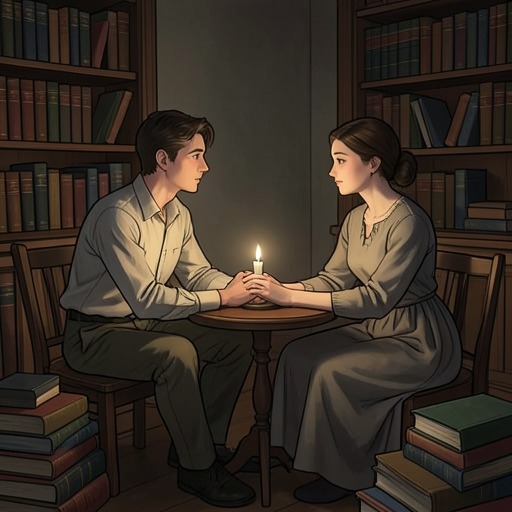
The undisciplined heart
David CopperfieldThe undisciplined heart names a movement from impulsive attachment toward a more attentive form of love. In David Copperfield, the phrase first articulates the danger of letting an early feeling dictate a life; later, David recognizes his own past in it. His growth does not require him to love Dora Spenlow less, but to stop treating his ideal of her as a model she must fit and instead make room for the person she is.
Annie Strong’s Reflection
Annie Strong gives the idea its clearest formulation while explaining her earlier attachment to her cousin, Jack Maldon. She had liked him when they were young, and recalls that, had circumstances gone otherwise, she might have persuaded herself that she loved him and married him. In retrospect, she believes that such a marriage would have made her unhappy: their minds and purposes were not suited to one another. Her gratitude to Doctor Strong includes the recognition that his marriage to her kept her from following what she calls the first mistaken impulse of an undisciplined heart.
Annie’s account distinguishes the force of an early feeling from the judgment required to build a life with another person. She does not deny that the feeling existed; she questions whether it could have sustained a marriage. David listens closely, turning her words over in his mind before he understands their particular relevance to his own life. The idea therefore enters his story first as someone else’s hard-won judgment, one whose meaning he will later have to test against his experience.
Childhood, Dependence, and the Ideal of Innocence
The novel repeatedly associates women with childlikeness, but that description can carry different implications. When Betsey Trotwood first meets Clara Copperfield, she calls her a baby. Clara, nervous before the formidable visitor, describes herself as a childish widow and fears that she will be a childish mother. Her youthfulness is presented alongside her vulnerability, not as proof that she has no feelings or judgment of her own.
That vulnerability becomes sharper in Clara’s marriage to Edward Murdstone. She asks him to consult her sometimes and recalls that he once seemed pleased by her inexperience and girlishness; now, she says, he is severe with her. Her request is modest, but the scene makes clear how little room she has to participate in the decisions shaping her home. Here, childlike dependence is not simply an affectionate image: it accompanies a lack of authority.
After Clara’s death, Peggotty recounts her final hours to David. He remembers his mother not as she had been in her last period of life but as the young mother of his earliest impressions, with bright curls and the memory of dancing with him at twilight. The adult narrator observes that Peggotty’s account strengthened this earlier image rather than restoring the later one. The movement of memory itself is important: David’s recollection turns his mother into an image of tenderness and infancy, a powerful but partial way of keeping her near.
David’s Idealization of Dora
When David first meets Dora at her father’s house, the introduction overwhelms his judgment. On hearing her name and seeing her, he describes himself as captive and in love at once. He imagines her as more than human, a fairy-like figure who seems to embody everything he could desire. The speed and completeness of this idealization make the encounter an instance of feeling arriving before knowledge of the person who has awakened it.
Marriage does not immediately correct that imbalance. David continues to love Dora, and their domestic life includes real mutual affection: he carries their practical cares and projects, while she holds the pens; she is proud of him and delighted by the success of his writing. Yet he also recognizes that he had tried to adapt her to himself, an effort he found impossible. His early love was not false, but its intensity had not taught him how to understand their differences.
Discipline as Adaptation
Annie’s words return persistently to David as he considers his marriage. He comes to see that, if his heart had been disciplined when he first loved Dora, it could not have felt in quite the same way when they married. This recognition is not a rejection of the marriage. It is a reassessment of the assumptions David carried into it: love cannot make two people alike simply because one has imagined a shared ideal.
David’s response is to adapt himself to Dora rather than continue trying to reshape her. He resolves to share what he can and bear what he must, while remaining happy with her. He reports that this change made their second year much happier than their first and made Dora’s life more joyful. The important consequence is practical and relational: discipline means adjusting his expectations to their actual life together, not demanding that Dora become a different person.
Limits of the Lesson
David’s understanding develops in the shadow of Dora’s failing health. He had hoped that help from others, and the arrival of a child, might change his child-wife into a woman; that hoped-for transformation does not occur. The language exposes a limit in his earlier outlook: even when he begins to question his idealization, he can still imagine Dora’s development as something that would make her fit a role he has anticipated.
The novel therefore places two ideas beside each other. Annie’s recollection warns against allowing an undisciplined first impulse to determine a marriage, while David’s experience shows that mature affection requires ongoing accommodation to another person’s nature and capacities. His growing recognition brings greater happiness within the marriage, but it does not erase their differences or control the course of Dora’s life. The concept is both an ethical lesson in attention and a measure of how difficult it is to love someone without confusing that person with one’s hopes for them.