
Delia Ortiz and Lani Walker’s Uneasy Kinship
Day of the DeadThis thread traces how Delia Ortiz’s resentment of Lani Walker’s place in the Ortiz family gradually gives way to recognition, practical cooperation, and shared care.
increasing Bearing strength in each event
 decreasing
Bearing strength in each eventdecreasingA Family Place in Dispute
Kinship Under Strain
Delia’s Resentment
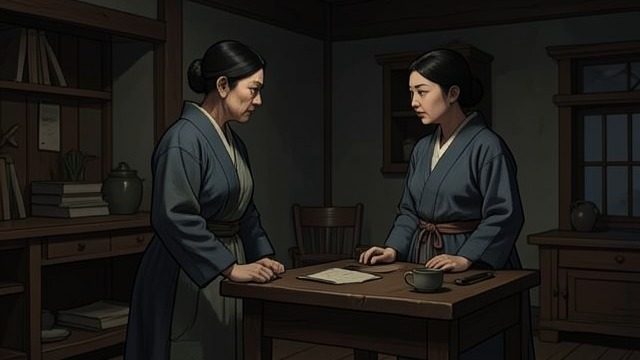
Delia Ortiz sees Lani Walker as an interloper whose bond with Gabe and Wanda Ortiz seems to push aside their biological son Leo and the family Delia has built with him. Her concern is intensified by earlier disputes about funding Lani’s medical education and by Delia’s sense that Gabe’s attention often centers on Lani.
The disagreement has both practical and emotional roots. Delia has invested in her role as tribal attorney and daughter-in-law, yet she fears that Lani’s closeness to Gabe gives the younger woman a special authority she herself has not earned or been offered.
A Relationship Not Yet Reconciled
Gabe notices that Delia and Lani are not friends and worries that their conflict could divide the people around him. Delia’s position is not simply dislike: she is also protecting a place in the family that feels precarious and measuring herself against a younger woman whose spiritual calling is publicly affirmed.
At this stage, neither woman fully understands the other’s vulnerability. Delia sees Lani’s belonging as an intrusion; Lani’s attention is largely fixed on Gabe’s illness and her own distance from home.
The Funeral Test

Grief Makes Kinship Visible
Delia Speaks First
At Gabe’s funeral, Delia unexpectedly stands to speak. She tells the community that Gabe saved her life twice: first by helping her mother leave an abusive situation so Delia could be educated, and later by offering her a position that brought her back to the reservation.
Her speech acknowledges a bond she had not fully honored while Gabe was alive. She describes him as a good and honorable man, despite their disagreements, and admits that her life is shaped by the help he gave her.
Lani’s Turn to Speak
Lani then tells the gathering that Gabe and Wanda were her godparents and that Gabe stood beside her after a difficult time. Delia resents her presence at first, questioning what right Lani has to speak as family, but Lani’s words make no false claim or attempt to displace anyone.
Hearing Lani forces Delia to recognize that Gabe exerted a formative influence on both women. Delia begins to see that Lani’s grief is genuine and that the young woman’s place in the family was created by years of care, not by a desire to compete with Leo or Delia.
A Small Gesture of Courtesy
Courtesy Before Understanding
Meeting at the Door
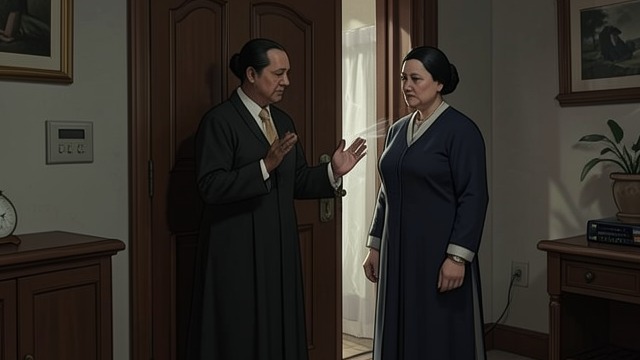
When Lani answers the door at the Ortiz home, Delia apologizes, though it is unclear whether she means the death or some deeper tension between them. Delia forces herself to be civil, and Lani receives her without turning the moment into an argument.
Neither woman is ready for a full reconciliation. The funeral has unsettled Delia’s certainty, but grief and family obligations leave little time to talk through old resentments.
A Pause in the Conflict
Their brief exchange matters because it replaces open hostility with restraint. Lani does not demand recognition, and Delia does not make the encounter a test of who belongs more.
The relationship remains strained, but the funeral has made room for a new interpretation: their connections to Gabe are different, yet both are real. This small courtesy becomes the groundwork for the cooperation that will be required later that night.
The Birth on the Road
Cooperation in an Emergency
Labor Interrupts the Feast
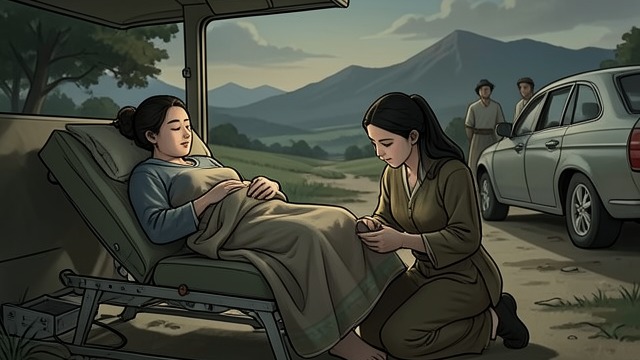
After hours of funeral preparations and service, Delia’s water breaks while she is still at the feast house. Her contractions become too strong and frequent for her to reach the hospital in time, and Lani recognizes that they must stop and respond immediately.
The two women’s roles shift from rivals over family belonging to people facing a concrete emergency. Delia is exhausted and frightened; Lani concentrates on what must be done, while Christine, Kath, and Wanda help prepare the car and light the scene.
Lani’s Hands-On Care
Lani delivers Delia’s baby in the back of Diana’s convertible and helps cut the cord with improvised supplies. She then places the healthy newborn in Delia’s arms and asks what she will name him.
The crisis creates trust through action rather than confession. Lani does not use the moment to assert her spiritual status, and Delia accepts her help because it is competent and necessary. The shared experience gives their relationship a new intimacy grounded in care for both mother and child.
A New Family Future
A Changed Understanding
A Child Named for the Family
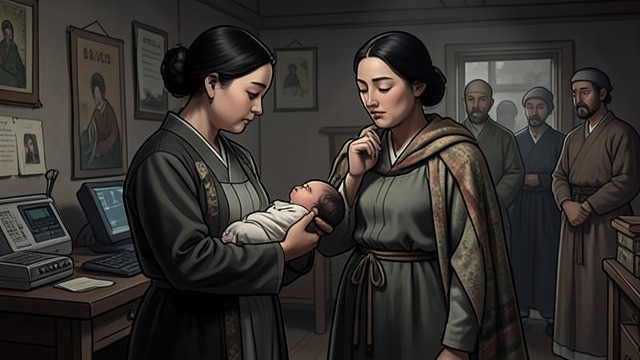
Delia names her son Gabriel Manuel, honoring both grandfathers. Lani calls him beautiful and perfect, and her response shows that she understands the baby as belonging to a family larger than the tension between herself and Delia.
Delia has just received Lani’s help in a vulnerable moment, while Lani has carried out the practical care that makes the birth possible. Their connection is no longer only an abstract argument about family status; it has become a shared memory with a child at its center.
Possibility Beyond Rivalry
Lani believes the child may be interested in learning the traditions Gabe and Rita taught her, and she imagines herself passing that knowledge onward. That hope does not require Delia to adopt Lani’s spiritual interpretation, nor does it erase the earlier hurt between them.
Instead, the birth opens a possible future in which both women can contribute to the same family in different ways. The bond remains unfinished, but the emergency has shown them that cooperation can create trust where argument alone could not.
April 2002, before Gabe Ortiz’s death
At Gabe Ortiz’s funeral in late April 2002
At the Ortiz Compound on the day of the funeral
Late on the night of Gabe Ortiz’s funeral
Immediately after Gabriel Manuel Ortiz is born
