Andrea Raises the Possibility That Roseanne Was Assaulted at the Hospital
Day of the DeadAndrea Tashquinth’s account gives Brandon Walker a neglected lead in the investigation of Roseanne Orozco’s murder: Andrea believes her sister was sexually assaulted at the hospital before she disappeared. Her statement does not establish that an assault occurred or identify a perpetrator. Its significance lies in what the old case had failed to examine: Roseanne’s time in hospital, the circumstances of her second discharge, and the possibility that the family’s assumptions had narrowed the inquiry too soon.
The Question Behind the Lead
Brandon asks Andrea how Roseanne could have become pregnant when, as Andrea and her mother understood it, Roseanne had no boyfriend and their father was not responsible. He also asks whether another man or boy regularly visited the household. Andrea remembers no cousin, younger brother, or other familiar visitor who might explain the pregnancy. When Brandon asks what she does remember, she initially says nothing. The pause matters: the lead emerges not as a prepared accusation but after he leaves space for her to speak.
The conversation takes place in Brandon’s Suburban on a hot afternoon. Outside, families arrive at a store in pickups, vans, and SUVs, children laughing as they go in and out with grocery carts. Brandon keeps quiet; Andrea is the one who eventually breaks the silence. In that ordinary setting, the investigation turns from the family home toward the hospital up the road. Her recollection changes the possible geography of the case, without resolving what happened there.
Andrea’s Recollection of the Hospitalizations
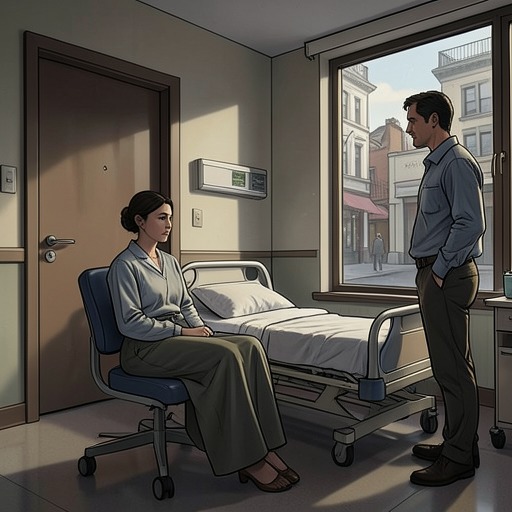
Andrea says she tried to tell Law and Order at the time that something had happened at the hospital, but nobody listened. She identifies the Indian Health Services Hospital nearby as the place she had in mind. Her account distinguishes two hospital episodes. During the summer, Roseanne became sick and underwent an appendectomy. She was expected to recover after leaving the hospital, but she remained unwell and was too sick to attend school when the school year began.
Their mother then took Roseanne to a doctor, who admitted her to the hospital for tests. When Roseanne was released, their father was supposed to pick her up after work and bring her home. By the time he arrived, she was gone. The family and others assumed she had left the hospital on her own. The following week, someone found her body in an ice chest along the road. Andrea’s account therefore places the disappearance at the second hospitalization, while her suspicion reaches back to the earlier stay for surgery. The distinction matters: the sequence supplies questions for an investigation, not proof that either stay involved an assault.
An Accusation Without an Identified Assailant
When Brandon asks directly whether Andrea believes something happened during the first hospital stay, Andrea turns to face him and insists that she knows something happened to her sister. She believes Roseanne was raped. Asked by whom, however, Andrea cannot say. She suggests possibilities rather than naming a suspect: someone employed at the hospital, such as an orderly or nurse, or perhaps a person visiting another patient. Her recollection that there were male nurses at the time makes the possibility concrete to her, but it does not identify anyone or independently confirm the allegation.
Andrea also explains why the possibility was not pursued then. She was sixteen when she tried to raise it, and the people around her were not interested in her opinion. Her parents did not listen either. Andrea says she had no communication from Roseanne that would substantiate her feeling; when Brandon asks what made her think of the hospital, she concedes that it may have been nothing more than a feeling. That qualification preserves the uncertainty in the lead. Andrea is neither presenting a confession from Roseanne nor claiming to know who harmed her. She is asking the investigation to take seriously a possibility that others had set aside.
Brandon’s Response and the Case’s Uncertainty
Brandon asks whether Roseanne communicated anything about an assault, and Andrea answers that she did not. Rather than treat the absence of a disclosure as a reason to close the question, he writes a reminder in his notebook. His work with The Last Chance has taught him that a cold-case investigator must follow up on leads earlier investigators ignored. The gesture is modest, but it marks a change in the inquiry: Andrea’s recollection becomes something to check rather than another discarded opinion.
The exchange does not solve Roseanne’s murder. It leaves the suspected assault unverified, the possible assailant unknown, and the hospital timeline in need of investigation. It also complicates the earlier focus on the family, where suspicion had fallen on Roseanne’s father even as Andrea and her mother believed he had nothing to do with the pregnancy. Andrea’s account redirects attention without exonerating anyone or establishing a new culprit. Its lasting importance is procedural as well as narrative: a sister’s once-dismissed memory gives Brandon a specific lead, and the case’s uncertainties become grounds for further inquiry rather than reasons to stop.