Diana Ladd
Day of the DeadDiana Ladd is Brandon Walker’s long-time partner and wife, a former teacher on the Tohono O’odham Reservation, and a central caretaker in the family formed around Brandon and Lani. Her life binds together several strands of the novel: Brandon’s first encounter with her during a homicide investigation, the family’s effort to bring Lani home, and the renewed attention to Roseanne Orozco’s unresolved case. She is both an intimate witness to Brandon’s history and a practical presence in the emergencies that follow.
Identity and Background
Diana had taught on the Tohono O’odham Reservation before becoming a local luminary in Tucson. Brandon first came to her mobile home in a teachers’ living compound near Topawa, looking for her first husband, Garrison Ladd, who was a suspect in a homicide Brandon was investigating as a Pima County detective. The visit belonged to a case; the connection that followed became a marriage lasting more than twenty-five years. The narrative thus places their shared life against the history of Brandon’s work, without making their first meeting a simple romantic beginning.
At the time of the Tucson Man and Woman of the Year benefit gala, Diana is asked to deliver an introductory speech for the honorees, Gayle Stryker and Lawrence Stryker, friends from her teaching days. She arrives in a deep blue, full-length taffeta gown, with auburn hair now streaked naturally with gray and drawn into a French twist. A diamond solitaire at her throat had cost more than Brandon’s first house. The detail establishes the formality of the evening and Diana’s public standing; it also contrasts with Brandon’s private unease about the couple she is there to honor.
Marriage and Family Life
Diana and Brandon’s long marriage is shown not as an absence of friction but as a durable intimacy. Years after their first meeting, Brandon still regards her as beautiful, and their history is measured across decades: she had once been waiting in a teacher’s compound near Topawa; now they share a home near Gates Pass and the ordinary rhythms of family life. The passage of time matters because the old homicide investigation and its unresolved questions continue to reach into their present.
Their differences as parents are particularly clear through Lani’s perspective. Lani understands her father as the softer, more easily persuaded parent and Diana as the disciplinarian. From childhood, she has been adept at playing one parent’s response against the other’s. This is not presented as a rupture in the family, but as a familiar pattern within it: Diana sets firmer limits, while Brandon is more readily moved by his daughter’s appeals. Their contrasting approaches give Lani room to maneuver and help define the family’s internal balance.
Diana’s care also appears in unceremonious domestic work. At a gathering where people are talking about trucks, Brandon expects that she may be ready to go home; instead, he finds her wrapping corn husks around meat-filled masa. The task is specific and practical, a quiet counterpoint to the public speeches and investigations elsewhere in the story. Later, when Lani is upset, Diana is in the kitchen unloading the dishwasher. The scene offers no explanation for her own distress, but it places mother and daughter in a shared domestic space at a moment when Lani’s return to family life is still unfolding.
Loyalty, Conflict, and the Roseanne Case
Diana’s friendship with the Strykers complicates Brandon’s renewed attention to them. At the gala, he intends to remain agreeable but says nothing about what troubles him. During a later Christmas-vacation exchange, Diana is angry that he has brought his suspicions into the holiday and challenges his objection to Gayle and Lawrence, whom she considers perfectly nice people. Her response arises from the relationship she knows; Brandon’s reserve signals that he is carrying knowledge or suspicion he has not fully shared. The tension is consequential precisely because it does not erase their long partnership: it exposes a divide in what each believes about people familiar to Diana.
The old case also gives Diana a place, though not the role of investigator, in the story’s work of recognition. Fat Crack tells Brandon that he and Diana saved Lani and are giving her back to The People, while I’itoi has chosen Brandon to speak for Roseanne. The statement frames the couple’s rescue of Lani as an act with a communal dimension, and sets Brandon’s continuing responsibility to Roseanne beside it. When Brandon asks Diana whether she remembers the girl in the ice chest, he brings the case directly into their shared past and into their conversation. The question is brief, but it shows that the investigation is no longer only professional history: it has become something the marriage must accommodate.
Diana is also present in the movement toward Lani’s return. Brandon comes home carrying the medicine pouch Fat Crack has entrusted to him for their daughter and tells Diana whom it is meant for. The transfer makes Diana part of the family’s response to Fat Crack’s death and to Lani’s place within the community, even though Brandon is the one who receives the pouch. Her role is expressed through the family context around the object rather than through a separate explanation of her beliefs.
Care in Crisis and Ending
Diana’s practical attentiveness continues as the family moves through uncertainty. When Brandon returns to the house near Gates Pass and finds her convertible missing from the garage, he briefly fears that she and Lani are not home. He finds Diana safely in the office with her attention on her computer and Damsel at her feet. The scene corrects his alarm without explaining where the car has been or what Diana is doing on the computer. Later, Diana calls to say the car is clean, Lani is on her way home from Smitty’s, and the two plan to come into town for Mexican food at Karichimaka. The call makes her an active link between Brandon and Lani while also restoring the small shared plans of a family day.
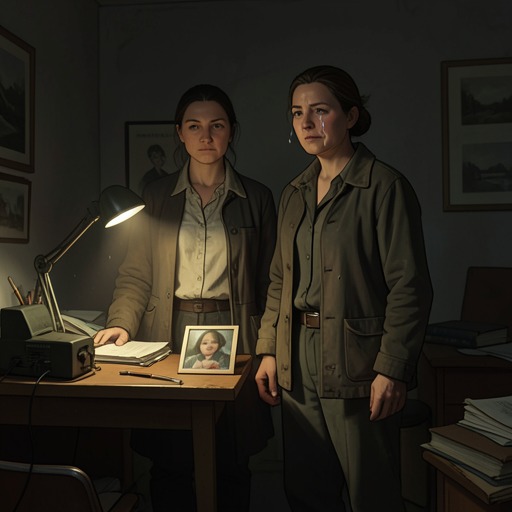
That ordinary connection is tested when Brandon suffers a heart attack and undergoes triple-bypass surgery at Tucson Medical Center. Diana explains the operation to him and, in the same breath, reproaches his doctor for focusing on his hip and knee without warning him about his heart. Her complaint gives way to tears. The reaction conveys the shock of the crisis without turning her into a detached medical narrator: she is the person who tells Brandon what has happened and the wife who has to face what it means.
Afterward, Diana sits dozing in a chair beside Brandon’s bed. He lets her sleep, reaches for a glass of water by himself, and notices a red rosebud in a vase. Diana clarifies that the flower is from Emma Orozco, who wanted to thank him but could not enter the intensive-care unit because only relatives were allowed. In this final gesture, Diana carries a message across a hospital restriction and into Brandon’s recovery. Her presence links private devotion to the gratitude generated by his work on Roseanne’s case, closing her arc not with a speech but with attentive care and a small, delivered sign of thanks.