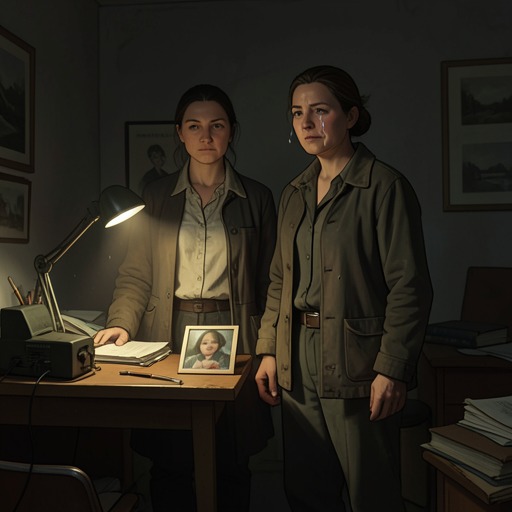
Garrison Ladd
Day of the DeadGarrison Ladd, the first husband of Diana Ladd, enters the story through a homicide investigation that entangles him with Andrew Philip Carlisle and brings detective Brandon Walker to Diana’s door. His death is initially understood as suicide, but the narrative later identifies that understanding as mistaken. Garrison’s limited presence is consequential: suspicion surrounding him, the loss Diana endures, and the case’s unsatisfactory resolution continue to affect the living long after he is gone.
Identity and Place in the Story
Garrison is identified as Diana’s husband and as a suspect in a homicide Brandon was investigating. The account does not provide a sustained view from Garrison’s perspective or establish the details of his private life. Instead, readers encounter him through the investigation, Diana’s responses, and Brandon’s memories. This indirect presentation makes him a point of uncertainty within the plot: he is connected to a serious crime, but the facts available in these recollections do not amount to a full account of his actions.
His connection to Carlisle gives that uncertainty a concrete shape. Carlisle was a professor of creative writing at the University of Arizona, and Garrison was one of his star pupils. The investigation into the murder of Gina Antone led Brandon to Carlisle and, eventually, to Garrison. The relationship places Garrison within the chain of people the case brought under suspicion, while leaving the precise nature and extent of his involvement unstated in the recalled account.
The Investigation and His Death
Brandon’s arrival at Diana’s mobile home took place during a stormy summer afternoon in a teachers’ living compound near the Papago village of Topawa. He had gone there to look for Garrison, who was then a suspect in the homicide investigation. By the time Brandon arrived, however, Garrison was already dead. Brandon and Diana did not yet know this; the detective questioned her about her husband’s activities and whereabouts without understanding that the person he sought could no longer answer for himself.
Garrison’s death was ruled a self-inflicted gunshot wound. The account later describes that as what was mistakenly thought to be a suicide, marking a gap between the original conclusion and the truth without supplying the full explanation here. The distinction matters: at the time of Brandon’s visit, Garrison’s death was unknown to both Brandon and Diana, and the circumstances had not yet altered the questions Brandon was asking. In retrospect, the scene is shaped by dramatic irony, since the detective and the wife sit within the investigation’s reach while missing a decisive fact about the suspect.
The case did not conclude with Garrison’s death. Carlisle, described as Garrison’s accomplice, faced the legal process and received a plea bargain that Brandon regarded as a slap on the wrist. The outcome left the detective dissatisfied and gave the investigation an unresolved emotional afterlife. The material does not specify the charge or sentence, so the significance lies in Brandon’s reported disappointment and in the continuing sense that the case had not reached a satisfying resolution.
Marriage, Loss, and Diana’s Response
Diana’s position in the investigation was not simply that of a witness. Brandon remembered her as answering difficult questions with poise and remaining loyal to Garrison, even though he believed she must have suspected some of what had happened behind her back. That recollection sets loyalty beside suspicion without explaining exactly what Diana knew. Her composure and allegiance are presented through Brandon’s perception, which is also marked by his attraction to her; the account therefore distinguishes what he observed from what he could know about her private understanding.
The investigation and Garrison’s death formed part of a larger accumulation of grief in Diana’s life. By the time the case’s consequences unfolded, she was dealing with Garrison’s death and the aftermath of the homicide investigation. Six months later, profoundly pregnant, she worked determinedly to ensure that Carlisle was sent to prison. Her actions show her continuing engagement with the case after her husband’s death, but they do not establish that she had been responsible for his suspected role or that she possessed complete knowledge of it.
Diana’s later recollection of the period emphasizes how much she was carrying. In 1970, she had a baby, Davy, and was helping Rita make a home habitable; she also recalled Garrison’s death as supposedly self-inflicted. The overlapping pressures help explain why she did not want to take in more accounts of violence. Garrison’s story thus remains present not only as a question of suspicion, but as part of the bereavement and exhaustion that shaped Diana’s response to later events.
Narrative Consequences
Garrison’s role connects the earlier Gina Antone investigation to Brandon and Diana’s enduring relationship. Brandon recalled first meeting Diana while seeking her husband, and he later understood that his attachment to her had begun at that encounter. The circumstances were professional and distressing: he was a detective asking questions in a homicide inquiry, while she was a wife facing the approaching consequences of a crisis. His affection did not erase that context; it grew out of a moment in which Garrison’s absence and suspected connection to the case defined why Brandon was there.
The case’s broader jurisdictional context also frames Garrison’s place in Brandon’s memory. Gina Antone had been murdered just off the reservation, and the investigation fell to the Pima County Sheriff’s Department; Brandon’s trail led from Carlisle to Garrison. When Roseanne Orozco’s murder later became a source of discussion, Brandon remembered the earlier case and the dissatisfaction left by Carlisle’s plea bargain. Garrison is not presented as a participant in that later murder. Rather, his case supplies part of the history through which Brandon understands another difficult homicide and the limits of a resolution that did not feel adequate.
As a result, Garrison functions less as a continuously depicted character than as a consequential absence around which other lives and recollections gather. His suspected connection to Gina Antone’s murder, his relationship to Carlisle, and the mistaken account of his death all remain important, but the evidence preserves uncertainty about the full truth. That restraint keeps the case’s unresolved quality intact: Garrison’s death closes his immediate presence, yet it does not settle what happened or undo the consequences for Diana and Brandon.