Lani Walker's sixteen-day purification ritual
Day of the DeadLani Walker’s sixteen-day purification ritual, or e lihmhun, follows her killing of Mitch Johnson and becomes a passage from survival toward a new understanding of her life and responsibilities. The ritual is not presented as a punishment: Fat Crack Ortiz explains that Lani’s act was justified self-defense, while insisting that taking a human life remains grave for her and her soul. Her return after sixteen days changes the relationship with her adoptive parents and deepens her connection to Tohono O’odham traditions.
Circumstances and Purpose
When Brandon Walker reached Ioligam, Mitch Johnson was already dead and Lani had killed him. Brandon expected to take his daughter home, but Fat Crack told him that she had chosen to remain by herself, fast, eat no salted food, and pray for sixteen days. Brandon protested the length and hardship of the observance, asking where she would sleep and what she would eat in the approaching summer. Fat Crack answered that Lani’s wishes mattered, and that the observance was what she had to do.
Fat Crack gave the ritual a purpose beyond compliance with custom. He explained that Lani had taken a human life, even though she had acted in self-defense and was justified. The act still required her to come to terms with what had happened and to consider why she was alive while Mitch was dead. In his account, the purification period joined reflection on the killing to a search for I’itoi’s purpose in her life. He also connected the practice to Lani’s identity as Kulani O’oks and to her potential to become a great medicine woman, a future he said required her to abide by the old ways.
The Sixteen Days and Fat Crack’s Care
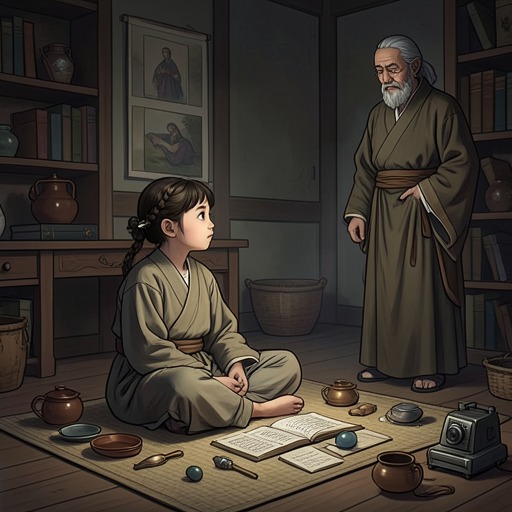
Although Brandon understood the observance as Lani staying alone, Fat Crack remained responsible for her care. He promised Brandon that he would look after her, describing this as one chief medicine man’s responsibility to another. During the sixteen days, he visited Lani every day, bringing soothing salve and the salt-free evening meal required by the fast. Their conversations gave Lani a setting in which to consider what she had done and what the time apart was for.
Lani’s recollection of the period includes the work she undertook while by herself. She made a medicine basket of her own and gave Nana Dahd’s basket to Davy because she knew he wanted it. When Fat Crack asked what she had done with the time, she also spoke of breaking pottery and releasing the spirit of the person it represented. Fat Crack acknowledged that she had put the period to good use, but returned her attention to the harder question: who she was after taking a life. The ritual thus encompasses practical making, spiritual reflection, and an effort to understand the consequence of the killing, rather than functioning only as a prescribed interval away from home.
The Final Night
On the last night, Fat Crack brought the evening meal and his huashomi, a fringed buckskin medicine pouch that had been given to him years earlier by the blind medicine man S’ab Neid Pi Has, also known as Looks at Nothing. After they ate together, Fat Crack drew a circle around himself and Lani with a stick. Inside it, he opened the pouch, took out wild tobacco, rolled it into a crude cigarette, and lit it with Looks at Nothing’s old Zippo lighter. Lani smoked the traditional peace smoke for the first time with Fat Crack, who was her family friend, godfather, tribal chairman, and respected medicine man.
The smoke left Lani light-headed, and she remembered some of their conversation only indistinctly. The questions she retained concerned the point of e lihmhun and why she had been required to remain apart for so long. Fat Crack’s response tied the rite to what she had done during it and to the work of understanding its meaning. The enclosing circle and shared smoke mark the final evening as a distinct moment within the observance: it is both a rite shared with her mentor and the threshold before her return to family life.
Return and Consequences
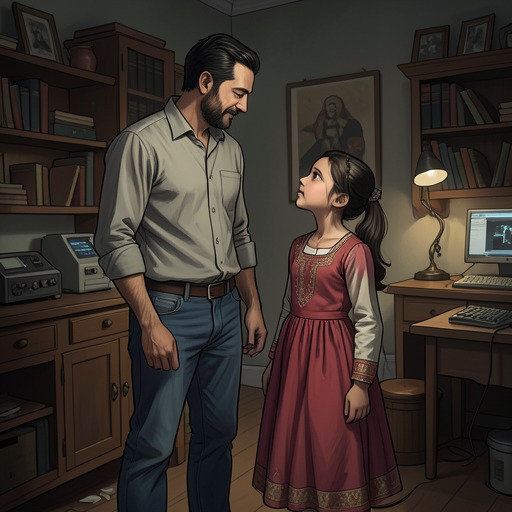
Brandon went home without Lani that Sunday. He held Diana Ladd as she wept and tried to explain why their daughter was staying away. He had difficulty accepting that Lani had turned to Fat Crack rather than to her parents at a moment of need, but recognized that arguing would not change her decision. Sixteen days later, Fat Crack brought Lani home to Gates Pass.
Brandon remembered her return as a marked change. She had left as a carefree teenager, still little more than a child; she came back a serious-minded young woman, more attuned to her Indian heritage. The shift did not take the form of a single rupture or argument. Lani remained their daughter, learned to drive, earned her license, and graduated from high school at the top of her class, yet the relationship with her adoptive parents was never quite the same. Brandon did not blame Fat Crack, but understood that Mitch’s kidnapping and death had taken something from the family that affection alone could not restore.
The ritual’s significance lies in this double consequence. It gives Lani a culturally grounded way to confront the fact that she has taken a life, while making visible a change her parents cannot direct or undo. Fat Crack’s care bridges the family’s distress and Lani’s commitment to the old ways; her return restores her to the household without restoring their earlier closeness. The sixteen days therefore mark not a simple return to normal, but Lani’s emergence with a more defined spiritual identity and a changed place within her family.