Lani's medicine basket
Day of the DeadLani's medicine basket is at once a work of her own hands, a container for inherited and recovered objects, and a practical part of her effort to understand what is happening to Fat Crack Ortiz. Lani made it for herself in the image of Nana Dahd's original, then filled it with things whose meanings come from family, tradition, and her own experience. When she turns to Looks at Nothing's crystals for answers, the basket holds the objects together—and, when the vision unsettles her, gives her a way to put them safely away.
Making and Meaning
Lani's basket is not simply an heirloom passed to her. She weaves it herself, aiming to make it as much like Nana Dahd's original as possible. Her work is respectable, though not quite as well made as the basket of Rita Antone's grandmother, Oks Amichuda. That comparison places Lani's craft within a lineage of basket-making while preserving the difference between an inherited model and her own attempt to follow it. The basket carries tradition, but its maker is also actively shaping her relationship to that tradition.
Lani first shares the story of her hair charm with Leah Donner, then reveals the basket as her prized possession. In the same confidences, she speaks about Fat Crack Ortiz's illness and her need to return home. The basket thus appears amid conversations in which Lani makes parts of her identity and loyalties known to a close friend. Its significance is personal as well as cultural: it is an object she made, keeps, and chooses to show to someone she trusts.
A Container for Inherited and Recovered Things
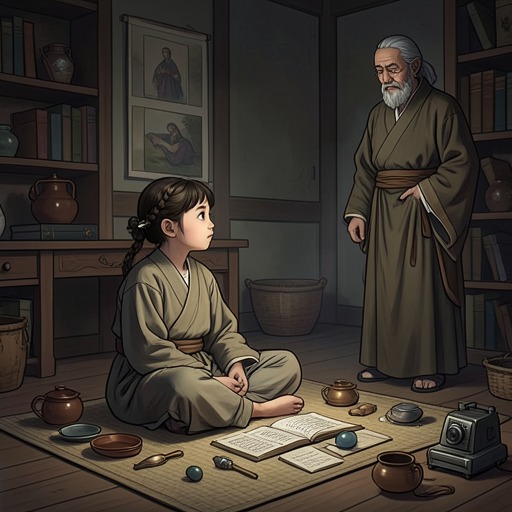
When Lani opens the basket during a night of unease, its contents make visible the several histories gathered within it. Among the objects that came to her from or through Nana Dahd are an ancient piece of red-clay pottery bearing a faint turtle image, a sacred scalp bundle, and a smooth bone awl Nana Dahd used to weave her baskets. The pottery belonged to Rita Antone's paternal grandmother, Understanding Woman. These objects connect Lani's basket to specific people and practices rather than to an abstract idea of ancestry.
Other contents belong to Lani's own experience. She has kept a blackened fragment of a broken pot and a delicate bone from a dead bat's wing, both retrieved from Betraying Woman's cave. The basket therefore holds inherited things beside objects Lani recovered herself. It gathers distinct histories without making them interchangeable: what came through Nana Dahd and what Lani brought back from the cave remain different kinds of possession, brought together in the same handmade vessel.
The Basket in the Divination
Lani has been troubled by a sense that something is wrong at home and believes Fat Crack Ortiz's illness may be the cause. With no one willing to tell her what is happening, she turns to a duajida of her own. She takes down a framed photograph from her high-school graduation, in which she stands between Gabe and Wanda Ortiz, retrieves the basket from her dresser, sits cross-legged on the floor, pries off its tight-fitting top, and spills the contents onto the rug. The small, deliberate actions change the basket from a stored possession into the center of an attempt to learn what she cannot otherwise discover.
She takes the soft chamois bag containing Looks at Nothing's crystals and spills the crystals into the basket, confining them there so none will be lost on the floor. Holding the photograph in one hand and a crystal in the other, she studies Fat Crack's face through the rock. Nothing happens with the first three crystals. With the fourth, his features shift; his face dissolves and reforms as a blond Anglo woman's face Lani has never seen, then as a bare skull. The vision is disturbing, but Lani does not know what it means or what the woman has to do with Fat Crack. The basket makes it possible to hold the crystals together during the test, but it does not resolve the mystery they reveal.
Restoration and Significance
Shaken, Lani carefully returns the crystals to their bag, puts the bag and the other treasures back into the basket, closes it, and returns it to its hiding place. The sequence reverses the opening: a tightly closed, concealed object becomes an arranged collection spread across the rug, then is restored to concealment when the divination leaves Lani more distressed than informed. She turns afterward to a different means of seeking help, sending three emails from her computer before going to sleep.
The basket's role is therefore practical and interpretive, not a solution in itself. It carries materials through which Lani confronts questions of inheritance, memory, and present danger, while its careful opening and closure frame her attempt to make sense of a troubling vision. Its contents bring the past into the room, but the final image is not certainty: Lani puts the objects away and continues searching elsewhere for answers.