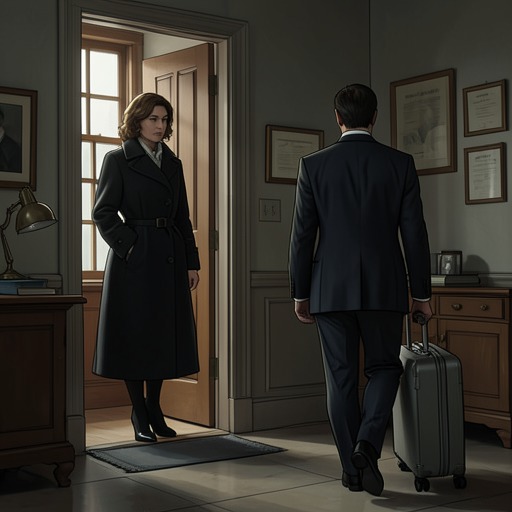
Larry Stryker—Gayle Stryker
Day of the DeadLarry Stryker and Gayle Stryker’s relationship is a marriage transformed into criminal complicity. After Larry disclosed that his abuse of Roseanne Orozco had resulted in a pregnancy, Gayle killed Roseanne; Larry then helped conceal what had happened. The marriage that had once rested on desire and vows became a private bond of shared responsibility and silence, helping both maintain a respectable public life while Roseanne’s murder went unaddressed for years.
Marriage and Separate Lives
Larry and Gayle had been married for ten years by the night of Roseanne’s death. They had first met when Gayle was an eighteen-year-old college sophomore, two years younger than Larry. The account presents their early relationship as physically passionate: Gayle knew how to draw Larry’s attention, and he remained strongly responsive to her years later. After Roseanne’s death, however, that intimacy carried a new and darker meaning. It became inseparable from the crime Larry knew Gayle had committed and from the secret he agreed to keep.
Their arrangement later made separation look like an ordinary feature of married life. After Gayle’s mother died, Larry moved to The Flying C, while Gayle remained in their El Encanto home. They could continue presenting themselves in public as happily married while pursuing separate lives. The divided households did not end their connection; they allowed the marriage’s public appearance to persist alongside the private distance and secrecy that shaped it.
Roseanne’s Pregnancy and the Turning Point
Larry’s disclosure followed a serious breach of his medical duties. After taking sexual advantage of Roseanne, a fifteen-year-old patient, he realized that a condom had failed. When Roseanne continued to be unwell, her mother, Emma Orozco, brought her back to the clinic several times. Larry eventually admitted her for tests, and the pregnancy test was positive. He feared the consequences of his actions, including losing his medical license, and told Gayle what had happened.
Larry had been drinking when he told her, and he did not know how she would respond. Gayle’s anger was immediate. She asked for the keys, and when Larry returned with water and cleaning supplies, she directed him to help dispose of clothing and clean up. Her explanation, as Larry understood it, was that she had solved the problem he had brought home. The sequence makes the imbalance between the spouses plain: Larry’s misconduct created the crisis, but Gayle acted decisively, and he followed her instructions without summoning the authorities.
The event changed how Larry understood his wife. He had considered Gayle ambitious and headstrong, but had not thought her capable of murder. Once he believed she had killed Roseanne, he could not treat her action as separate from his own wrongdoing. He knew that he had abused a vulnerable minor and exposed himself to professional and criminal consequences; he also believed that his actions had driven Gayle to the crime. His sense of responsibility did not erase the difference between their acts, but it made the marriage a place where blame and allegiance became difficult for him to separate.
Intimacy, Complicity, and Silence
After the killing, Gayle’s attention to Larry and their renewed intimacy intensified rather than restored their former marriage. Larry later understood that Gayle was not behaving as though she regretted what she had done. Her apparent excitement, followed by his participation in their closeness, drew him into an emotional complicity as well as practical concealment. In his reckoning, the relationship had helped turn the crime into a shared secret: he had cleaned away evidence, failed to report her, and accepted the intimacy that followed.
By dawn, Larry viewed their unspoken agreement as more binding than their wedding vows. He had broken marital promises before without believing that they held him, but this secret was different. Gayle’s crime and his concealment of it had made separation seem impossible; he also recognized that a part of him accepted the bond. The marriage thus joined coercive pressure, guilt, and attachment without reducing them to a single motive. Larry feared what disclosure would mean, blamed himself for the chain of events, and remained drawn to Gayle even as he understood the danger of their shared silence.
In the months afterward, their relationship changed again. Gayle became more demanding about Larry’s sexual conduct and questioned whether he had been unfaithful. The change made sex an explicit issue between them where it had not been before. Her attention to his affairs suggests a new form of control and scrutiny within the marriage, following a crime that had already made Larry feel implicated and unable to speak freely. The evidence does not depict a return to the earlier, uncomplicated pattern of their relationship; instead, intimacy had become bound to the consequences of the secret they shared.
Public Respectability and the Crime’s Afterlife
The contrast between the Strykers’ public standing and their private conduct endured. Larry later reflected that he might have lost his medical license and his place among Tucson’s respected citizens if Gayle had not acted as she did. The same reflection shows how completely the murder had altered both spouses: Larry’s career and reputation survived, while the concealment of Roseanne’s death remained a defining fact beneath the marriage’s public facade.
The truth also had witnesses beyond the couple, but their accounts were not taken seriously at the time. Andrea Tashquinth later recalled that she had tried to tell Law and Order that Roseanne’s disappearance was connected to the hospital, and that nobody listened. She had also tried to offer her account when she was sixteen, but adults had disregarded her because of her age and because suspicion had settled on her father. Years later, Emma Orozco rejected the claim that there was no hospital record of Roseanne and concluded that someone at the hospital had been involved. These later revelations expose the limits of the Strykers’ secrecy: it concealed the crime for years, but it could not erase the recollections and records that eventually reopened questions about Roseanne’s disappearance.
As a relationship, the Strykers’ marriage is defined less by a final separation than by a lasting entanglement. A shared household was no longer necessary for them to maintain the appearance of a couple; nor did private distance undo the agreement formed after Roseanne’s death. Larry’s guilt, Gayle’s decisive violence, their intimate bond, and their outward respectability all became parts of the same concealed history.