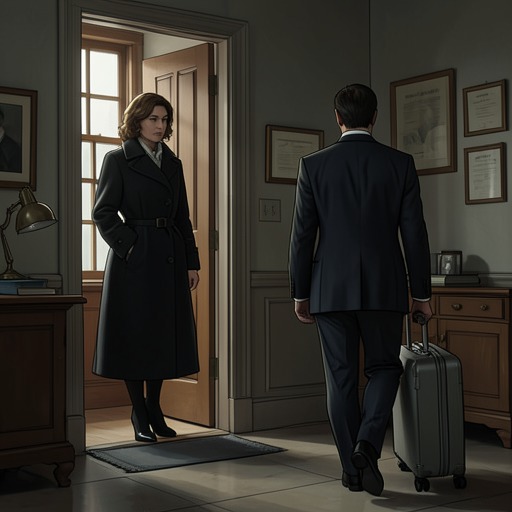
Larry Stryker's assault of Roseanne Orozco
Day of the DeadLarry Stryker’s assault of Roseanne Orozco was not an isolated breach of medical care but one instance of a longstanding scheme in which doctors exploited female patients under sedation. Roseanne was fifteen, had been admitted for treatment of a ruptured appendix, and was due to leave the hospital the next day. Larry’s assault led to her pregnancy; the discovery set off a chain of concealment and violence that ended in her murder and reshaped both Larry and Gayle Stryker. The episode exposes how professional authority and gaps in oversight made repeated abuse possible, while Roseanne’s muteness and the later dismissal of her family’s concerns left the harm difficult to recognize and pursue.
The Hospital Scheme
Larry later described the abuse as having grown out of a seemingly inconsequential misstep. He and other young doctors at the reservation hospital treated their conduct as a reward for working at an isolated facility. When a high school girl became a patient, the doctor responsible for her care would alert the others. During evening rounds, that attending physician administered a sedative in a dose intended to render her unconscious; the other doctors then entered her room in turn and assaulted her. The girl would wake after the night, surgery, or procedure without knowing what had happened. The doctors treated the routine as harmless, but its operation depended on the patients’ vulnerability, their trust in medical staff, and the concealment that sedation enabled.
For years, the doctors used condoms, ostensibly to protect themselves and the patients from sexually transmitted infections. That precaution did nothing to make their actions consensual or medically legitimate. Larry’s condom broke while he assaulted Roseanne, and he immediately understood what had happened but told no one. His silence preserved the scheme temporarily and left Roseanne, rather than the person who had harmed her, to bear the consequences. The narrative’s account of the broken condom marks a turning point in Larry’s private recollection, not an excuse for the assault: what changed was the risk of discovery, not the nature of his responsibility.
Roseanne’s Pregnancy and the Disclosure
Roseanne had already endured a traumatic experience at school as a very young child. Her sister, Andrea Tashquinth, recalled that after a principal forcibly removed Roseanne from her, shut her in a dark closet, and made Andrea return to class, Roseanne stopped speaking and never spoke again. Her parents sought help from doctors in the area and in Phoenix, and also consulted a medicine man, but none helped her. This history matters to the hospital episode because Roseanne’s silence was part of her life long before Larry assaulted her; it should not be mistaken for evidence that she was unharmed or unable to suffer.
After Roseanne left the hospital, her mother, Emma Orozco, brought her back to the clinic several times because she was not getting better. Larry initially kept the assault secret. He eventually admitted Roseanne to the hospital for an extensive battery of tests, and the pregnancy test was the only one that came back positive. Roseanne was due to be released the following day after her treatment for the ruptured appendix. Larry told Gayle that afternoon as soon as he learned the test result. His disclosure moved the crisis into the hands of a spouse who had already participated in the couple’s concealment, with fatal consequences for Roseanne.
Concealment and Consequences
Larry later wondered what might have happened had he not told Gayle. He thought he might have lost his medical license and would not have become one of Tucson’s most respected citizens. This is his own retrospective calculation, centered on the career and public standing he retained; it does not lessen the harm to Roseanne. The aftermath, he acknowledged, changed both spouses. Gayle became more controlling and increasingly focused on his sexual conduct, while their shared response to the pregnancy tied his private wrongdoing to her subsequent violence.
The couple’s alibis for the night Roseanne died proved unnecessary: neither Law and Order nor the Pima County Sheriff's Department asked them where they had been or what they had done. Years later, Larry still wondered how one act had shaped the course of his life, but his recollection also points to the surrounding institutional failure. The doctors had relied on routine, medical access, and the expectation that their patients would leave unaware; afterward, investigators did not question the couple. Roseanne’s assault thus sits within a wider pattern in which people with authority could exploit girls with little effective protection or scrutiny.
The Buried Case and the Wider Pattern
When Andrea later tried to explain that she believed Roseanne had been harmed at the hospital, she said the people investigating the case had not listened. At sixteen, she had little authority in their eyes, and her suspicion that someone at the hospital might have taken Roseanne was set aside while suspicion fell on her father. Her account also supplied a concrete outline of Roseanne’s last known movements: after her appendix operation and later tests, their father was expected to collect her from the hospital, but she was already gone. Her body was found the next week in an ice chest beside the road.
The old investigation’s blind spots persisted in the handling of hospital records. Emma later challenged the claim that there was no record of Roseanne Orozco ever being admitted: the same records showed Emma’s own hospitalizations, including the births of Andrea and Roseanne. That discrepancy does not by itself establish who removed or lost Roseanne’s record, but it reinforced Emma’s and Andrea’s belief that the hospital was central to the case. Their testimony and the missing documentation turn the assault from Larry’s private recollection into part of a larger inquiry into a death that had gone unexamined for years.
The broader pattern also extended beyond the hospital. Larry recalled that Gayle could obtain new girls for him through detention centers served by Medicos for Mexico. The charity gave the Strykers money, public respectability, and access to a recurring supply of vulnerable girls; its limited outside scrutiny and poorly specified expense accounts also helped fund their lavish life. This larger system does not establish that every girl supplied through the organization experienced the same abuse, but it shows how the couple’s resources and standing helped sustain exploitation. Roseanne’s case is decisive because the assault produced a pregnancy that threatened to expose Larry, and the response to that threat joined his abuse to Gayle’s murder and their years of apparent impunity.