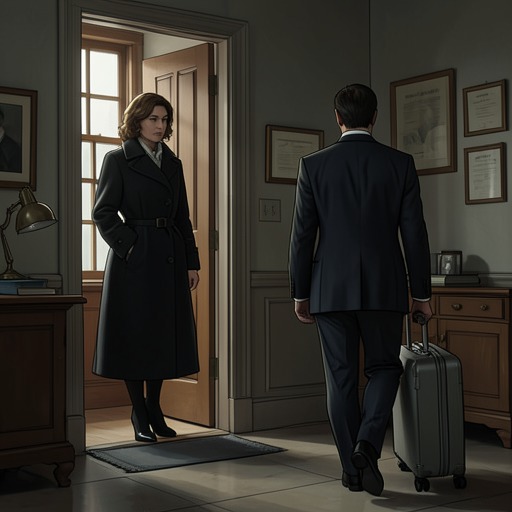
Medicos for Mexico’s criminal corruption
Day of the DeadMedicos for Mexico’s criminal corruption turned a cross-border medical charity into a cover for exploitation, private enrichment, and the supply of vulnerable girls to Gayle Stryker and Larry Stryker. Its respectable public identity concealed a system that joined professional abuse to institutional privilege and financial concealment.
Origins in Medical Abuse
The conditions that led to Medicos for Mexico began at a reservation hospital, where Larry and other young physicians treated the sexual abuse of sedated high-school patients as a shared diversion. The girls were patients under their care and could not consent; the doctors used their medical authority to make the assaults possible while expecting the girls to leave the hospital unaware of what had happened. The practice continued for years before Larry’s condom broke while he was abusing Roseanne Orozco, who was recovering from surgery. When Roseanne’s mother, Emma Orozco, repeatedly brought her back for care, Larry eventually admitted Roseanne for further tests. A pregnancy test was positive. The result exposed the consequences of the doctors’ abuse and threatened Larry’s career and standing.
Gayle treated the danger to Larry as a threat to their carefully maintained respectability and took action to prevent the scandal from becoming public. Two years later, a former associate’s plea bargain disclosed the hospital abuse and named Larry and other physicians; they were dismissed from the Indian Health Service. Yet the disclosure did not end their medical careers. Connections helped keep the story out of local newspapers, and the rules governing disciplinary records kept the lists from state and national medical associations. The gap between serious abuse and limited professional accountability became part of the environment in which Gayle could build a new source of money and influence.
A Charity Built as Infrastructure
Medicos for Mexico began after Gayle Stryker learned that she could use Larry Stryker’s abuse of vulnerable girls to exert control over him. Her parents supplied the initial capital: Gretchen wrote a check, while Calvin’s death left Gayle the ranch and additional assets. The charity’s public purpose gave her a respectable institutional framework, but the narrative connects its creation to the private system of coercion she was developing around Larry.
Over time, the cross-border organization became both a source of income and a means of obtaining girls for the Strykers. Its network reached detention centers served by Medicos, from which Gayle could arrange for girls to be brought to Larry. When he had grown accustomed to one, Gayle could remove her and leave him without a replacement until another girl became available. The charity thus did more than provide access: it let Gayle regulate that access and keep Larry dependent on her decisions. She sometimes watched what he did to the girls; at other times, she took part herself.
The organization’s public standing and private uses reinforced one another. Gayle was skilled at cultivating donors, and once contributions entered Medicos’ accounts, the charity faced little outside scrutiny. It paid both Gayle and Larry generous salaries and covered some of their affluent lifestyle through vaguely described expense items; Gayle also skimmed funds to help finance a nearly completed mansion in a gated compound outside Cabo San Lucas. The same institution that supplied money and community respectability also sustained the exploitation hidden behind them.
Money, Mobility, and Concealment
As the investigation threatened the Strykers’ arrangement, Gayle considered emptying Medicos’ accounts and moving the money to Mexico or the Cayman Islands. She reasoned that the funds would go further if she did not have to divide them with Larry, and regarded him as expendable. The proposed transfer extended the charity’s corruption beyond the ongoing exploitation: its accounts could also become a means of financing Gayle’s departure and separating her future from her husband’s.
The Record and the Investigation
The charity’s criminal uses were concealed by more than its respectable public standing: the later effort to investigate Roseanne Orozco’s abuse encountered a hospital record that did not account for her admission. Emma Orozco was told that the hospital had no record of Roseanne ever being admitted, but Emma’s own file documented three admissions, including visits connected with the births of both daughters. The discrepancy did not establish who had removed or lost Roseanne’s records, but it strengthened Emma’s conviction that someone at the hospital had been involved. Her insistence made the missing documentation consequential: the institution whose medical authority had enabled the original abuse now offered no clear record to help explain it.
Institutional Silence and Unequal Accountability
The charity’s private exploitation unfolded against a wider pattern of institutions failing to protect vulnerable girls. Near Vail, a woman walking her dog discovered an arm; deputies found the rest of an unidentified girl’s dismembered body in garbage bags. When Brian Fellows later sought the case file, a sheriff’s investigator said the victim had never been identified and dismissed the case as one involving an undocumented immigrant whose death did not merit further attention. The evidence does not connect Medicos for Mexico to this killing, but the episode sharpens the larger contrast: Medicos used its public respectability and weak oversight to conceal abuse, while official indifference could leave a vulnerable victim unnamed and her death unpursued.