Papago Tribal Police Force
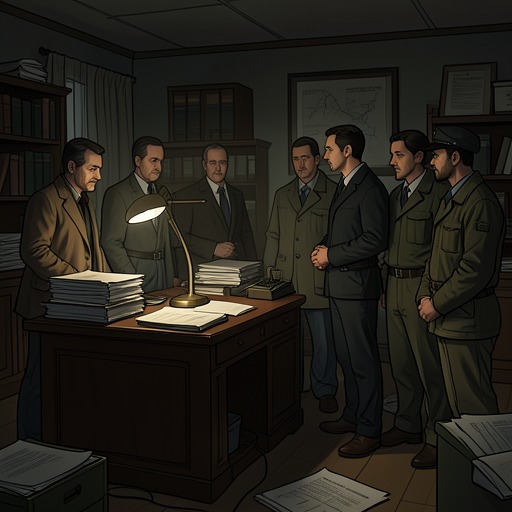
Day of the DeadThe Papago Tribal Police Force, known in the novel by the informal name Law and Order, is the local tribal law-enforcement authority called to investigate Roseanne Orozco’s 1970 murder on the reservation. Its part in the case is defined less by a successful resolution than by the limits under which it worked: it suspected Henry Orozco, could not prove the suspicion, and allowed the inquiry to go cold. The case also shows how divided jurisdiction and inadequate resources shaped what could be investigated—and what was left unanswered.
Jurisdiction and institutional setting
The novel contrasts Roseanne’s case with the murder of Gina Antone, which took place off the reservation and involved Anglo perpetrators. Because that crime fell within the jurisdiction of the Pima County Sheriff’s Department, Brandon Walker investigated it. Roseanne’s presumed murder site, by contrast, was thought to be somewhere on the reservation, although investigators never found the actual location. The presumed identity of her killer—a fellow Indian—placed the case under either the Federal Bureau of Investigation or the local tribal police.
That division of responsibility mattered in practice. The novel describes FBI investigations into reservation murders as often cursory, particularly when both victim and suspected perpetrator were Native. In Roseanne’s case, the Papago Tribal Police Force was summoned, but it lacked three essentials for an effective investigation: training, equipment, and money. The account does not present those deficiencies as an individual officer’s failure; they are the institutional conditions under which the force was expected to investigate a serious homicide.
The Orozco investigation
The force’s investigators suspected that Roseanne’s father, Henry, had abused her and fathered her unborn child. The possibility arose because no one knew of a boyfriend or other identified father. Emma Orozco later told Brandon Walker that investigators had raised the accusation against Henry, upsetting both parents. Diana Ladd, who had known Henry, rejected the suspicion, while Emma’s account likewise maintained that he had done nothing of the kind.
The suspicion was never converted into proof. In 1970, DNA testing was unavailable, and paternity was harder to establish. Henry was therefore neither tried nor cleared; the unresolved accusation remained attached to him. Once the Papago Tribal Police Force let the investigation go cold, Henry was willing to leave it alone as well. The case did not yield an identified killer, and Emma’s later explanation made clear to Brandon that the investigation had reached no conclusive outcome.
The novel places that failure within a larger difference in how reservation and off-reservation murders were pursued. Roseanne’s death was not Brandon’s case at the time, and he had been occupied with his own circumstances; he had not followed its eventual disposition. The force’s lack of resources and the broader division of investigative responsibility help explain why the case could recede from official attention, even while the loss remained central to Roseanne’s family.
The cold case and its afterlife
More than thirty years later, Emma decided to reopen the question of her daughter’s death. She had waited because her husband had urged the family to forget the past; after Henry’s death, she told Brandon that she wanted to know what had happened. Brandon understood the effort involved in speaking about the murder and asking a stranger to investigate it. Her account also challenged the presumed finality of the old inquiry: what had been left unresolved by the Papago Tribal Police Force could still be examined, though reopening the case meant confronting painful family history.
Later investigative work brought tools unavailable in 1970, but it also raised procedural questions distinct from the original investigation. Emma arranged for Roseanne’s separately buried baby to be exhumed without waiting for tribal-council permission. Brandon recognized that the decision had produced material for testing but compromised the chain of evidence; his work for The Last Chance put him between the urgency of answering a family’s questions and the need for evidence that could support accountability in court. The episode underscores that solving an old case involves both access to new techniques and respect for the rules governing remains and proof.
A later fingerprint comparison further unsettled the assumption that Larry Stryker was the answer to Roseanne’s murder. Prints associated with the Orozco case did not match those recovered from a Burger King cup attributed to Larry, while one Orozco print matched an unidentified print from Erik LaGrange’s house and another from Yuma County. The result did not identify the killer, but it demonstrated that the case could not be settled by Brandon’s earlier suspicion of Larry. In the novel, the Papago Tribal Police Force’s unresolved investigation thus becomes the starting point for a second inquiry: one shaped by Emma’s insistence on knowledge, new forensic possibilities, and the continuing need to distinguish suspicion from evidence.