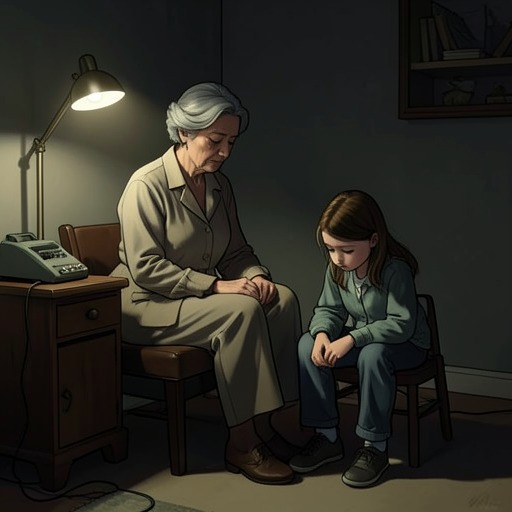
Roseanne Orozco disappears from the hospital
Day of the DeadRoseanne Orozco’s disappearance followed a return to the hospital in 1970, after an appendectomy and continuing illness. Her family believed she had left before her father could collect her; the following week, her body was found in an ice chest beside a road. Years later, her sister Andrea Tashquinth connected the disappearance to Roseanne’s earlier hospital stay and said that authorities had ignored her suspicions. The event thus remains not only a family loss but a case shaped by testimony discounted and records whose apparent absence could not be reconciled with Emma Orozco’s own memories.
Background and Hospitalization
That summer, Roseanne had surgery for appendicitis at the Sells Indian Health Services Hospital. According to Andrea, Roseanne remained ill after leaving the hospital. Emma Orozco later recalled that a doctor diagnosed an infection from the surgery and gave Roseanne medication. When Roseanne became too sick to attend school, Emma took her to a doctor, who admitted her for tests.
The two hospital stays matter to the family’s account. Andrea suspected that something had happened during the earlier admission for surgery; Roseanne disappeared during the later admission for tests. Andrea remembered that Henry Orozco was supposed to collect his daughter after work, but when he arrived, she was already gone. The family never saw her again. The next week, someone found her body in an ice chest along the road.
The Family’s Account
Andrea remembered Roseanne’s disappearance as the end of a sequence of events whose beginnings had never been explained. As children, the sisters had attended school together until Roseanne was placed in a different class. After a frightening encounter with the principal, Roseanne stopped speaking and never spoke again. Her parents sought medical help, including consultations in Phoenix, but no doctor identified a cause. Andrea’s recollection supplies important context for how the family understood Roseanne’s vulnerability, although it does not establish what happened at the hospital.
When Brandon Walker asked Andrea what she remembered about Roseanne’s death, she said she had tried to tell the tribal police that the hospital was involved, but nobody had listened. She suspected that someone connected to the hospital—perhaps a staff member or a visitor—had assaulted Roseanne during the earlier stay. Andrea was sixteen at the time she tried to raise this possibility. She said that her age meant others were not interested in her opinion, while investigators were convinced that her father was responsible. Her suspicion remained an allegation, not a proven account of the disappearance or assault.
Records and Unanswered Questions
Emma’s account confirmed that Roseanne had been admitted for appendicitis and later returned to the hospital, but the hospital’s response to a records inquiry appeared to contradict the family’s recollections. Emma said a hospital employee reported that no record existed of Roseanne Orozco ever being admitted. The employee suggested the records might have been lost because so much time had passed. Emma rejected that explanation: the same search had located her own records of three hospital stays, including the births of Andrea and Roseanne and a later hysterectomy.
Brandon had reason to think older records might still exist. He remembered that a grant-funded study in the early 1990s had entered existing hospital health records, some dating back to the 1950s, into computers. The project examined longevity and causes of death among the Tohono O’odham; it also contributed to the hospital’s capacity to establish a kidney dialysis center. Brandon therefore believed Roseanne’s July 1970 appendectomy records might be retrievable, while recognizing that the existence of a database did not guarantee access to it. The conflicting account of the records strengthened Emma’s conviction that someone at the hospital was involved, but it did not by itself prove that conclusion.
Investigation and Significance
The disappearance became part of a homicide investigation that had never produced a clear account for Roseanne’s family. Because investigators assumed that she had been killed on the reservation by another Native person, responsibility lay with the FBI or the local tribal police rather than the county sheriff’s department. Brandon remembered that reservation investigations were often cursory, and that the tribal police lacked training, equipment, and funding. He had not followed the case at the time and learned from Emma that the investigation had achieved nothing.
In the later inquiry, Emma’s memories and Andrea’s long-unheard suspicion helped Brandon revisit the case, but they did not remove the evidentiary gaps. The narrative places the family’s testimony beside institutional failure: Andrea had tried to speak when the event was recent, while the possibility of retrieving medical records remained uncertain decades later. Roseanne’s disappearance is therefore presented both as a specific sequence—readmission, absence before her father arrived, and discovery of her body the following week—and as an unresolved event whose unanswered questions were compounded by the failure to listen.