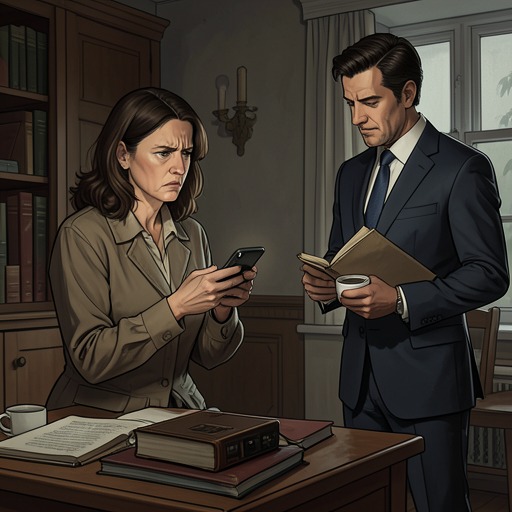
Sue Lammers
Day of the DeadSue Lammers is introduced in an ordinary domestic moment, but becomes a key witness when her dog Ranger finds a bloodied human arm during their walk south of Vail. Before the discovery, she has noticed a man beside a parked pickup and watched him drive away. Her account gives Detective Brian Fellows a witness who saw the person leaving the scene, even though she cannot say where he went afterward.
Identity and Circumstances
At eleven on a Saturday morning, Sue goes into the family room to check on her husband, Ken, who has spent the morning watching golf. He is still absorbed in a tournament on the Golf Channel and then ABC. The scene establishes the weekend routine from which Sue soon steps away: while Ken stays with the television, she walks outside with Ranger.
On this walk she is resentful about working hard all week only to spend the weekend alone with a dog. Yet the late-April desert bloom offers some relief. Prickly pear leaves that she has watched for weeks have produced buds, and the desert is now bright with yellow. The landscape briefly improves her mood, setting the calm of the walk against the unease that follows.
The Pickup and the Discovery
Sue walks along a rough road beneath a power line, parallel to a more substantial road. About half a mile ahead, she spots a dark vehicle pulled onto the shoulder. With no houses or businesses nearby, the parked vehicle seems out of place. She can make out a person moving between a mesquite clump and what she first takes to be the back of a pickup.
The possibility of encountering someone dumping rubbish in the desert makes Sue uneasy, particularly because she is alone. She checks her cell phone and finds that a recently installed neighborhood tower has given her a strong signal. As she gets closer, the person turns as if noticing her, jumps into the driver’s seat of a dark pickup with what appears to be a camper shell, and speeds away. Sue feels relieved. She lowers the whistle she had been about to use to call Ranger and lets the dog continue exploring.
That choice precedes the discovery. Sue is still several hundred yards short of where the pickup had been when she hears a freight train in the distance. Ranger hears it too and comes bounding back from farther along the road. Sue first mistakes what he carries for a stick, then recognizes it as a bloodied human arm. She orders him to drop it; he obeys and comes to her side as the train draws nearer.
Reporting What She Saw
Sue does not manage to call for help until the freight train has passed. Her fingers fumble over the phone before she reaches the necessary numbers. Speaking in a hoarse whisper, she tells the emergency operator that she is walking south of Vail, south of Fast Horse Ranch, and that her dog has found a human arm. Her report gives the authorities both the location and the nature of the discovery.
When Detective Brian Fellows later approaches her, Sue is climbing out of a vehicle. He estimates that she is in her early forties; she is wearing a sweatshirt, faded jeans, and hiking boots, and her hand is still visibly shaking. She tells him that she is sure she saw the man who dumped the victim. Her certainty is grounded in the encounter she has just recounted: the person was beside the pickup as she and Ranger approached, then drove away when he appeared to notice them.
Witness and Narrative Role
Sue can describe the direction in which the pickup left: it headed back toward Vail. She cannot follow its route beyond the intersection, which lies behind the crest of a hill, and does not know which way the driver turned there. Her testimony therefore supplies a concrete observation without resolving the suspect’s whereabouts. The distinction matters: she saw someone leave the area, but the limits of her view prevent her from tracing his escape.
The discovery also turns a solitary walk into the first human report of a disturbing find. Sue’s unease about the isolated roadside proves justified, though she had no reason to know what lay beyond it. Ranger’s return with the arm brings her directly into the investigation; her call and subsequent account then make her a witness to the departure as well as the person who reports the discovery. The scene’s shift—from domestic frustration and a brief lift in the blooming desert, to a suspicious vehicle, to an emergency call—gives Sue’s observations their importance without making her knowledge greater than it is.