The girls’ captivity in the Strykers’ basement
Day of the DeadThe girls’ captivity in the Strykers’ basement was not an isolated crime but a recurring system of confinement, deprivation, and control. Gayle Stryker supplied vulnerable girls and decided when they would be taken away; Larry Stryker controlled their immediate conditions and was expected to clean up after her. The arrangement made the basement a site of abuse and a private arena in which the couple’s unequal partnership was repeatedly enacted.
The Captivity System
Larry kept a notebook listing each girl’s name and a set of photographs, a record that made the captives identifiable to him even as he treated them as replaceable. In one feeding episode, he could not recall the girl’s name without consulting the notebook. He prepared a hamburger patty, cold refried beans, and stale tortilla, and carried the plate downstairs. Food was part of the captives’ controlled routine: Larry sometimes withheld it for about a day, then watched as hunger overcame a girl’s reluctance to eat under his observation. The book presents this not as care, but as a means of exercising power over someone whose choices and privacy had been taken away.
The conditions of feeding reinforced the captivity’s imbalance. Larry watched the girls eat, while they were made to do so in circumstances he controlled. His attention to their discomfort and his interest in their fear show that the coercion was not incidental to the arrangement. The basement’s routines—confinement, controlled access to food, and observation—gave him repeated opportunities to assert authority over the girls.
Control Shared by Gayle and Larry
Larry’s authority in the basement had limits. He took satisfaction in making the girls fear him, but Gayle held the decisive power over who remained there. She could remove a girl without warning, often while Larry was away, and replace her with another. Larry understood these removals as punishment for some perceived failure of his own, whether at work or in conduct Gayle disapproved of. Even when he had established a pattern with one captive, Gayle could take her away and leave him waiting for a replacement.
The supply of girls was connected to Medicos for Mexico, the cross-border charity Gayle and Larry ran. The organization gave them money, social standing, and respectability, while its work brought them into contact with detention centers from which vulnerable girls could be obtained. Gayle made inquiries, and a new captive might appear within days or weeks. The charity’s public role thus concealed a private system in which girls were treated as expendable and their vulnerability was exploited. The book also identifies the organization’s weak outside oversight and the couple’s use of its finances to support their lifestyle, placing the basement’s crimes within a wider structure of institutional respectability and concealed abuse.
The Couple’s Pattern of Abuse
The novel links the couple’s later arrangement to an earlier encounter in Mazatlán, where a girl was subjected to abuse at Larry’s hands with Gayle’s involvement. The episode helped reveal to Gayle the power she felt in a victim’s helplessness. She later created Medicos for Mexico, which served both as a legitimate-looking charitable operation and as a means of maintaining access to girls. The text presents the basement’s recurring abuse as connected to that discovery, not as a separate or accidental feature of the couple’s life.
Their roles were distinct but interdependent. Gayle selected and removed the girls, and at times participated in the abuse; Larry exercised day-to-day control and, when she left him with the consequences, handled the cleanup. His resentment at losing a captive did not give him the final say. This arrangement also made the girls’ captivity part of the couple’s own coercive relationship: Gayle could use access to the girls to assert control over Larry, while he retained power over those confined below.
Discovery and Aftermath
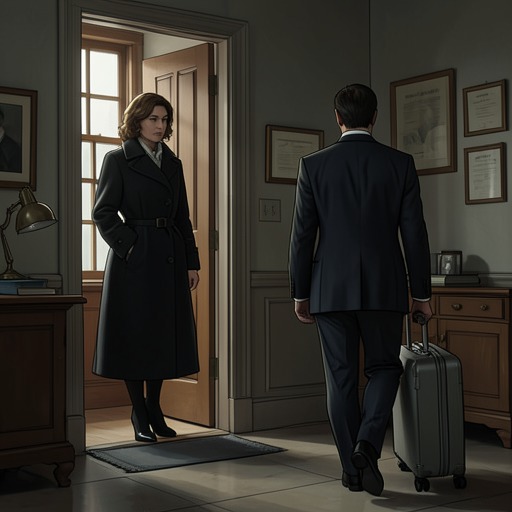
When Larry went downstairs with food on one occasion, he immediately recognized that the basement was empty and understood that Gayle had left a violent aftermath. He disposed of the meal and fetched a power washer to clean the blood from the basement’s concrete surfaces. The scene repeats the established pattern: Gayle had entered while he was away, removed the girl, and left Larry to discover and clear what remained. He associated such removals with something he had done wrong, though Gayle did not tell him in advance what she planned.
The aftermath also exposes the practical measures Larry had developed to keep the system going and to make its traces easier to remove. He wrapped layers of plastic tarp around the basement cot’s mattress, reasoning that ruined coverings could be discarded more easily than a bloodied mattress. After Gayle’s latest killing, however, the blood had passed through the tarps and soaked the mattress. Larry struggled alone to carry it up the basement stairs and out to his pickup, then gathered the damaged coverings and bedding for disposal. The ordinary labor of cleaning became part of his assigned role in the partnership.
The captivity’s significance lies in this repetition: vulnerable girls were brought in, subjected to the couple’s control, and removed at Gayle’s discretion, while Larry managed the physical aftermath. When Gayle murdered Roseanne Orozco, she was cleaning up after her husband; Larry had been cleaning up after Gayle ever since. That reversal captures the history between them without erasing the girls at its center. The basement was both the setting of their confinement and the material record of a criminal arrangement sustained by the couple’s shared concealment.