Iruwen
De brief voor de KoningIruwen is an elderly, sharp-eyed resident of Dangria whose understanding of the city’s political danger becomes practical aid for Tiuri and Piak. He moves between roles that might seem separate—guide, public critic, and local observer—but each rests on the same habit of noticing what others would rather ignore. He recognizes Tiuri when the fugitive is alone in the streets, helps secure the friends’ escape, and later returns to meet them after the political leadership has changed. His importance lies not in holding office, but in using his knowledge of the city and willingness to speak openly when its citizens are reluctant to act.
An Observer in Dangria
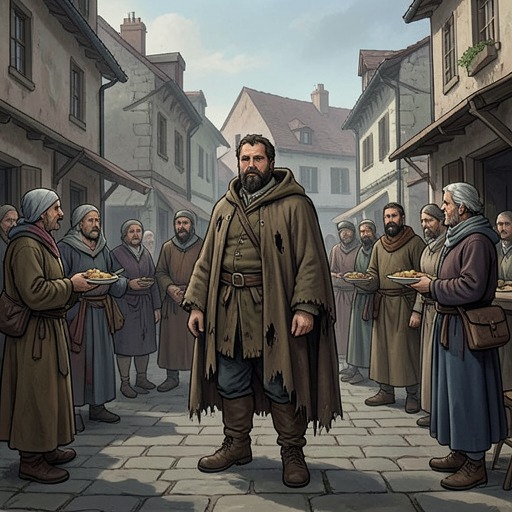
Iruwen first appears when Tiuri, newly escaped from the town hall, is trying to find his way through an unfamiliar city. Tiuri has seen armed men nearby and has hurried through several streets before stopping in a dark doorway on the market square. Iruwen suddenly appears and offers to walk with him. He recognizes Tiuri as one of the two young strangers he had encountered earlier, and immediately connects the escape to its consequence: Piak is in the dungeon while Tiuri remains at risk of being caught as well.
That recognition makes Iruwen more than a passerby offering shelter. He understands the danger facing both friends and knows how the city’s authorities have treated them. His manner is direct: he tells Tiuri to take his arm and walk beside him, turning a frightened fugitive’s hurried flight into the appearance of an ordinary stroll. The gesture is modest, but its usefulness depends on Iruwen’s local presence and composure. He can move through Dangria in a way Tiuri cannot yet manage alone.
Iruwen leads Tiuri to the White Swan, where the two meet again with the innkeeper. He has already ordered their meal, though Tiuri must pay for both of them. The innkeeper jokes that Iruwen never carries money. The exchange gives his assistance an everyday, sociable setting: he is not presented as a distant political figure, but as someone known to the people at the inn, comfortable in their company, and accustomed to being teased. At the same time, his help is not merely convivial. The meal provides a place for Tiuri to pause while Iruwen continues to help him navigate the city.
Speaking Against the Mayor
Iruwen’s concern extends beyond the two strangers. In conversation at the inn, he hopes that the knights of Unauwen will soon return and that the mayor will be removed. Some listeners dismiss him as someone who talks as if an enemy might appear at the gates tomorrow. Others say they dislike the mayor because of injustice or excessive taxes, but insist they are not afraid of him. Iruwen sees a danger that his neighbors do not: in his view, their complaints remain too narrow if they fail to recognize the larger threat to the city.
His criticism draws on Dangria’s civic customs as well as its immediate politics. As he explains to Tiuri, the mayor and the council once met in the town hall for regular public meetings, where inhabitants could bring proposals, ask questions, and lodge complaints. In recent times, meetings have often been cancelled or closed to the public for trivial reasons. Iruwen identifies this retreat from open civic life as one of the grievances against the mayor. The change matters because it restricts the public’s ability to challenge the people governing the city.
Iruwen puts that grievance before a crowd on the market square. He gathers listeners and speaks passionately about the mayor’s conduct, alluding to the dangers he believes are approaching. He also makes the treatment of Tiuri and Piak a public issue: two young foreigners have been deprived of their freedom, one is still imprisoned, and the other has escaped and is standing beside him. His appeal links the strangers’ case to the citizens’ own rights, rather than presenting their imprisonment as a problem that concerns only outsiders.
He sharpens the argument by pointing to the town hall’s grandeur and the enlarged prison beneath it. Iruwen says that the mayor used the city’s money to beautify the building until it resembled a king’s palace, while also expanding the dungeon. He asks whether the mayor needed more room to imprison people, feared enemies, feared the peaceful inhabitants of Dangria, or intended the prison for innocent strangers. These are questions in a public challenge, not proof that Iruwen knows the mayor’s private intentions. Their force comes from setting conspicuous civic spending beside the imprisonment of visitors and the closing of public meetings.
Help, Escape, and Civic Consequences
Iruwen’s opposition to the mayor is not confined to speech. After Piak is freed, Tiuri thanks Iruwen and says that without his help Piak would not have regained his freedom; Piak thanks him as well. Iruwen then offers a concrete way for the two friends to leave the city. A friend of his guards the small northern gate and is on duty from ten until two, so the friends can depart promptly. His knowledge of the watch and his personal connection to the gatekeeper provide a practical route out of Dangria, at a moment when the mayor’s authority still makes remaining there dangerous.
The sequence shows how Iruwen’s public and private actions reinforce one another. He draws attention to the imprisonment before the townspeople, then helps the friends escape rather than leaving them exposed after speaking on their behalf. The evidence does not make him the sole cause of Piak’s release or describe every step by which the crowd responds; it does establish that Tiuri and Piak regard his help as decisive. His support therefore carries both civic and personal weight: the strangers are people in danger, but their case also exposes the abuses he has been warning his neighbors about.
Return and Refusal of Office
When Tiuri and Piak return to Dangria after completing their journey, the market square looks much as it did before, crowded with tents, stalls, sellers, and buyers. Piak remarks on the apparent sameness. Iruwen answers that much has changed: Lord Dirwin is now mayor and is awaiting the king’s official authorization before being formally installed. The altered leadership gives visible consequence to the political upheaval that had earlier seemed remote or exaggerated to some of the inn’s patrons.
Iruwen adds that the citizens first asked him to become mayor, but he refused. He wants time to walk around the city and keep his eyes and ears open, and he believes Lord Dirwin will make a good mayor. His refusal does not mean that he has ceased to care about public affairs. Instead, it preserves the independent position from which he observes the city and speaks about what he sees. The distinction is central to his character: he has the nerve to challenge authority, but does not treat formal office as the only way to serve Dangria.
He promptly turns from political news to the travelers’ return. Iruwen notices that Tiuri’s mission has succeeded, says that the city already knows of the deaths of the good knights and the clerk through messengers from the capital, and maintains that Eviellan remains an enemy despite its request for peace. He accompanies the friends to the town hall steps, invites them to meet him at the White Swan, and tells them that Ardoc is in town and that their travel bags, left in the town hall on their earlier visit, are at the inn. The friends later join Iruwen, Ardoc, and other acquaintances there to eat and exchange news; Ardoc offers to take them toward his home the next morning.
Narrative Role
Iruwen connects Dangria’s public crisis to the travelers’ immediate needs. His warning about closed council meetings and political danger gives local meaning to the mayor’s treatment of Tiuri and Piak; his intervention on the market square turns their imprisonment into a question about justice and civic power. His later assistance at the northern gate translates that concern into a means of escape. On the friends’ return, his news of the new mayor and his account of the city’s response locate their completed mission within a changed political landscape.
His role is also defined by the tension between warning and recognition. At the inn, other residents regard his alarm as excessive, while Iruwen insists that discontent with taxes or unfairness is not enough if the danger itself goes unseen. Later, the city has a new mayor, and the travelers arrive bearing news that confirms the broader threat he had identified. The narrative does not make him an officeholder or a warrior; it gives consequence to his attentiveness, his willingness to speak before a crowd, and his readiness to help people whose predicament reveals what is wrong with the city.