Jaro
De brief voor de KoningJaro, son of Janos, is a Red Rider whose mission to kill Tiuri is overturned when Tiuri saves his life. His brief appearance brings the pursuit’s hidden organization into view: Jaro serves the Black Knight with the Red Shield, but warns Tiuri that another agent, Slupor, remains on his trail. The change in Jaro is real but limited; he abandons the attempt on Tiuri and disobeys his master, without claiming to have become a good man or offering to join Tiuri’s mission.
Identity and Introduction
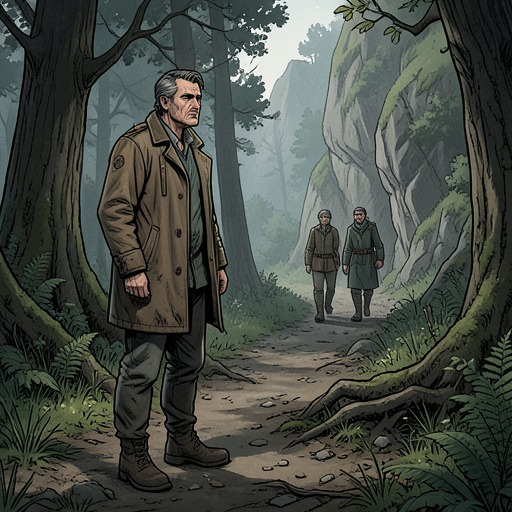
Jaro introduces himself as Jaro, son of Janos, and says that he comes from the valley nearby. He meets Tiuri as an unexpected traveling companion while Tiuri is wary of strangers. The letter Tiuri carries has made him suspect that apparently innocent people may be spies, a danger Ristridin has already raised. Tiuri is ashamed of his distrust, but still conceals his identity: rather than give his own name or the name Tarmin, which he fears the enemy may know, he calls himself Martijn and presents himself as a monk of the Abbey of Brown. Jaro repeats the assumed name and asks whether Tiuri is truly a monk. Their early exchange is thus shaped by unequal knowledge: Jaro gives his name, while Tiuri protects his own.
The Ravine and the Reversal
The pair continue along a narrowing path beside the river, with Tiuri leading over loose stones as the water grows louder and the gorge below becomes dangerously deep. Jaro follows, breathing hard, though Tiuri notices no sign of fatigue when they pause. On the narrow track, Jaro suddenly appears to stumble into Tiuri and grabs him. Tiuri manages to keep his footing; Jaro lets go, cries out, and disappears over the edge amid scraping stone and falling rocks.
Tiuri’s first response is alarm, followed by relief when he sees Jaro clinging with both hands to a branch jutting from the rock face. Jaro hangs in a perilous position, visibly terrified and unable to speak. Tiuri moves to the edge, reaches down, takes his hands, and begins pulling him up. The physical reversal is decisive: the man who had been traveling beside Tiuri as a stranger becomes someone whose life depends on him. Tiuri acts before he knows who Jaro is or why he followed him; the rescue creates the debt that will break the assassination attempt.
Mission and Allegiance
Once safe, Jaro tells Tiuri plainly that he had been sent to kill him and keep the letter from ever reaching King Unauwen. He says he can no longer carry out the killing because Tiuri has saved his life. Jaro also admits that Tiuri’s earlier trust was misplaced: had Tiuri not trusted him, Jaro says, he would not have made the mistake that left him powerless. The rescue does not erase the danger Jaro posed; instead, it makes that danger newly legible as a choice he now refuses to repeat.
Jaro confirms that he is one of the Red Riders and that the Black Knight with the Red Shield is his master. He will not identify the master further, saying only that he has disobeyed the man’s order for the first time, and that this should be enough for Tiuri. His refusal to explain more sets a boundary around what he is willing to disclose. At the same time, he acknowledges that he has killed other people and does not ask Tiuri to think better of him. He tells Tiuri to continue in peace, while leaving the outcome of the mission to Tiuri.
Warning About Slupor
Jaro does not let Tiuri mistake his own withdrawal for the end of the pursuit. Before departing, he turns back to explain that another pursuer was sent after the group that had traveled west: two Grey Knights, a squire, and a young man on a black horse. The pursuers initially thought that the young man was their target, but Jaro says they began to doubt this when they saw Tiuri traveling alone along the Blue River. Jaro then followed Tiuri, believing him to be the person they needed to capture or kill.
The other agent, Jaro warns, will not abandon the assignment even after realizing he has followed the wrong people. He may keep searching for Tiuri or try to cross the mountains ahead of him and wait on the far side. Jaro describes this pursuer as a spy who can appear as a Red Rider, an ordinary soldier, or in other disguises. The group knows him only as Slupor; no one, Jaro says, knows his true name. Jaro contrasts Slupor’s ruthlessness with his own changed decision, claiming that Slupor would have pushed a rescuer into the ravine without hesitation. His warning turns his departure into a final act of assistance: he gives Tiuri information about the threat that remains after his own attack has ended.
Change and Narrative Role
Jaro’s account of the ravine complicates the apparent accident. He tells Tiuri that he had intended to throw him into the gorge, but stumbled and fell into it himself. The attempted murder therefore precedes the rescue, not the other way around: Jaro does not simply happen upon a moral choice after an innocent mishap. Tiuri’s decision to save him intervenes in a planned act of violence and makes Jaro confront the life he owes his intended victim.
His change is neither a full conversion nor a new allegiance. Jaro says he cannot and does not want to kill Tiuri, and he has knowingly thwarted his master’s orders by warning him about Slupor. Yet he does not offer to accompany Tiuri or take responsibility for completing the delivery. He departs after giving the warning, leaving Tiuri to continue toward the mountains with the letter still at stake. In this compact encounter, Jaro functions as both a pursuer and a source of intelligence: the rescue transforms the immediate conflict, while his disclosure makes clear that the larger danger persists.