Kingdom of Dagonaut
De brief voor de KoningThe Kingdom of Dagonaut is defined in the available account less by a survey of its borders than by the obligations linking its people, king, and knights. Its most important test of those obligations comes when Tiuri leaves the vigil that should lead to his knighting: his journey takes him away from the kingdom, but his return reveals that service to its ideals may matter more than obedience to ceremony alone.
The kingdom and its places
The account locates the kingdom’s civic and ceremonial center in the City of Dagonaut. On a hill outside its walls stands a small chapel where young candidates spend the night before their knighting. The chapel is set apart from the city, yet it is the place where the kingdom’s expectations of its future knights are made personal: each candidate must keep vigil, reflect, and prepare to serve.
The narrative also places Mistrinaut in a remote part of Dagonaut’s realm, beyond a great forest. Tiuri knows the names of most castles in the kingdom but has not heard of this one, and the region has seldom figured in the stories and history familiar to him. The castle stands across the Blue River, reached by a road and a lowered bridge. On Tiuri’s arrival, rain and the dark, imposing fortress make this outlying place feel unlike the welcoming ceremonial center he has left. The contrast establishes that the kingdom contains regions distant from its best-known places, though the account does not provide a comprehensive map or describe how those regions are governed.
At Mistrinaut, access is controlled locally: the castle’s lord has ordered that the bridge not be lowered until he says so, delaying the departure of guests and workers. This is a specific instance of authority shaping movement within the kingdom, not evidence of a general rule applied at every castle. Elsewhere, Tiuri’s route eventually crosses a mountain pass toward Unauwen, making travel between the realms part of the story’s political and personal geography.
Knighthood and service
Knighthood in Dagonaut is a public ceremony preceded by a demanding private test. On Midzummer Day, the king knights those young people judged worthy. The celebration continues with a service in the cathedral, a palace meal, a procession through the city, and festivities that spread from the palace to the streets. The new knights also attend a royal meeting and take part in a tournament during the following days. These public observances place the individual’s new status within the life of the kingdom.
The qualification is not merely ceremonial. During the twenty-four hours before the knighting, candidates must fast and spend the night awake in the chapel outside the city walls. Their swords rest before the altar while they kneel in white garments and reflect on the task ahead. They resolve to serve the king and their homeland faithfully, to be honest and helpful, and to fight for what is good. They must neither sleep nor speak, and must refuse to listen to any voice from outside until a delegation of knights comes for them at seven in the morning. The rules bind readiness for knighthood to self-command and to an ethical commitment, while making the refusal of outside appeals part of the test.
Tiuri’s departure and return
Tiuri is the youngest of the five candidates gathered in the chapel, only sixteen years old. When a voice calls for help during the vigil, he leaves rather than remain obediently in place. The resulting journey takes him away from Dagonaut and into events connected with Unauwen. He carries out Sir Edwinem’s charge and delivers a letter to King Unauwen; afterward, he returns to Dagonaut with a letter for King Dagonaut. The journey thus reconnects the kingdom’s ceremonial expectations with a mission whose importance reaches beyond its borders.
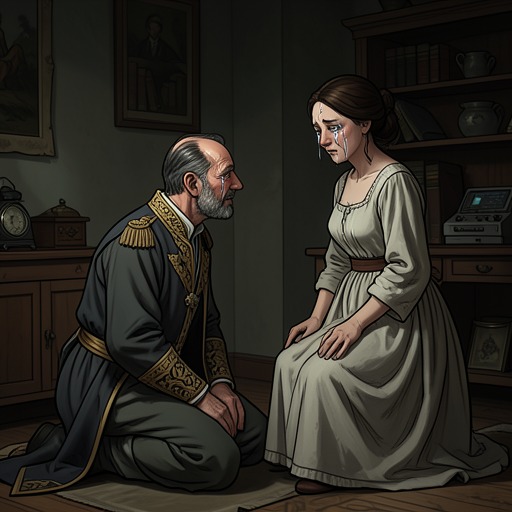
On his return, Tiuri tells King Dagonaut that he wants to explain why he left the chapel on Midzummer Night. The king has heard part of the story from Ristridin but asks to hear it from Tiuri. When Tiuri hopes to be knighted after all, the king points out that more than a month has passed and that the scheduled day is over. He explains that candidates are chosen once every four years, tested beforehand, and bound by the vigil rules. Tiuri broke one of those rules by responding to the call for help, so the question is not whether the departure happened, but what it says about the kind of knight he has become.
Recognition and the white shield
King Dagonaut’s judgment turns on the choice Tiuri made. The king says that if Tiuri had ignored the plea, he would now be a knight; because he answered it, completed the mission, and kept his promise to Sir Edwinem, he has shown himself to be one without the expected ceremony. The distinction does not erase the formal rite: the king still has Tiuri kneel, strikes his neck with the flat of the sword, and names him Sir Tiuri. He then returns the sword to him and gives him a white shield.
The shield joins Dagonaut’s recognition to a wider obligation. At King Unauwen’s request, King Dagonaut gives it as a sign that Tiuri will also serve Unauwen, and as a reminder of the knight whose task Tiuri took over. Tiuri promises to serve Dagonaut, the king’s subjects, and anyone who calls for help, and to use his sword for good and his shield to protect the weaker. The episode presents the kingdom’s ideal of knighthood as loyalty that is pledged to a ruler but tested through action toward others.
The final return to the chapel makes the change visible without suggesting that Tiuri’s trials are finished. He keeps vigil alone, with the white shield above the altar, and understands that he is no longer the boy who left the chapel. His journey has become a test through which he must continue to grow; he promises himself that he will try to be a good knight. In this ending, the Kingdom of Dagonaut is both the home to which he returns and the community whose ideals he must now practice beyond the ceremony.