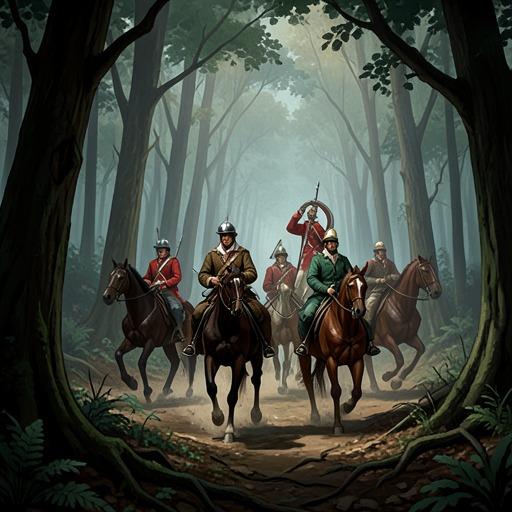
Leor, Sunset Inn informant
De brief voor de KoningLeor, Sunset Inn informant, is a servant at the Sunset Inn whose evasions conceal a connection to the Red Riders’ intelligence network. At first he denies knowing anything about horsemen; under questioning, he admits that the Riders have been watching for the Grey Knights and Tiuri. His guarded attention to the party makes the inn’s apparent hospitality feel compromised before his role is established.
Identity and Introduction
Leor enters the inn’s common room after Bendoe, the innkeeper, calls for him as someone who always knows the news. The contrast between that reputation and Leor’s immediate denial is telling: he presents himself not as a source of information but as someone with nothing useful to say. When he sees the Grey Knights, he reacts with a visible shock, approaches at the innkeeper’s gesture, and stands before them with his head bowed. Yet his eyes move around the room, taking in each member of the company.
Tiuri notices the discrepancy between Leor’s deferential posture and his watchfulness. The servant’s gaze seems sharp and appraising, and Tiuri privately finds him deeply untrustworthy. Leor’s outward manner is therefore unsettled from the start: the bowed head suggests submission, while the restless eyes imply alert calculation. The scene does not establish what Leor is thinking, but it gives the company, and the reader, concrete reasons to doubt his performance of harmlessness.
When Bendoe asks whether any red-clad riders have passed, Leor slowly repeats the question and denies ever seeing any riders, red or black. He then remarks that he has just seen grey and blue riders, indicating the knights present. He grins at the company before quickly lowering his head again, as if he fears he has said too much, while continuing to watch them. The combination of denial, a teasing observation, and renewed surveillance makes his answer feel less like straightforward ignorance than a deliberate effort to control what he reveals.
Suspicion at the Inn
Leor’s attention extends beyond the conversation. In the stable, he calls Ardanwen a spirited animal and looks again at Tiuri with a meaningful smile. Tiuri dislikes him more with each encounter and is glad to leave the stable. The horse matters because Tiuri is riding Ardanwen, the horse of the murdered knight Edwinem; later, Tiuri connects Leor’s repeated looks at the animal and his remark about it to the possibility that Leor warned the Red Riders. This remains Tiuri’s suspicion rather than a confirmed account of the precise warning.
At supper, the Grey Knights remove their helmets and neck guards and unbuckle their weapons, settling in after the journey. Bendoe slides the bolt across the door into the rear of the house and says they are now among themselves. In that more private setting, Tiuri tells the others that he does not trust Leor. Bendoe agrees that he shares the suspicion, though the company still intends to find the Red Riders whether or not the servant chooses to speak. Leor’s presence has altered the mood of the meal: the knights are resting, but they are not treating the inn as a place where vigilance can safely end.
Disclosure and the Red Riders’ Orders
When Leor is challenged, he initially insists that he has done nothing and knows nothing. Bendoe lets him go, and the innkeeper reproaches him, saying he is ashamed of his servant. Ristridin then confronts Leor directly, asserting that Leor has seen the Red Riders. Bendoe’s grim look helps end the servant’s objections. Leor admits unwillingly that he saw riders two nights earlier, though he says they were not dressed in red. His account emerges under pressure, not as a voluntary warning.
Ristridin explains that the Red Riders have committed murder and that the knights, acting for King Dagonaut, must punish them. Leor appears somewhat impressed by this appeal to the riders’ crime and the knights’ authority, then apologizes to Ristridin and supplies the information he had withheld. The Red Riders asked him whether he had seen four Grey Knights and their squires coming from the direction of Mistrinaut Castle. He says he had not seen them and had answered accordingly. They also asked after a young man wearing a fine ring. At this point Leor glances at Tiuri before saying that he had not seen such a young man either.
Leor further reports that the Riders instructed him to watch for the Grey Knights and the young man, and to warn them if he saw them. The information makes clear that the pursuit is not simply a chance encounter: the company and Tiuri have been identified in advance as targets of interest. Leor’s glance at Tiuri gives the disclosure a particular focus, connecting the general order to the young man among the knights. The evidence establishes what the Riders wanted Leor to do, though it does not show the exact means by which he communicated with them or prove that he had already sent a warning.
Place in the Spy Network
A captured Red Rider later provides broader confirmation of Leor’s position. The man says that the Riders had several spies and identifies Leor, the servant at the Sunset Inn, as one of them. He explains that the company’s approach, including the presence of the young man they had long sought, had reached the Riders through another intermediary. The account places Leor within an information network but does not identify him as the sole source of the report or specify what he personally transmitted. It also explains why the Riders’ questions at the inn were so pointed: they were seeking confirmation of the Grey Knights’ arrival and of the young man riding the black horse.
Leor is a minor figure, but his brief appearances sharpen the distinction between visible loyalty and concealed allegiance. His bowed posture does not prevent him from watching; his denial does not erase the knowledge revealed under pressure; and his innkeeping role does not make the place neutral. Tiuri’s suspicion begins with Leor’s looks and remarks, then gains context when the spy network is exposed. The supplied events do not establish Leor’s eventual fate or show him being punished. What they do establish is that the party’s danger reaches into an ordinary roadside stop, where a servant’s seemingly casual attention can become part of a pursuit.